Use cases
Conversation Intelligence Platform: A Guide for Sales Teams
What conversation intelligence is, how sales teams use a conversation intelligence platform from call prep to follow-up, and the best Gong alternatives.
Sales process
 By Samarth WaghUpdated 9 min readResearch checked against the linked sources in November 2026
Part of: Sales meeting guides
Summarize this article with
Quick answer: The best discovery call questions uncover the buyer's situation, problem, impact, decision process and timeline. Ask 11 to 14 of them: Gong's analysis of 519,000 recorded discovery calls found that range correlates with the best results. Pick a dozen from the 35 below, then spend most of the call listening.
A discovery call is the first real conversation with a prospect, where you find out whether there's a problem worth solving before you pitch anything. Good discovery questions get the buyer talking. Bad ones turn the call into a survey nobody enjoys.
A discovery call is a 20 to 60 minute conversation where a seller learns the buyer's needs and decides whether a demo makes sense. It usually comes right after a lead books time. It's diagnosis, not a pitch, and Salesforce cites its State of Sales finding that 87% of business buyers expect reps to act as trusted advisors.
Leave with three things: a clear problem, a reason it matters now, and an agreed next step. Can't name all three? Then discovery isn't finished, whatever the calendar says.
Ask between 11 and 14 questions. Gong Labs analysed 519,000 recorded discovery calls and found that range "correlates with the greatest success", and that the best calls uncovered 3 to 4 business problems.
Highspot lands in a similar place, suggesting 8 to 12 thoughtful questions per call.
More isn't better. Past about 15 questions, a call starts to feel like an interrogation, and Gong found that piling on questions hurts most with senior executives. Ask fewer, better questions. Then follow the answers wherever they go.
The best sales discovery call questions are open, specific and about the buyer's business, not your product. These 20 are grouped by what they uncover. Pick 2 or 3 from each group.
| Group | Discovery question | What you learn |
|---|---|---|
| Situation | 1. Walk me through how your team handles this today. | Current process and tools |
| Situation | 2. Who's involved in that process, day to day? | Users and stakeholders |
| Situation | 3. What prompted you to take this call now? | The trigger event |
| Situation | 4. What have you already tried? | Past attempts and objections to come |
| Problem | 5. What's the hardest part of that process right now? | The main pain |
| Problem | 6. How often does that happen? | Frequency and scale |
| Problem | 7. Can you give me a recent example? | A real story to quote later |
| Problem | 8. What's the workaround today? | Hidden cost of doing nothing |
| Impact | 9. What does that problem cost you, in time or money? | The business case |
| Impact | 10. Who else feels that problem? | Wider impact and allies |
| Impact | 11. What happens if nothing changes this year? | Urgency |
| Impact | 12. If this were solved, what would you do with the time? | The value the buyer imagines |
| Decision | 13. How does your team usually buy a tool like this? | The buying process |
| Decision | 14. Who else needs to be involved before you decide? | The buying group |
| Decision | 15. What would make this an easy yes for them? | Decision criteria |
| Decision | 16. Is there budget set aside, or does it need approval? | Budget status |
| Timeline | 17. When would you want this working by? | Target date |
| Timeline | 18. What's driving that date? | Whether the date is real |
| Timeline | 19. What could get in the way? | Risks and competing projects |
| Timeline | 20. What would a good next step look like for you? | The next meeting |
These groups line up with frameworks you may already use. The problem and impact questions follow SPIN selling, and the decision and budget questions cover what BANT and MEDDIC ask you to qualify.
On a cold call, ask 1 or 2 discovery questions, not 10, because you've only earned about a minute. All you're doing is finding out whether a problem exists, then booking a proper discovery call.
These 5 cold call discovery questions work because they're short and easy to say yes or no to:
Agencies and freelancers should ask client discovery call questions about goals, past work and how decisions get made, because scope creep starts in discovery. Ask these 5 before you quote anything:
The same list works for marketing, branding, web design and virtual assistant discovery calls. Just swap the outcome in question 26 for whatever the client is hiring you to change.
Coaches should use discovery call questions to test fit and readiness, not to sell. A coaching discovery call is usually 15 to 30 minutes, and these 5 life coach discovery call questions cover the ground:
Structure a discovery call in 5 parts: agenda, situation, problems, decision process and next steps. Give most of the time to the problems. That's where the deal gets decided.
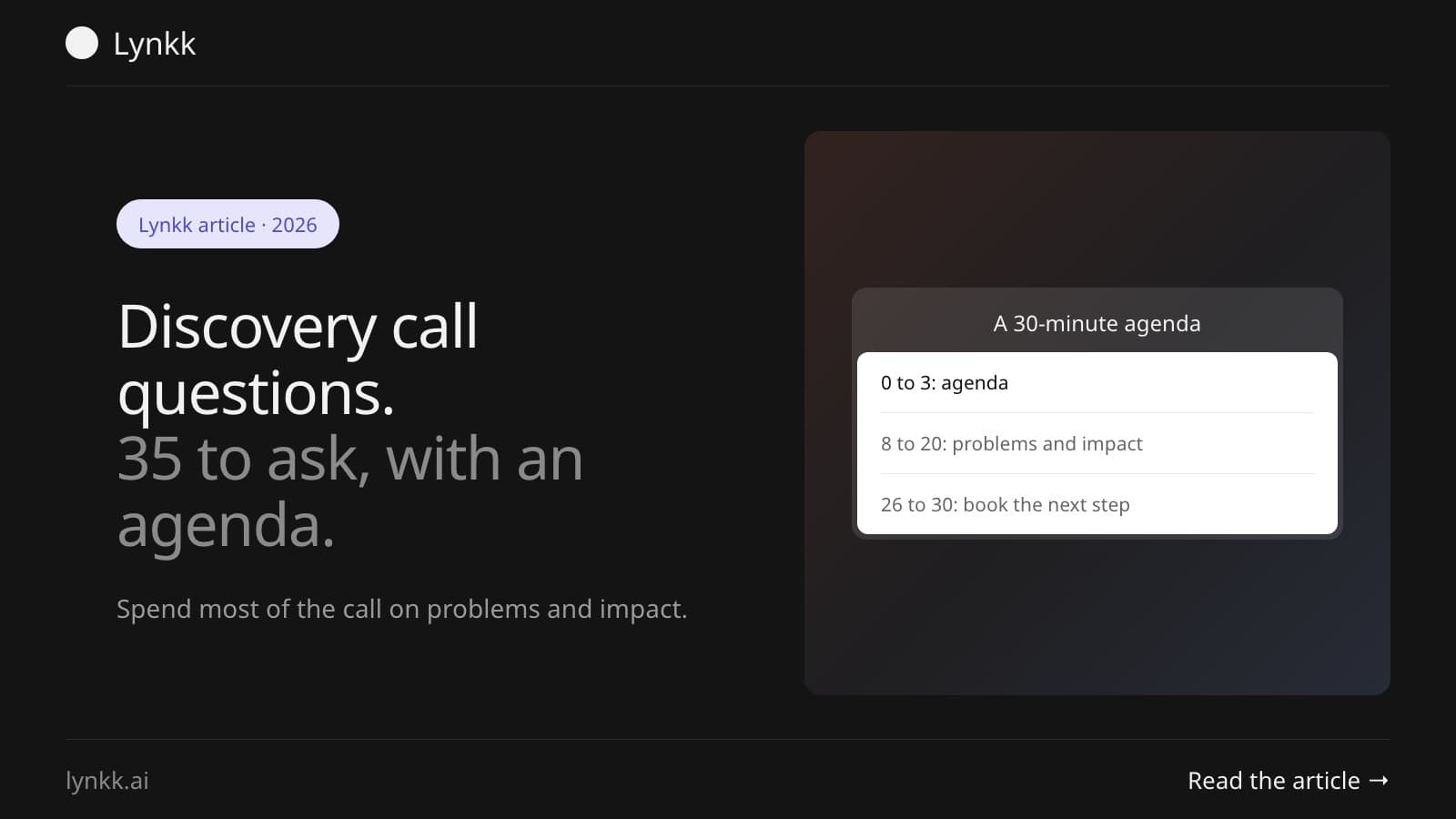
Here's a 30-minute discovery call agenda:
| Minutes | Part | What you do |
|---|---|---|
| 0 to 3 | Agenda | Confirm time, goals for the call, and that it's fine to ask questions |
| 3 to 8 | Situation | Questions 1 to 4: how things work today |
| 8 to 20 | Problems and impact | Questions 5 to 12: dig into 3 or 4 problems |
| 20 to 26 | Decision and timeline | Questions 13 to 19: who, how and when |
| 26 to 30 | Next step | Question 20, then book the next meeting before you hang up |
A discovery call script should be an opening line and a list of questions, not a word-for-word monologue. This opening sets the agenda in under 30 seconds:
"Thanks for making the time. I'd love to spend most of this learning how your team handles [process] today, then share whether we can help. If it's a fit, we'll agree a next step at the end. If not, I'll tell you. Does that work?"
Then stop and let the buyer talk. Gong's research shows top reps get the customer speaking more, so treat the script as a checklist of things to learn. Not lines to read.
Most sales discovery calls run about 30 minutes. Salesforce's guide puts a simple transactional sale at 20 to 30 minutes and says complex enterprise deals can take up to an hour, often across several calls. Book 30, finish early if you've learned enough, and plan more sessions for deals with several stakeholders.
Prepare for a discovery call in about 15 minutes: research the company and the person, write 3 hypotheses about their problem, and pick 12 questions. A guess, even a wrong one, makes your questions sharper.
Our meeting preparation checklist has a one-page brief template for this.
A discovery call is for learning about the buyer, and a demo is for showing how your product solves what you learned. Skip discovery and jump to a demo, and the demo usually feels generic. Buyers notice.
| Discovery call | Demo | |
|---|---|---|
| Goal | Understand the problem | Show the solution |
| Who talks most | The buyer | The seller |
| Typical length | 30 minutes | 45 to 60 minutes |
| Output | Problems, impact, next step | A shortlist decision or trial |
Send a follow-up email within 24 hours that recaps the problems you heard, the impact, and the agreed next step. Use the buyer's own words. It's the email they'll forward to their boss.
A short discovery call follow up email has 4 parts: thanks, what you heard (3 bullets), what happens next, and the date of the next meeting. Our guide to the follow-up email after a meeting has templates, and our sales call follow-up email guide covers demos, pricing calls and proposals.
Yes. An AI note taker records the discovery call so you can listen instead of typing, then writes up the problems, quotes and next steps. Tell the buyer you're recording at the start.
Lynkk records sales calls on Zoom, Google Meet and Teams, or on your Mac with no bot, and writes notes with action items after the call. On Pro, Ask Lynkk can answer "what did they say about budget?" across every call with that account, with the minute behind each answer. For other tools and the consent rules, see our guide to sales call recording software.
Yes, in sales and most services, a discovery call is free for the buyer. It's how the seller or provider learns whether they can help before anyone commits money. Coaches and consultants also usually offer a free 15 to 30 minute discovery call before a paid first session.
Not usually. In sales, a discovery call is a conversation to understand a buyer's needs. In hiring, some recruiters use "discovery call" for a short first chat about a role, which works like a screening interview. Either way, both sides are checking for fit, so come with questions of your own.
A discovery call checks whether you're a good fit and what the client needs, while a consultation usually gives advice or a plan. Discovery calls are typically short and free. Consultations are often longer, more detailed and paid, because the client receives expert guidance during the session.
Treat objections on a discovery call as more discovery. Acknowledge the concern, then ask a question to understand it, such as "what makes you say that?" Early objections tell you what the buyer worries about, which shapes the demo and proposal you build next. Avoid arguing before you understand it.
A discovery call template should include the agenda, your three hypotheses, 12 chosen questions, space for the buyer's answers, and a box for the agreed next step. Keep it to one page. Fill in the answers in the buyer's own words, because those phrases make the strongest follow-up email.
Yes, if the buyer agrees. Recording lets you focus on listening, catch exact phrases, and share the call with colleagues who join later. Ask for permission at the start, and check local consent laws, because some places need every participant to agree before a call is recorded.
Great discovery call questions are short, open and about the buyer's business. Pick 11 to 14 from this list. Spend most of the call on problems and impact, and book the next step before anyone hangs up. When objections come up later in the deal, our guide to objection handling picks up where this one stops.
Lynkk records your discovery calls and turns them into notes and next steps. Get Lynkk Pro, $4 a month.
Where Lynkk fits: AI for sales calls
Keep reading
Use cases
What conversation intelligence is, how sales teams use a conversation intelligence platform from call prep to follow-up, and the best Gong alternatives.
Sales process
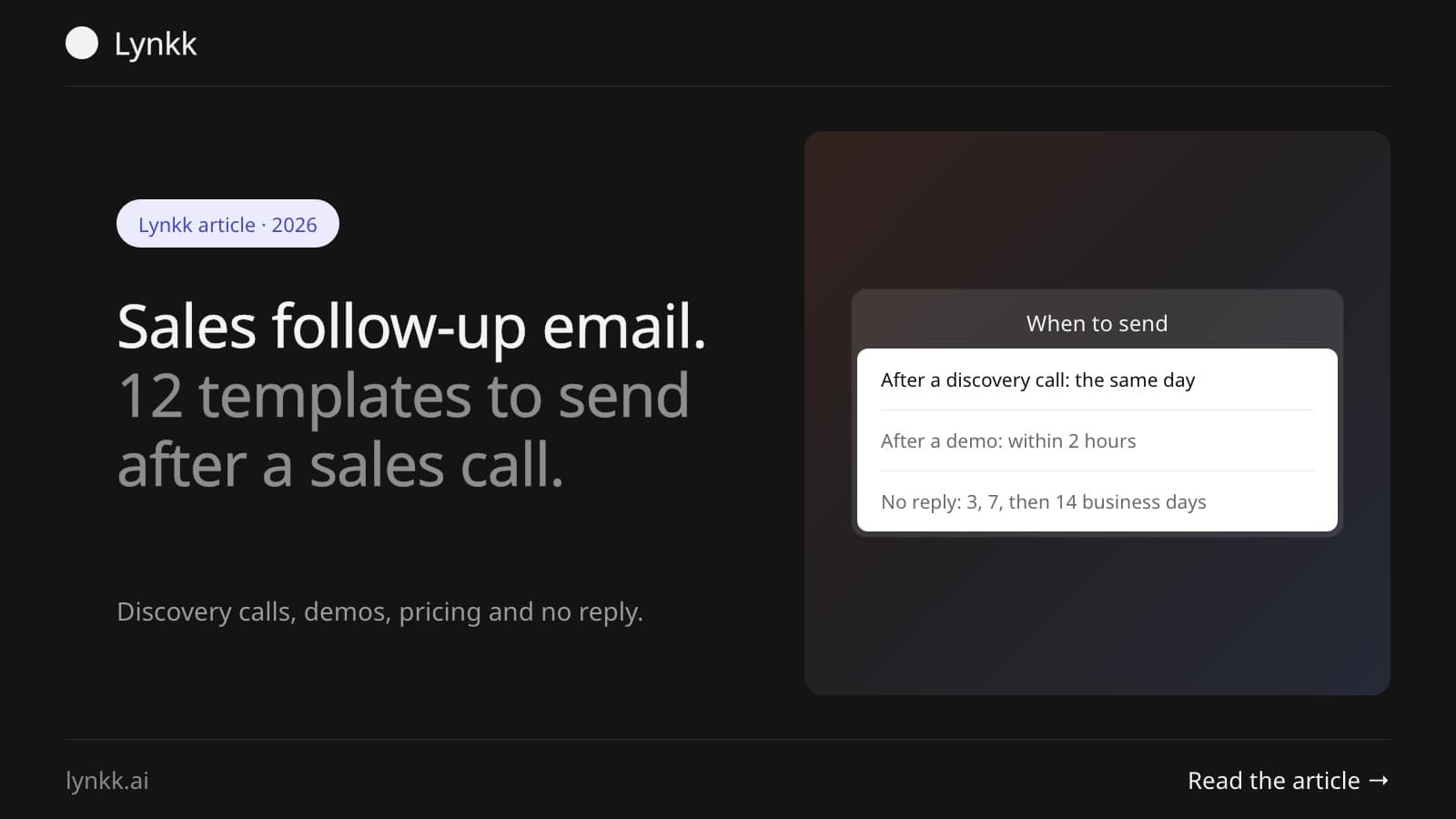
Copy 12 sales follow-up email templates for discovery calls, demos, pricing calls and proposals with no reply, plus subject lines and when to send each one.
Sales process
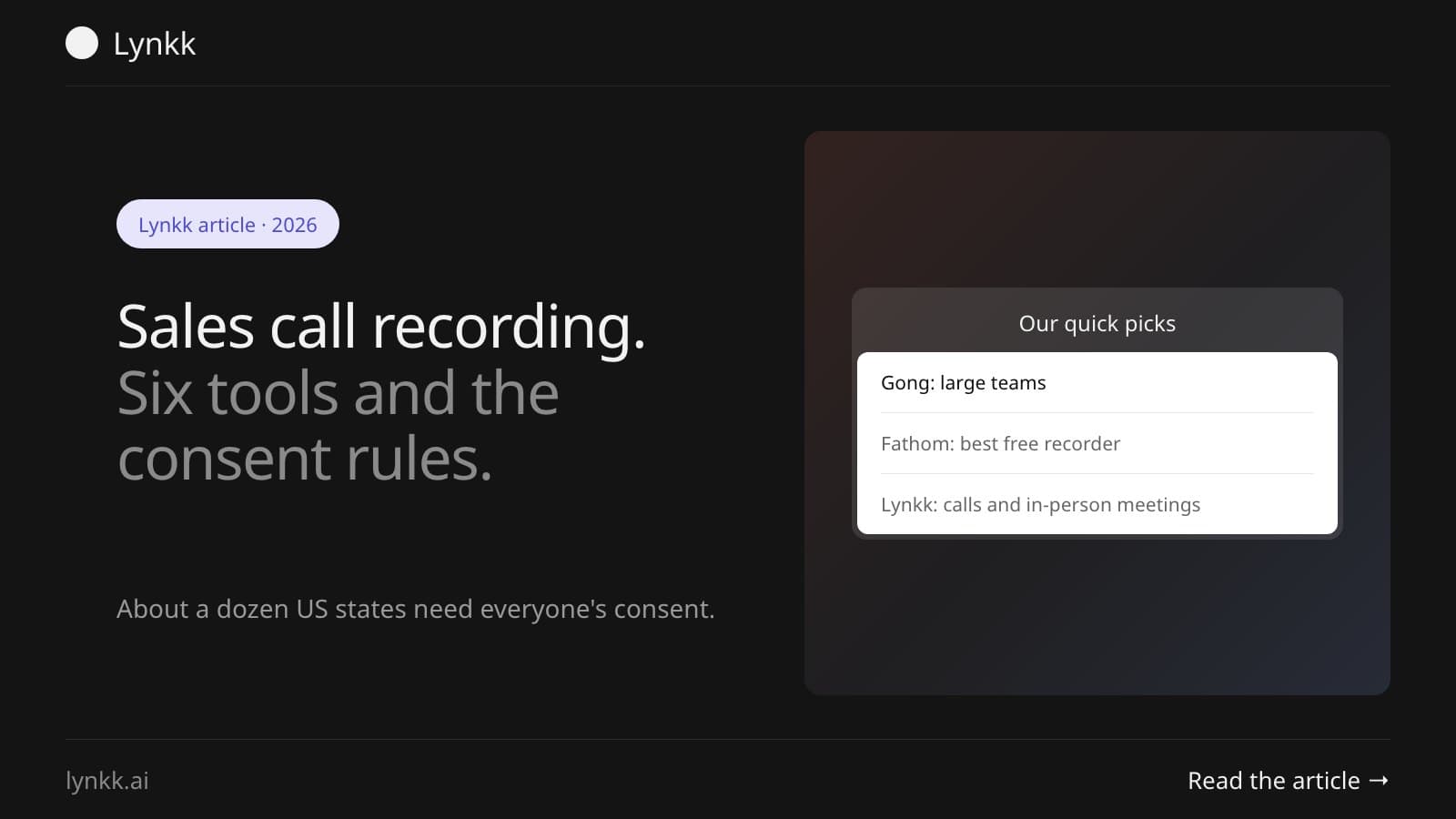
Sales call recording software compared: Gong, Clari Copilot, Avoma, Fathom, Zoom and Lynkk, with real prices, consent rules and what to check before buying.
Start remembering today
Find context, get answers and keep moving.