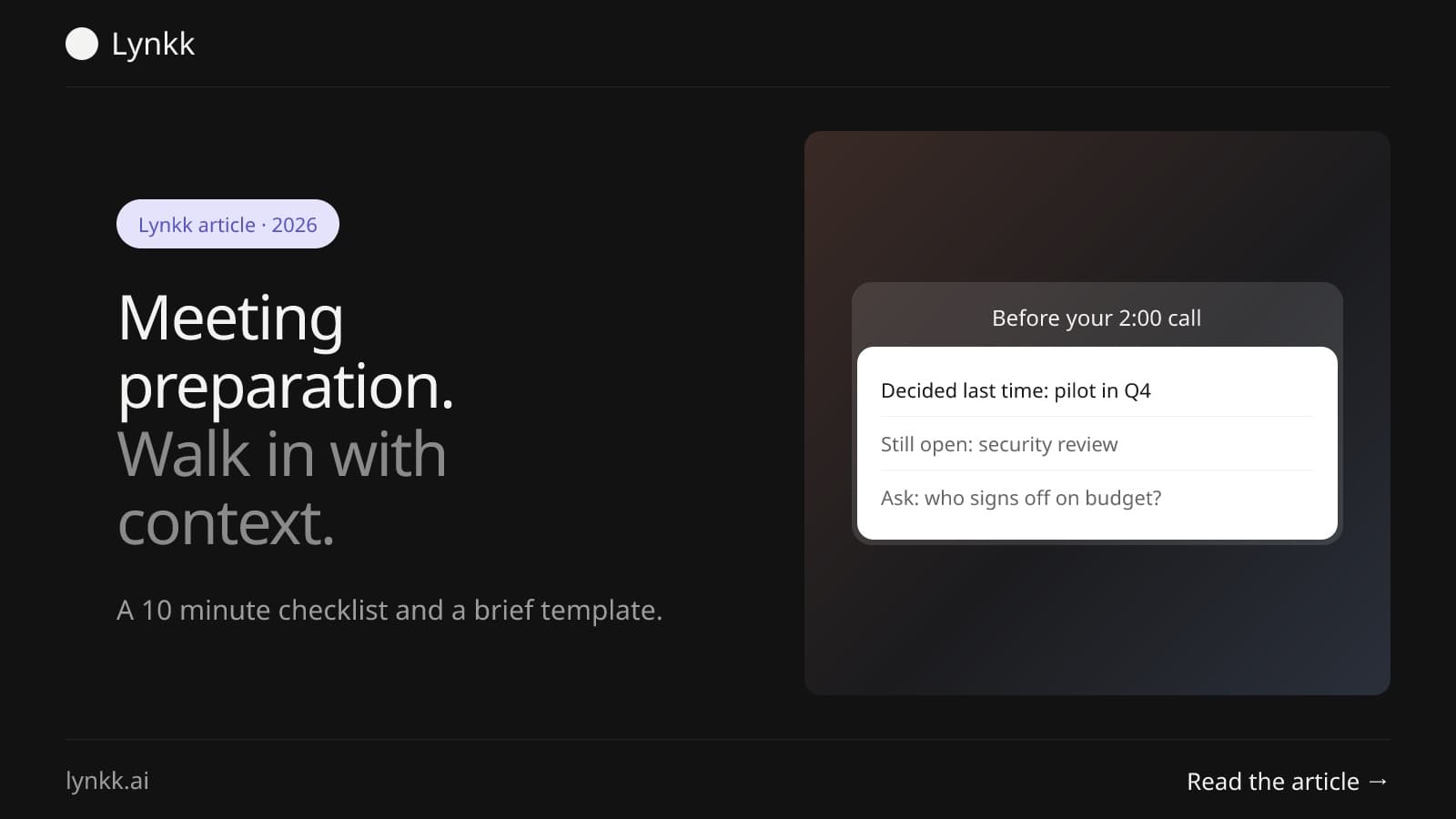
Quick answer: Good meeting preparation takes about 10 minutes: reread the last notes with the same people, list open tasks and decisions, set 1 goal and 3 agenda points, and write a one-page meeting brief. Lynkk does the first part for you with a morning briefing email showing who you are meeting, your last note with them and how many tasks are still open.
What is meeting preparation?
Meeting preparation is the 10 to 15 minutes you spend before a meeting reviewing what happened last time, deciding what you want from this one, and writing it down. The goal is simple: start ahead, not cold.
Most people prepare the agenda and skip the history. That is backwards. The most useful prep is remembering what you already agreed, what is still open, and who promised what. Without it, the first 10 minutes of a meeting go to "where were we?"
What should a meeting brief include?
A meeting brief is a one-page summary you read before a meeting, and a good one has 6 parts: who you are meeting, the goal, what happened last time, open tasks, open questions and the agenda. It should fit on 1 screen.
Part
What to write
Example
Who
Names, roles, company
Dana (VP Ops), Leo (IT) at Acme
Goal
The 1 outcome you want
Agree the pilot start date
Last time
Decisions from the last meeting
Pilot scope set to 2 teams
Open tasks
Who owes what
Leo: security review, due Oct 14
Open questions
What is still unresolved
Budget owner for year 2
Agenda
3 to 5 topics, in order
Security review, dates, budget
The "last time" and "open tasks" rows are the ones people skip, and they are the ones that save the most time in the room.
Free meeting brief template
This meeting brief template takes about 5 minutes to fill in once you have last meeting's notes open. Copy it into a doc or your calendar event.
Meeting: name, date, time, link
People: who is coming, and their role
My goal: 1 sentence, the outcome you want by the end
Last meeting: 2 to 3 decisions, with the date
Open tasks: each with an owner and a due date
Open questions: anything you still need answered
Agenda: 3 to 5 topics, most important first
After: who sends the notes, and when
Keep the brief to 1 page. If it runs longer, the meeting probably needs splitting into 2.
What is a good checklist for meeting preparation?
A checklist for meeting preparation should have 7 steps you can run in order in about 10 minutes. Here is a simple version.
Read the invite. Check who is coming and why. If the purpose is unclear, ask before the meeting, not during it.
Find the last notes with these people. Search by person or company, not by meeting title.
List the open tasks. Note who owes what, and whether it is done.
List past decisions. Write the 2 or 3 that this meeting depends on.
Set 1 goal. What must be true when the meeting ends?
Write 3 to 5 agenda points. Share them with attendees if you are running the meeting.
Plan the follow-up. Decide who records, who takes notes and who sends the summary.
Steps 2 to 4 are the slow ones when notes live in 5 different places. They are also the steps AI can do for you.
How do you prepare for a meeting using past meeting notes?
To prepare from past notes, search by the people or company you are meeting, open the most recent note, and copy its decisions and open tasks into your brief. That takes 2 to 3 minutes when every meeting is recorded in 1 place.
It takes much longer when notes are scattered across docs, chat and notebooks. That is the real cost of weak note-taking: not the meeting itself, but every meeting that follows it.
In Lynkk, every recording becomes a Meeting Brief with 7 parts, including decisions with context, open questions and action items with an owner, a due date and a priority. Each timestamp plays the recording from that moment, so you can check exactly what was said.
How can AI prepare you for your next meeting?
AI can do steps 2 to 4 of the checklist before you open your laptop: it finds your last meeting with the same people, pulls the decisions and lists what is still open. In Lynkk, this arrives as a morning briefing email on days you have meetings, once Google Calendar is connected.
The morning briefing email
For each meeting that day, the briefing shows 3 things: who you are meeting, the most recent note with those people, and how many action items are still open between you. It is a ready-made start to your meeting brief.
Ask Lynkk (Pro)
Ask Lynkk is a chat that answers from 1 source only: your own notes. Ask "what did we decide with Acme last month?" and it finds notes by person, company or project, lists open tasks and decisions, and shows citation chips that open the note at the exact moment, such as "Play from 12:04". You can also attach 1 file, such as a PDF spec or a CSV, and ask about it next to your notes.
After the meeting
Lynkk sends 1 summary email after every meeting, to you and to attendees if you opt in. That email becomes the "last meeting" row of your next brief.
How do engineering leads prepare standups with past decisions?
Engineering leads prepare standups fastest by reading 1 thing: yesterday's decisions and blockers, not the whole chat history. A short brief with 3 lines per person beats scrolling Slack before 9 a.m.
In Lynkk, recurring standups get a Meeting Brief each day, and Pro adds a Daily Stand-up Summary Shape, 1 of 9 built-in formats. Ask Lynkk can then answer "what did we decide about the API migration this week?" with citations from each standup note. For a full standup routine, see standup notes with action items, blockers and decisions.
How do you prepare for a client or sales meeting?
For a client or sales meeting, preparation should answer 3 questions: what did they ask for last time, what did we promise, and what is blocking the deal. Write those answers at the top of your brief.
Search your notes by company, not by date. Sales teams do this at scale with conversation intelligence. In Lynkk, Ask Lynkk finds every note with that company and lists open tasks between you, and the Sales Call Summary Shape (Pro) formats call notes for exactly this kind of follow-up. See how sales teams use this in AI notes for sales calls.
How long should meeting preparation take?
Meeting preparation should take about 10 minutes for a routine meeting and 20 to 30 minutes for a high-stakes one, such as a board meeting or a renewal call. If prep takes longer than the meeting, your notes are too hard to search.
Not everywhere, so check before you record the meetings you prepare from. In the US, federal law (18 U.S.C. § 2511) allows recording with 1 participant's consent, but several states require everyone to agree. In the EU, a recording of identifiable people is personal data under the GDPR.
The simple rule is to say at the start of every meeting that it is being recorded. The NIST Privacy Framework is a useful checklist when you review any tool that stores meeting notes. Lynkk keeps recordings private to your account and never trains on your conversations. This is general information, not legal advice.
FAQ
What is a meeting brief?
A meeting brief is a one-page summary you read before a meeting. It covers 6 things: who you are meeting, your goal, decisions from last time, open tasks, open questions and the agenda. It takes about 5 minutes to write when past notes are easy to find, and it saves the first 10 minutes of the meeting.
How do I prepare for a meeting in 5 minutes?
Open the last note with the same people, copy the 2 or 3 decisions and every open task into a short list, then write 1 goal and 3 agenda points. That is enough for most routine meetings. A morning briefing email, like the one Lynkk sends, gives you the first half before you start.
What should I do before a meeting with a client?
Before a client meeting, answer 3 questions in writing: what they asked for last time, what you promised, and what is still blocking progress. Search past notes by company, list open tasks with owners, and set 1 clear goal. Share a short agenda with the client the day before if you are running the call.
Can AI write my meeting brief?
AI can write most of it. Lynkk's morning briefing email lists 3 things: who you are meeting, your most recent note with them and how many action items are open, once Google Calendar is connected. Ask Lynkk (Pro) can then answer follow-up questions from your notes with citations. You still set the goal yourself.
How do I remember what was decided in past meetings?
Record your meetings and keep the notes in 1 searchable place. In Lynkk, every Meeting Brief lists decisions with context, and Ask Lynkk finds them by person, company or project, with citation chips that open the exact moment in the recording. Search by who you met, not by meeting title, to find them fastest.
Conclusion
Meeting preparation is mostly memory: what you agreed, what is open and what you want next. A 10-minute checklist and a one-page meeting brief cover it, and Lynkk's morning briefing email and Ask Lynkk do the remembering for you. Start free with Lynkk.
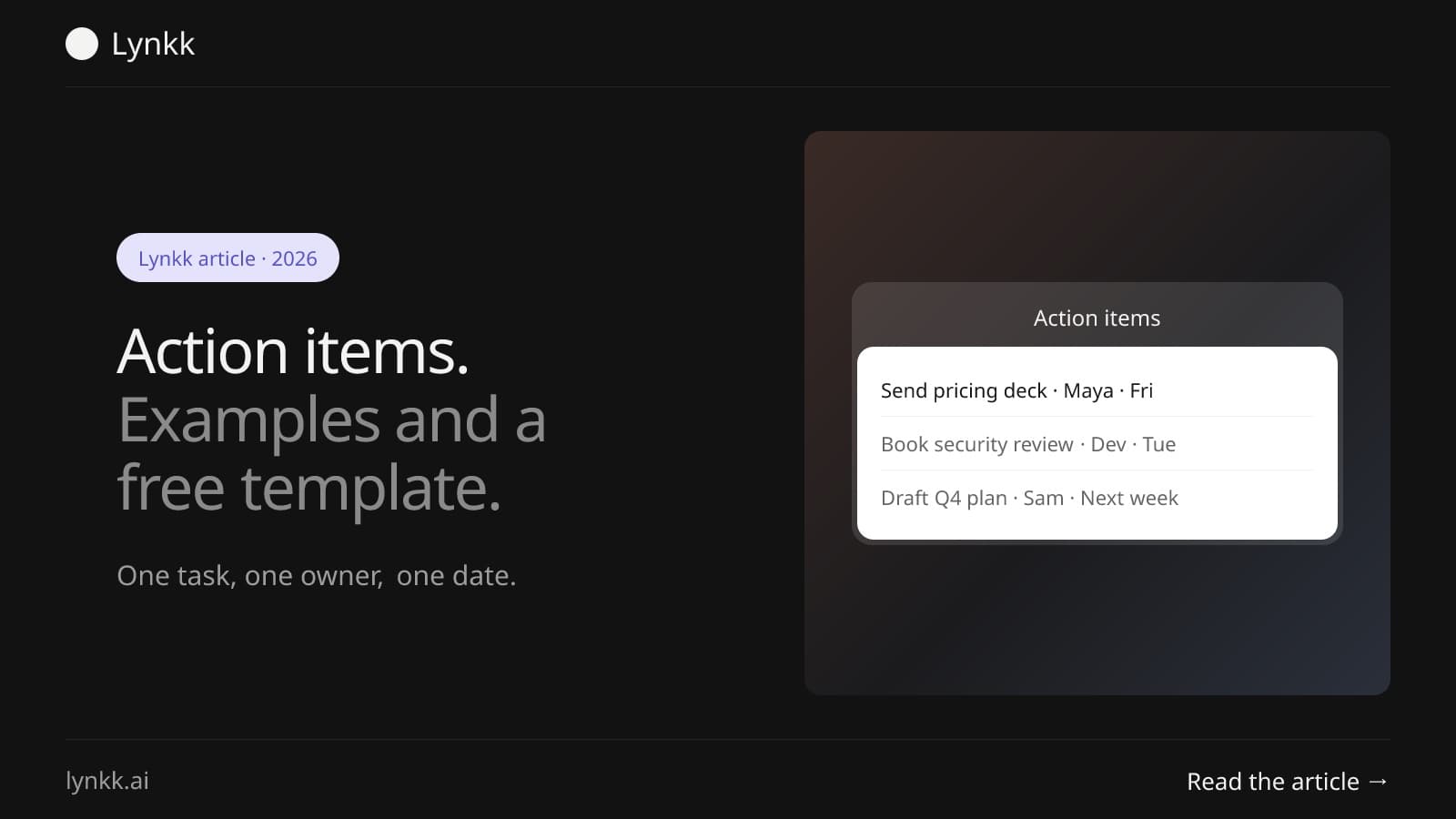
What action items are, 12 real examples, a free template you can copy, and a simple way to track every task after a meeting so owners and dates do not slip.
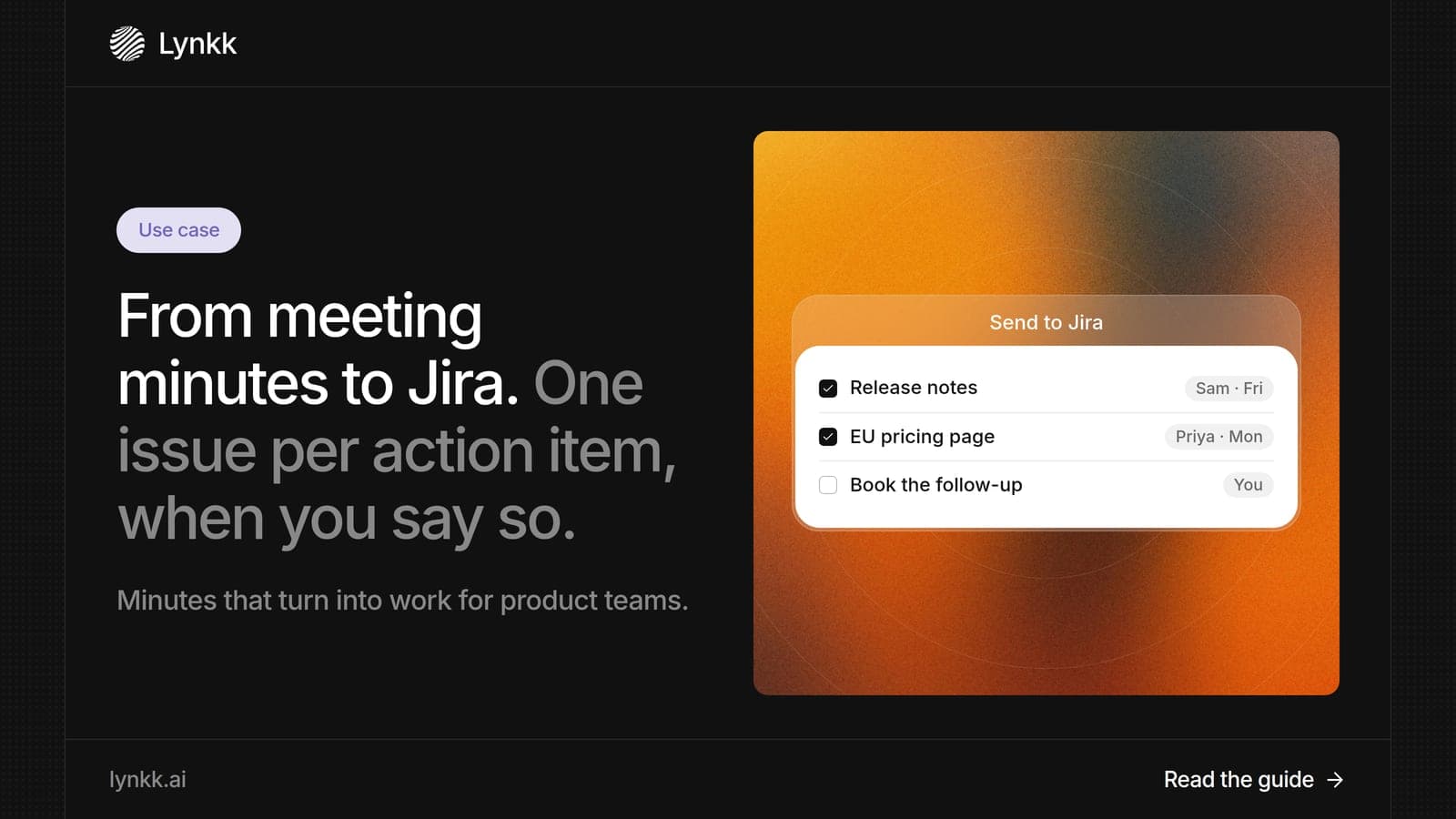
What meeting minutes should include, whether they must be verbatim, and how product teams use AI meeting minutes to send action items to Jira as issues.
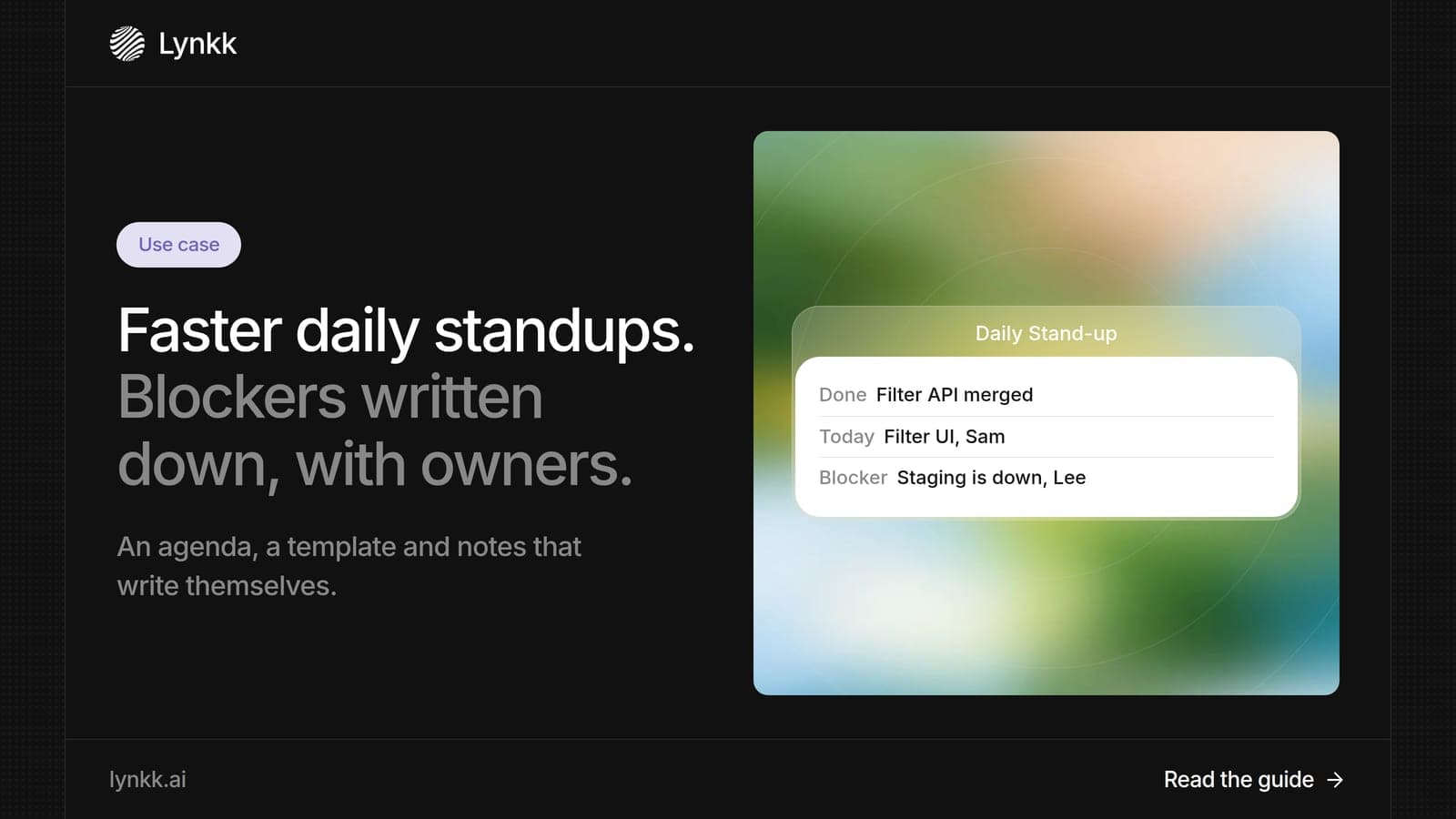
What a standup meeting is, how long it should last, what to say, a standup meeting template, and how AI notes help you send blockers to Jira in 1 step.
7 min read
Lynkk · Your conversations, connected · Start remembering today
Everything your team knows, connected in one living memory, ready whenever you need it.
One memory for your meetings, decisions, and commitments. Find context, get answers, and keep moving.