Use cases
Conversation Intelligence for Sales Teams: From Prep to Follow-Up
What conversation intelligence is, how sales teams use a conversation intelligence platform from call prep to follow-up, and the best Gong alternatives.
Sales process
 By Samarth WaghUpdated 7 min read
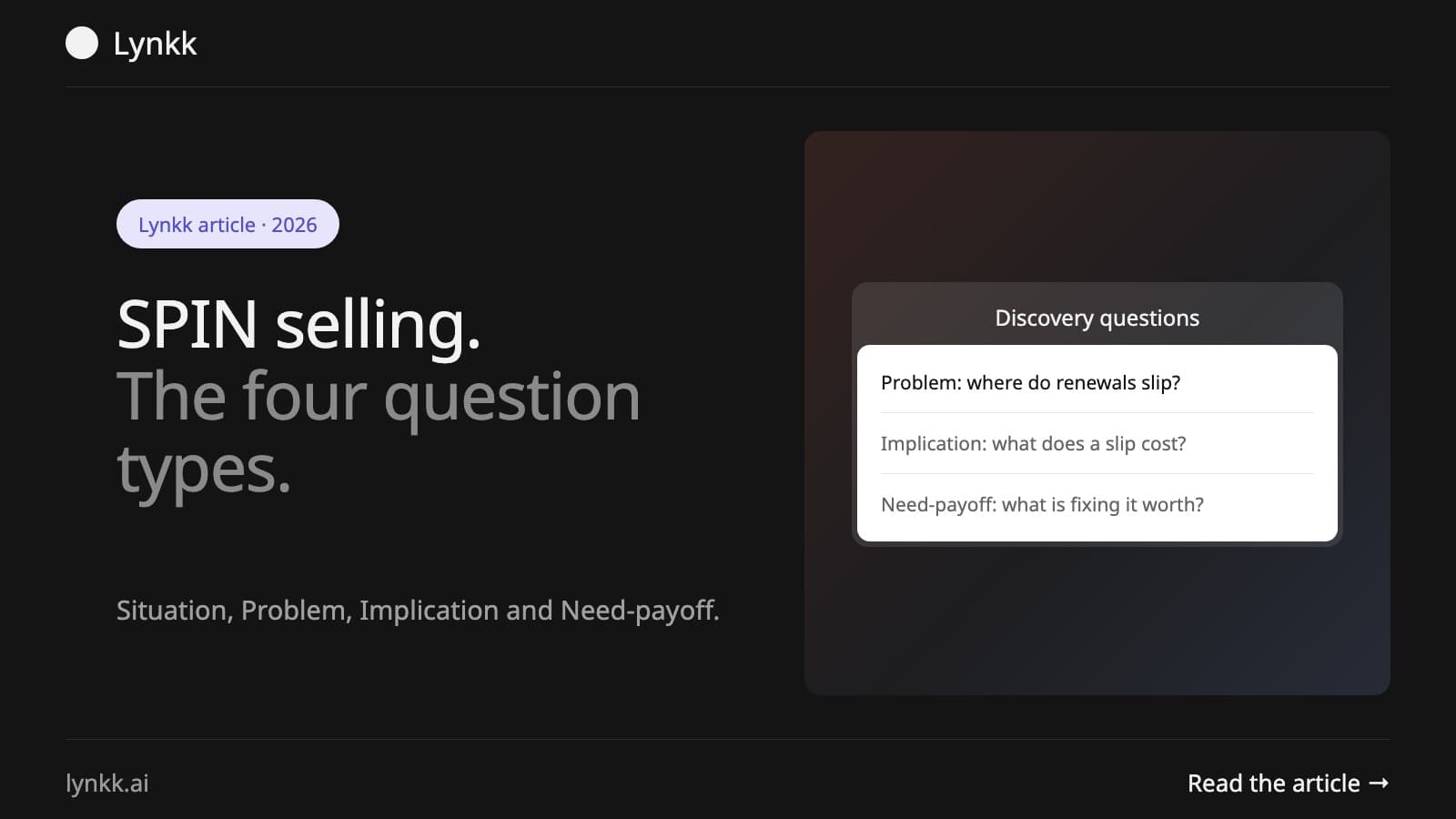
Quick answer: SPIN selling stands for Situation, Problem, Implication and Need-payoff. Neil Rackham published it in 1988 after analyzing roughly 35,000 sales calls, and the core finding was that successful salespeople in large, complex sales ask more Implication and Need-payoff questions than their peers. It is a questioning sequence, not a script, and the sequence matters more than the wording.
Most sales methodologies are somebody's opinion dressed as a framework. SPIN is one of the few built on observed data, which is why it has outlived almost every method published alongside it.
SPIN stands for Situation, Problem, Implication and Need-payoff: four types of question asked roughly in that order during a discovery conversation. Each type does a different job, and the order is the method. The method spends the least time on Situation and the most on Implication.
| Letter | Question type | What it does |
|---|---|---|
| S | Situation | Gathers facts and context |
| P | Problem | Surfaces difficulties and dissatisfaction |
| I | Implication | Makes the cost of the problem visible |
| N | Need-payoff | Gets the buyer to state the value of solving it |
The jump most sellers never make is from P to I. Finding a problem is easy. Making the buyer feel what it costs is the part that moves a deal.
Neil Rackham wrote SPIN Selling, published in 1988, based on research conducted through Huthwaite, Rackham's research firm. The study is usually cited as covering around 35,000 sales calls across 20-plus countries over 12 years, which remains one of the largest datasets ever assembled on selling behavior.
The research question was simple: do the techniques that work in small sales also work in large ones? The answer was no, and that gap is what SPIN was built to close.
Situation questions gather the facts you need (team size, current tools, process, volumes), and you should ask about three of them. They are necessary and they are the ones Rackham found successful sellers ask fewest of. Look up anything their website or LinkedIn already tells you before the call.
Examples:
The discipline is research. Every Situation question you could have answered from their website, LinkedIn or your own CRM spends the buyer's patience for information you should already have. Ask three, not fifteen.
Problem questions surface difficulties, dissatisfaction and things that are not working. Ask two or three. They are where the conversation becomes useful, and Rackham found successful sellers ask more of them than average performers. The goal is to find the one difficulty worth pursuing for the rest of the call.
Examples:
A Problem question that gets a one-word answer has not landed. Follow it: "what does that look like in a bad week?"
Implication questions connect a stated problem to its consequences (cost, time, risk, knock-on effects on other people), and three or four is the right number. This is the highest-value question type in the method and the one most sellers skip.
Examples:
The mechanism matters. The aim is to get the buyer to build the business case themselves, out loud, instead of you presenting one back. A problem the buyer has quantified in their own words survives a budget conversation. One you quantified for them does not.
Need-payoff questions, of which two is usually enough, ask the buyer to describe the value of solving the problem, which flips who is arguing for the purchase. Instead of you listing benefits, they list them. Ask them after the Implication questions, once the buyer has put a cost on the problem.
Examples:
Rackham's finding was that these reduce objections rather than overcome them, because a buyer rarely objects to a benefit they named themselves.
Run the sequence as a loop rather than a checklist, spending the least time on S and the most on I. Confirm what you researched, find one problem worth pursuing, explore what it costs, let the buyer state the value, and only then talk about what you do. A workable shape for a 30-minute discovery call:
Most calls fail at step 3. The seller finds a problem and immediately demonstrates the feature that solves it, which skips the part where the buyer decides the problem is worth money.
SPIN is not outdated, because it describes buyer psychology rather than a sales process, and buyer psychology has not changed since 1988. What has changed is the Situation half: buyers now arrive having done their own research, so the tolerance for basic fact-finding is far lower than it was.
Two adjustments keep it current:
The parts that have aged best are Implication and Need-payoff, which is also the half most sellers never reach.
SPIN is a questioning method; BANT with four elements and MEDDIC with six are qualification checklists. They answer different questions and are commonly used together rather than chosen between. SPIN runs the discovery conversation, and BANT or MEDDIC is where you record what you learned from it.
| SPIN | BANT | MEDDIC | |
|---|---|---|---|
| Type | Questioning method | Qualification checklist | Qualification checklist |
| Answers | How do I run discovery? | Is this lead worth time? | Will this deal close? |
| Best for | Any complex sale | Short cycles | Enterprise deals |
In practice: use SPIN to run the conversation, then record what you learned against whichever checklist your team uses, such as BANT or MEDDIC. Our guide to lead qualification covers how the frameworks fit together, and Salesforce's BANT versus MEDDIC comparison covers the checklist side.
The weak point in SPIN is recall. Implication answers are the most valuable thing a buyer says and the hardest to reconstruct from memory three weeks later, because their force is in the exact phrasing. Recording the call, or writing their exact words down during it, keeps that phrasing usable for the proposal.
Two habits help. Write the buyer's words rather than your summary of them: "we lose about six hours a week rebuilding context" is usable in a proposal, where "efficiency concerns" is not. And prepare the next call against the last one, as our meeting preparation guide sets out.
If your team records its calls, Lynkk joins your Zoom, Google Meet and Microsoft Teams calls and keeps the transcript, a summary and the action items for each one. On Pro, Ask Lynkk searches all your notes and answers with numbered sources, so the Implication answer from six weeks ago comes back in the buyer's own words.
What does SPIN stand for in SPIN selling? Situation, Problem, Implication and Need-payoff: four question types asked in roughly that order during a discovery call. Situation gathers context, Problem surfaces difficulties, Implication makes the cost visible, and Need-payoff gets the buyer to state the value of solving it in their own words.
Who wrote SPIN selling? Neil Rackham, published in 1988, based on research through Huthwaite analyzing roughly 35,000 sales calls. The study is usually cited as spanning more than 20 countries over 12 years, and its core finding was that successful sellers in large sales ask more Implication and Need-payoff questions.
Does the method still work? Yes. It describes how buyers reason rather than prescribing a script, though the Situation stage needs cutting hard now that buyers research before they speak to anyone. Implication and Need-payoff have aged best, and buying groups mean you should ask who else feels the problem.
What is the most important SPIN question type? Implication. It converts a stated problem into a cost the buyer has quantified themselves, which is what survives a budget conversation. It is also the type most sellers skip, jumping from a stated problem straight to a demo. Ask three or four on one problem.
How many Situation questions should you ask? About three. Anything answerable from their website or your CRM spends the buyer's patience for information you should already hold. Successful sellers ask the fewest of these, so research team size, tools and process before the call and use the time for Problem and Implication questions.
What is the difference between SPIN selling and BANT? SPIN is a questioning method for running discovery. BANT is a checklist for deciding whether a lead is worth pursuing. Teams commonly use both. SPIN shapes the conversation, and BANT is where you record what it told you about budget, authority, need and timeline.
Further reading: Shopify's SPIN selling guide and Coursera's overview of the method.
Ask an AI to summarize this article
Keep reading
Use cases
What conversation intelligence is, how sales teams use a conversation intelligence platform from call prep to follow-up, and the best Gong alternatives.
Sales process
BANT sales qualification stands for Budget, Authority, Need and Timeline. What each letter means, the questions that get real answers, and where BANT fails.
Sales process
MEDDIC sales qualification stands for Metrics, Economic buyer, Decision criteria, Decision process, Identify pain and Champion. What each means, with questions.
Start remembering today
Find context, get answers and keep moving.