Use cases
Conversation Intelligence Platform: A Guide for Sales Teams
What conversation intelligence is, how sales teams use a conversation intelligence platform from call prep to follow-up, and the best Gong alternatives.
Sales process
 By Samarth WaghUpdated 9 min readResearch checked against the linked sources in November 2026
Part of: Sales meeting guides
Summarize this article with
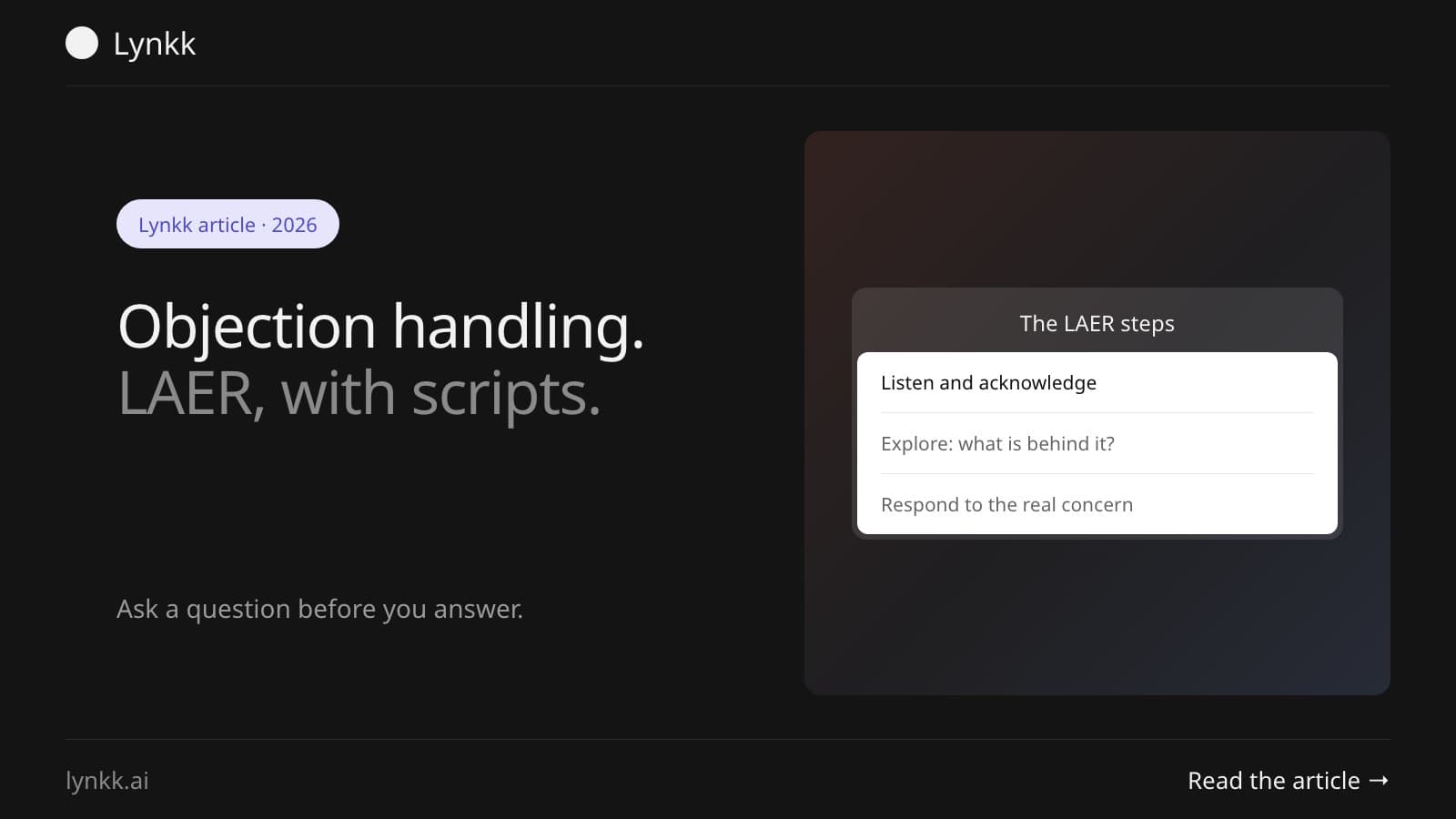
Quick answer: Objection handling is how a sales rep responds to a buyer's concern so the deal keeps moving. Use the four LAER steps: listen, acknowledge, explore with a question, then respond. In Gong's study of 67,149 demo calls, top reps paused and asked a question, while average reps talked for about 21 seconds straight.
Handling objections well is the skill of turning "no, because" into "yes, if". Most objections aren't refusals at all. They're the buyer telling you what's missing. Find out what that is, and you usually win the deal.
In sales, handling an objection means hearing a buyer's concern, finding the real reason behind it, and answering it so the call moves to a next step. A good answer lowers the buyer's risk. A bad one starts an argument.
An objection isn't a rejection. "We already have a tool for this" leaves the door open, while "we've signed a three-year contract with someone else" mostly shuts it. Telling the two apart, fast, is half the job.
Handling objections decides most late-stage deals, because almost every buyer raises at least one concern before they sign. Gong Labs analysed 67,149 demo calls and found a clear split: average reps answered an objection with a 21.45-second monologue, while top reps slowed down and asked questions.
That gap is the whole lesson. Objections rarely kill deals on their own. The rush to answer does, because the rep ends up solving a problem the buyer never actually had.
Most sales objections fall into 4 groups: price, need, timing and trust. HubSpot's list of 44 common objections sorts them much the same way, and knowing the group tells you which question to ask first.
| Objection group | What the buyer says | What it usually means |
|---|---|---|
| Price | "It's too expensive." "We don't have budget." | The value isn't clear yet, or the wrong person holds the budget |
| Need | "We're fine with what we have." "Not interested." | They don't see the problem, or don't think it's urgent |
| Timing | "Call me next quarter." "I need to think about it." | Something else is competing for attention, or a risk is unspoken |
| Trust and authority | "I need to run it past my boss." "Send me some info." | They can't sign alone, or don't yet trust the claim |
The most widely used objection handling framework is LAER, which stands for listen, acknowledge, explore and respond. Carew International developed it and still sells training on it, per Think Insights' summary of the LAER model. It works for a simple reason: step three forces a question before you're allowed to answer.
| Framework | Steps | Best for |
|---|---|---|
| LAER | Listen, Acknowledge, Explore, Respond | Any objection, and the default for B2B |
| LAARC | Listen, Acknowledge, Assess, Respond, Confirm | Complex deals where you need a clear yes before moving on |
| Feel, felt, found | "I understand how you feel. Others felt the same. They found..." | Emotional or risk objections, with a real customer story |
| Boomerang | Turn the objection into the reason to buy | Objections that are really a strength in disguise |
The 5 steps are: pause, clarify, isolate, answer and confirm. The National Association of Sales Professionals teaches a similar five-step method, and it maps cleanly onto LAER with a check at the end.
Say less than you think you need to. Lead with a question.
Each objection handling script below opens with a question, then answers in one or two lines. Change the wording to fit your product and your own voice. Buyers can hear a script being read.
Handle a price objection by asking what they're comparing the price to, then showing the cost of the problem staying unsolved. "Too expensive" almost always means "I can't see the return yet," which is why HubSpot's price objection guide also starts with value, not discounts.
Try: "Fair question. Compared to what, another tool, or doing nothing? ... If it saves each rep two hours a week, what's that worth to your team over a quarter?"
Treat "I need to think about it" as a sign that something is unspoken, and ask what specifically they want to think through. Name the concern now, and you won't lose the deal to silence later.
Try: "Of course. So I can send the right thing, what's the part you want to think through, the price, the rollout, or whether it fits the team?"
Respond to "I'm not interested" with a short, specific reason to keep talking, then ask permission for one question. On a cold call, each sentence has to earn the next one.
Try: "Totally fair, you weren't expecting me. Most sales leaders I talk to are losing deal notes between calls. Is that a problem for your team, or not really?"
Answer a no-budget objection by finding out whether the budget is missing, already spent, or held by someone else. Each needs a different next step. Only the first is a real no.
Try: "Understood. Is that no budget this year, or no budget line for this yet? Who usually decides when something new comes up mid-year?"
Handle a no-time objection by shrinking the ask and booking a specific slot. "Let's talk later" with no date attached is how deals quietly die.
Try: "I get it. Would 15 minutes on Thursday at 10 work, just to see if this is worth a proper look? If not, I'll leave you alone."
Here are 2 short, realistic objection handling examples, written the way they sound on a call. Both follow LAER, and both end with a confirmed next step rather than a clever line.
Example 1: a price objection on a renewal call
Buyer: "Honestly, your renewal is 20% higher than last year. That's hard to justify."
Rep: "That's a real jump, and I'd push back too. Can I ask what you're measuring it against, last year's price or what the team gets out of it?"
Buyer: "Last year's price, mostly. Finance just sees the number."
Rep: "Makes sense. Last quarter your team logged 340 calls through us. If I put that next to the cost per call for finance, would that help you make the case?"
Buyer: "Yes, that would actually help."
Example 2: a timing objection on a discovery call
Buyer: "This looks good, but we're not looking at anything until Q2."
Rep: "Thanks for telling me straight. What's happening between now and Q2, a budget cycle or another project?"
Buyer: "We're migrating our CRM. Nobody has bandwidth."
Rep: "That's useful. Would it be worth a 20-minute call in March to plan around the migration, so you're not starting from zero in April?"
The numbers in these examples are illustrative. The shape is what carries over: acknowledge, ask, then answer the real concern with something the buyer can actually use.
On a cold call, handle objections with one acknowledgement and one question, and never more than about 20 seconds of talking. They didn't ask for the call. Earning another minute is hard.
The most common cold call objections are "not interested", "send me an email" and "we already use someone". For each one, agree first, then ask a single question that tests whether the problem even exists.
Clear no? Thank them and hang up. You'll get a warmer hearing next time.
The fastest way to practice is to replay your own recorded calls, find every objection, and rewrite your answer using LAER. Role-play helps. But real objections from real buyers beat anything a manager can invent.
Try this weekly drill with your team:
Reps mostly lose deals by answering too fast and for too long. Five mistakes turn up in call review after call review:
Yes. Objection handling AI comes in 2 forms: note takers that find how objections were handled across past calls, and real-time assistants that suggest what to say during the call. Both need the call recorded, so tell people first.
After the call, a recorder like Lynkk turns each sales call into notes, and on Pro, Ask Lynkk can answer "how did we handle pricing pushback last month?" across every note, with the minute behind each answer. That's the raw material for the weekly drill. Our comparison of sales call recording software covers the other recorders and the consent rules.
During the call, Lynkk's Spotter is a live assistant for the Mac with a Sales mode built to help handle objections from your own notes. It's in development, with early access open, and it stays visible in any screen share. For the wider picture on call analytics, see our guide to conversation intelligence for sales teams.
Yes. It's a soft skill built on listening, empathy and asking good questions, but it can be trained like a hard one. Reps improve fastest when they review real call recordings, practise specific objections with a colleague, and measure whether their new responses actually move deals to a next step.
Feel, felt, found is one of the oldest objection handling techniques, and it has three parts. You say you understand how the buyer feels, that other customers felt the same, and what those customers found after buying. It only works with a true customer story, so keep one or two real examples ready for each common objection.
Often, yes. A buyer who raises an objection is still engaged enough to explain what's stopping them, which is better than polite silence. Questions about price, rollout or contracts usually mean they're picturing the purchase. The risk is treating every objection as a buying signal and missing a real no.
An objection matrix is a table that lists common objections, what each one usually means, and a tested response for each. Teams keep it in a shared doc or sales playbook. The best matrices are built from objections heard on real recorded calls, and updated whenever a better response wins a deal.
Keep it short and ask one question. Thank them for being direct, ask what they're comparing the price to, and offer a 15-minute call to walk through the return. Avoid sending a discount by email, because it anchors the price lower before you know what the objection really means.
In customer service, use the same LAER steps but slow down even more. Let the customer finish, acknowledge the frustration without blaming anyone, ask a question to find the real problem, then offer a specific fix with a time frame. The goal is a solved problem, not a won argument.
Handling objections is less about the perfect line and more about the pause and the question that come before it. Learn LAER. Keep a few honest scripts. Then review your real calls, every week, without skipping.
If you want a framework for the questions that come earlier in the deal, read our guide to SPIN selling or BANT qualification.
Lynkk records your sales calls and lets you search every objection you've ever heard. Get Lynkk Pro, $4 a month.
Where Lynkk fits: AI for sales calls
Keep reading
Use cases
What conversation intelligence is, how sales teams use a conversation intelligence platform from call prep to follow-up, and the best Gong alternatives.
Sales process
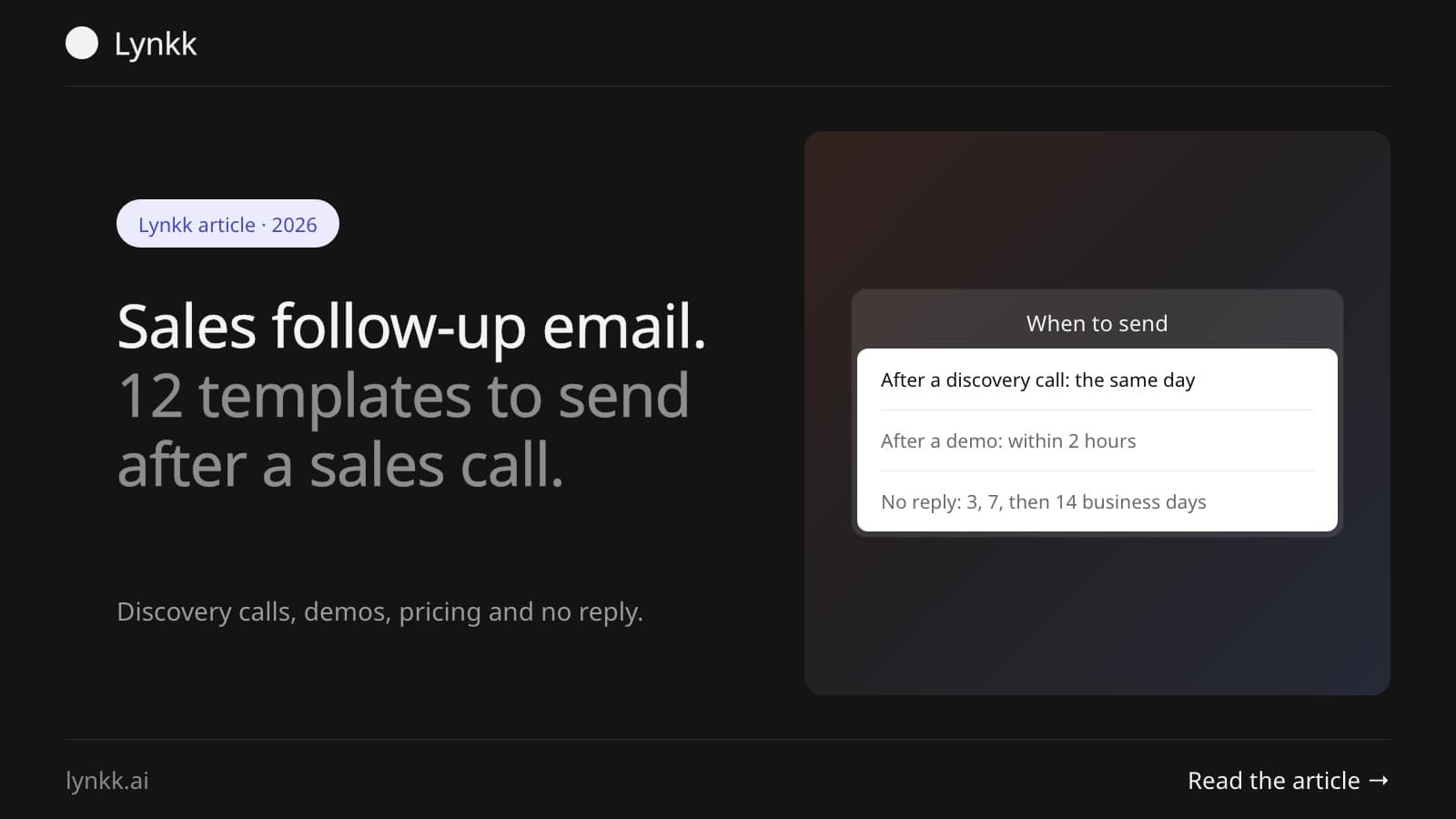
Copy 12 sales follow-up email templates for discovery calls, demos, pricing calls and proposals with no reply, plus subject lines and when to send each one.
Sales process
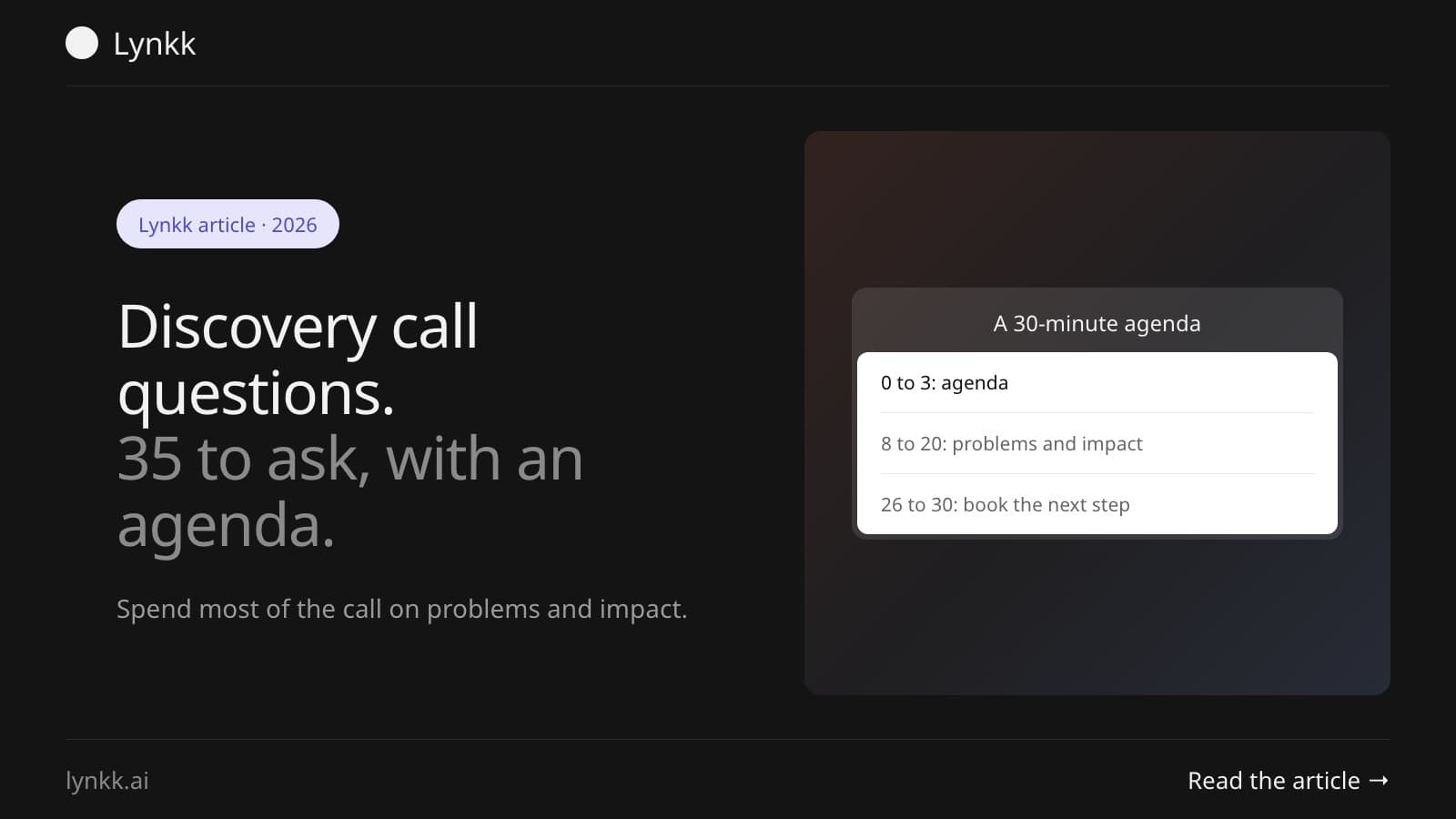
35 discovery call questions for sales, cold calls, agencies and coaches, plus a 30-minute agenda, a script, and Gong's data on how many questions to ask.
Start remembering today
Find context, get answers and keep moving.