Quick answer: BANT sales qualification stands for Budget, Authority, Need and Timeline, a qualification framework IBM built in the 1950s. The original rule was that a lead meeting three of the four was worth pursuing, and that rule is its biggest flaw: Budget, Authority and Timeline without Need describes a prospect who can buy and has no reason to. BANT suits short cycles and buying groups of one or two; MEDDIC maps complex deals better.
Further reading: Mixmax on capturing qualification answers from sales calls, and our guide to meeting preparation.
BANT sales qualification is the oldest framework of its kind still in daily use, and seventy years on it is still the first thing most new reps are taught. It also attracts more criticism than any other framework, most of it fair and some of it fixable by changing the order of the letters.
What does BANT sales qualification stand for?
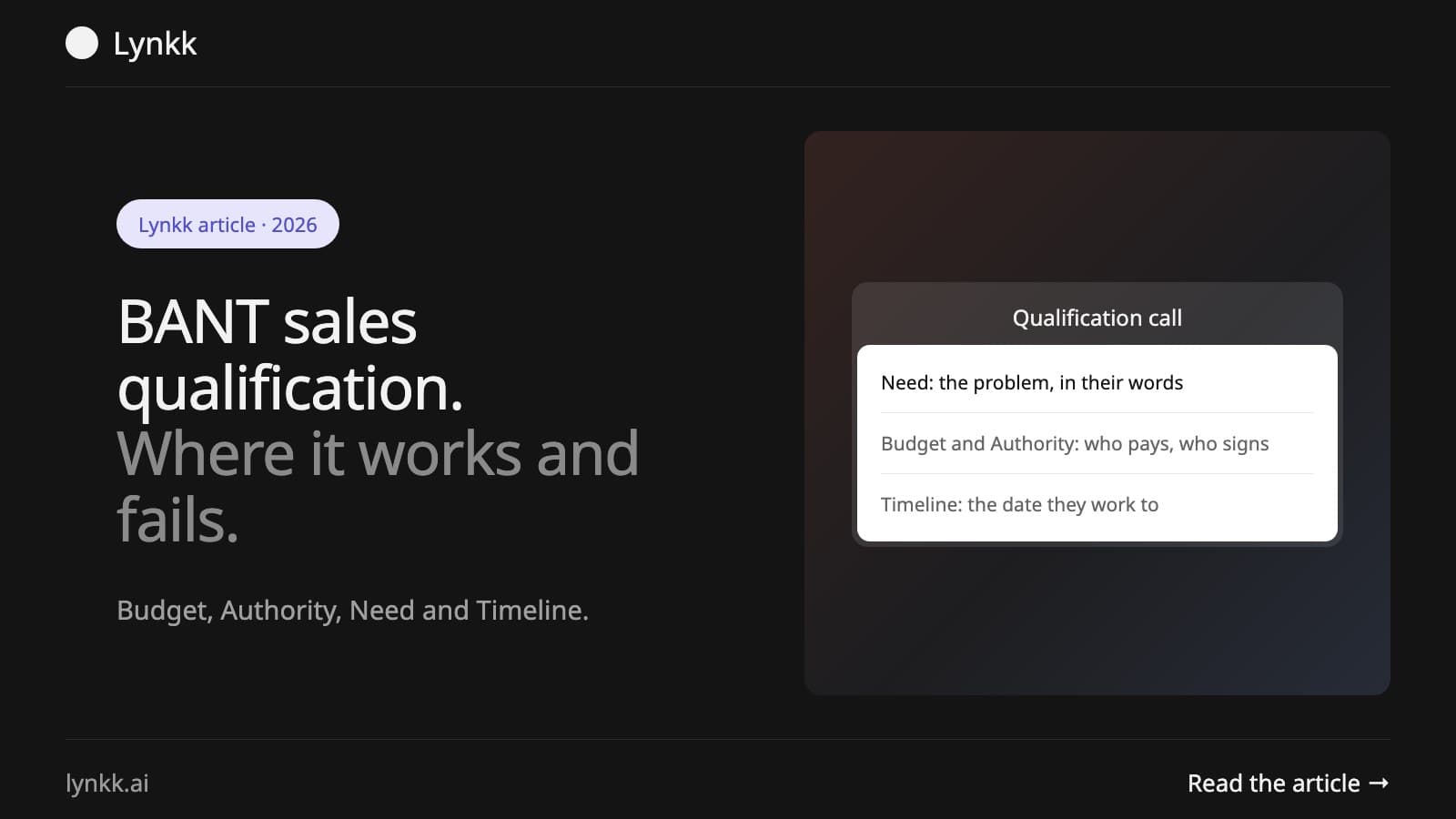
The acronym stands for Budget, Authority, Need and Timeline: the four things a salesperson establishes to decide whether a lead is worth pursuing. IBM developed it in the 1950s, and it remains the most widely taught qualification framework in B2B sales.
- Budget. Can they pay for it?
- Authority. Can this person say yes, or reach someone who can?
- Need. Do they have a problem your product solves?
- Timeline. When will they decide?
What is BANT in sales, in practice?
In practice BANT is a set of 4 things a rep must be able to answer before a deal enters the forecast, usually recorded as CRM fields after a discovery call. The framework's value is shared language: two reps describing a deal mean the same thing by "qualified".
Its weakness shows in the same place, and HubSpot's practitioner guide to BANT reaches the same conclusion. Four CRM checkboxes compress a conversation into four binary answers, and three of the four are things a sales manager wants for a forecast rather than things a buyer needs to make a decision.
What are the BANT criteria for budget?
The budget criterion is not "do they have money", since almost every company does. The 5 questions below get at the real one: whether money can be moved to this problem, by whom, and against what alternative.
Questions that work:
- Have you set money aside for this, or would it need to be found?
- What would you be comparing this against?
- What have you approved for something similar before?
- Who would need to sign off on the spend?
- What would make this an easy yes on price, and what would make it an obvious no?
The question that does not work is "what's your budget for this?" It returns one of three things: an invented number, a refusal, or a number deliberately set low to anchor you. It also assumes budget exists before the buyer has decided they have a problem worth solving, which in most modern B2B purchases is backwards. Budget gets created once the business case exists.
If a prospect cannot name who signs off on spending and what they approved last, you do not have budget information. You have a pleasant conversation.
How do you establish authority?
You establish authority by mapping the approval path and the 5 or more people on it, not by asking whether your contact is the decision maker. That question is answered "yes" far more often than it is true.
Questions that work:
- Who else cares about solving this?
- Who would be using this day to day?
- Who has approved something like this in the past?
- Is there anyone who would push back on this?
- Is procurement, legal or security involved in a purchase this size?
The framework was designed when one person signed the check. B2B buying now runs through groups: a user, a manager, a budget holder, someone in security, someone in procurement, and usually a skeptic. "Authority: yes" in a CRM field typically means "my contact described themselves as the decision maker".
Why is Need the most under-used letter?
Need is 1 of the 4 letters and the only true precondition. Yet most reps treat it as a yes-or-no box: does the prospect want what we sell? A need with a cost attached is worth ten needs without one. The letter that most determines whether a deal closes gets the least conversation time.
Compare two statements. "We'd like better notes" is a preference. "We spend about six hours a week rebuilding context before client calls" is a need with a number on it. Only the second survives a budget conversation.
Questions that work:
- What made you take this call?
- What are you doing about this today?
- How long has this been going on?
- What have you already tried?
- What happens if you do nothing?
- Who else feels this?
The move is to ask the implication questions: how long, how often, who else, what has it cost. The point is to help the buyer hear their own problem out loud.
What are the best BANT framework questions for timeline?
The best timeline question is not about timing at all: "where does this sit against everything else on your list?" A date gets you a number the prospect invented to be helpful. A rank gets you the truth, which is often fourth, behind an ERP migration, a reorganization and a hiring freeze.
Questions that work:
- Is there a date this needs to be working by?
- What drives that date?
- Where does this rank against the other things you could do this quarter?
- What would cause this to slip?
- What happens between now and then?
Dates without drivers are not dates. Real ones have a forcing function: a contract expiring, a compliance deadline, a product launch, a fiscal year, a person leaving. Ask for the driver and write it down.
Is BANT sales qualification outdated?
It is not outdated for short cycles and buying groups of 1 or 2, and it is outdated for complex enterprise deals, where it has no field for a champion, a blocker or the decision process. Four specific failures explain most of the criticism:
-
It qualifies the seller's needs, not the buyer's decision. Budget, Authority and Timeline all serve a forecast. The one letter that helps a buyer decide sits third.
-
It assumes a single decision maker. Buying groups broke this, and the framework has no way to record them.
-
The three-out-of-four rule is dangerous. Budget, Authority and Timeline without Need scores three of four and will never close. Need is a precondition, not an equal letter.
-
It gets asked too early. Budget and timeline questions on a first call, before the buyer has articulated a problem, read as a credit check.
Which aspect of the framework matters most?
Need matters most, and the other 3 are degrees rather than gates. A prospect with a costed problem and no budget is an early deal; a prospect with budget, authority, a timeline and no problem is not a deal at all.
This is the single highest-value change to how most teams run BANT: drop the three-out-of-four rule, make Need mandatory, and treat the rest as a measure of how far along the deal is.
How does the framework work in SaaS?
In SaaS the letters survive but their meaning shifts, because budget is usually created rather than pre-allocated and purchases are approved by a group rather than a person. Most SaaS teams that keep BANT reorder it and rename two letters.
A workable adaptation:
- Need first, always. Nothing else matters until there is a problem with a cost.
- Replace Timeline with Prioritization. Ask where it ranks, not when it lands.
- Replace Authority with Process. Ask what the approval path is and who is on it.
- Keep Budget last and ask it as a comparison question rather than a number question.
That is effectively CHAMP, which is why CHAMP exists.
What are the alternatives?
3 frameworks cover what BANT misses, each at a different cost in training time.
| BANT | CHAMP |
|---|
| Leads with | Budget | Challenges |
| Handles buying groups | Poorly | Partly |
| Maps the decision process | No | No |
| Captures a champion | No | No |
| Learning curve | Low | Low |
| Best deal size | Small to mid | Small to mid |
| MEDDIC | SPIN |
|---|
| Leads with | Metrics | Situation |
| Handles buying groups | Well | Partly |
| Maps the decision process | Yes | No |
| Captures a champion | Yes | No |
| Learning curve | Medium to high | High |
| Best deal size | Large | Any |
CHAMP (Challenges, Authority, Money, Prioritization) is BANT reordered to lead with the problem. MEDDIC adds decision criteria, decision process and a champion, which is what separates forecast accuracy on long deals. SPIN is a questioning method rather than a checklist, and it is how you get good answers for Need whichever framework you log afterwards.
When is BANT still the right choice?
Across 4 situations the framework is still right. It fits when deal sizes are small enough that a heavier one costs more than it returns. It also fits short cycles and buying groups of one or two. And it suits onboarding new reps who need one thing everyone can hold in their head.
Consistency outranks sophistication, and our guide to conversation intelligence for sales teams covers how recorded calls help keep it consistent. A team applying it the same way every time beats a team using MEDDIC differently every time, because only the first can compare two deals in a pipeline review.
How to run it without the usual problems
Five changes, none of which cost training time:
- Reorder it. Need first.
- Drop the three-out-of-four rule. Need is mandatory.
- Replace Timeline with Prioritization.
- Replace Authority with Process.
- Record what they said, not the checkbox. "Budget: yes" is worthless in six weeks. "The VP approved a $40k tool last year and would need to approve this" is useful indefinitely.
That last one is where qualification quietly fails. The CRM gets completed days later, from memory, by someone invested in the deal being real. If your team records its calls, the words are still there and a deal review becomes checking rather than remembering. Lynkk joins your Zoom, Google Meet and Microsoft Teams calls and writes a summary and action items after each one. On Pro ($15 a month), Ask Lynkk searches every call you have recorded, so "what did the buyer say about budget?" comes back with the answer and numbered sources. Lynkk does not sync with a CRM today, so you copy the summary into the deal record yourself. The free plan includes unlimited notes and your first 5 hours of AI summaries (pricing).
Frequently asked questions
What does BANT stand for?
Budget, Authority, Need and Timeline. It is a sales qualification framework developed by IBM in the 1950s.
What is BANT sales qualification?
A four-part checklist a rep completes to decide whether a lead is worth pursuing: can they pay, can they decide, do they have a problem, and when will they act.
Is BANT still relevant?
For short cycles, smaller deals and buying groups of one or two, yes. For complex enterprise deals with multiple stakeholders, MEDDIC maps the decision better.
What does BANT qualified mean?
Traditionally, a lead meeting at least three of the four criteria. That rule is widely criticized, because a lead meeting Budget, Authority and Timeline without Need will not close.
What is the difference between BANT and MEDDIC?
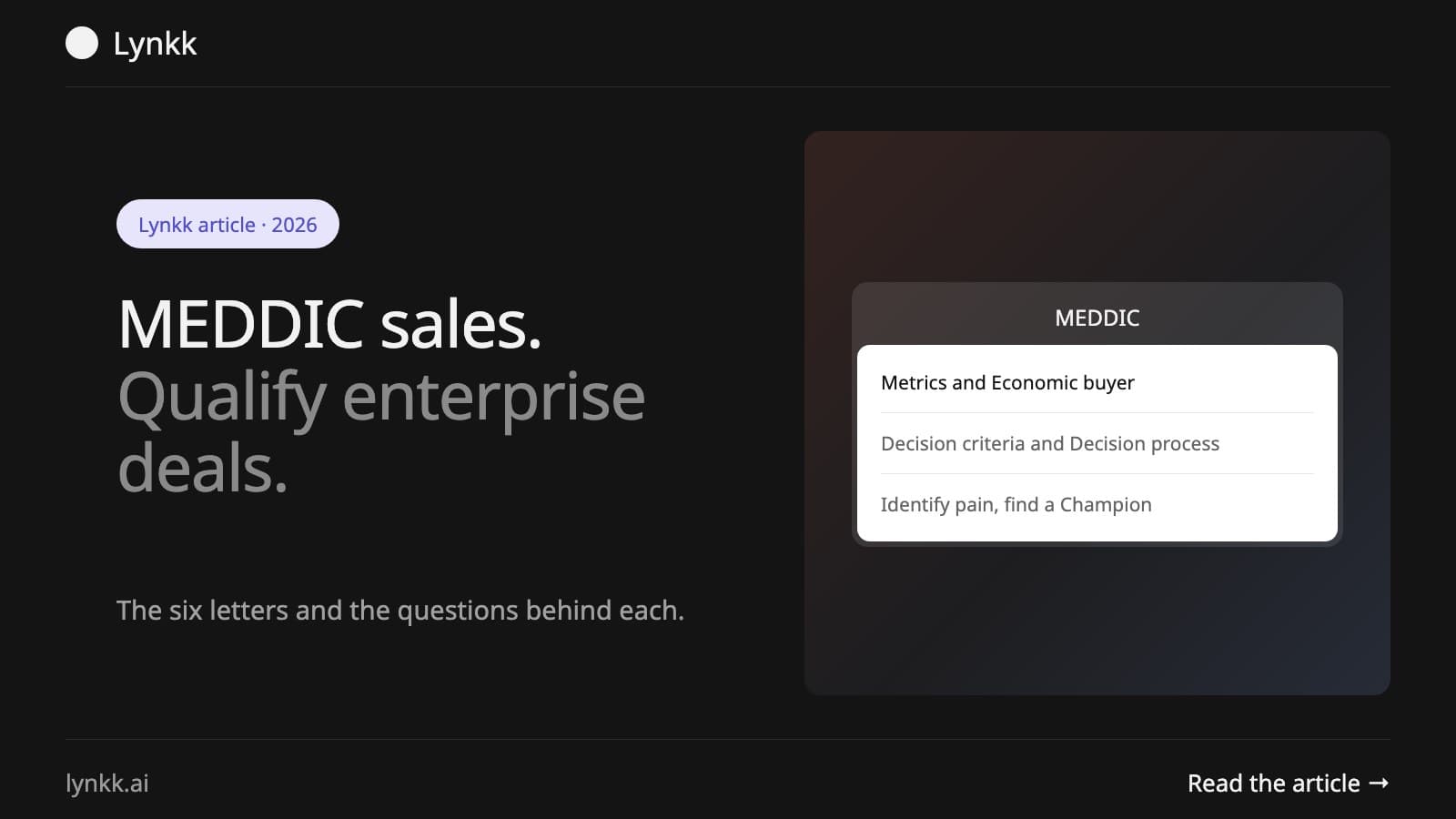
BANT has four elements and asks whether the prospect can buy. MEDDIC has six and maps how the decision gets made, including decision criteria, decision process and a champion.
What is the difference between BANT and CHAMP?
CHAMP reorders the same ideas as Challenges, Authority, Money, Prioritization, leading with the problem rather than the budget and asking about priority rather than timeline.
How do you ask about budget without sounding pushy?
Ask what they would compare the purchase against, what has been approved for similar tools before, and who signs off. You learn the same thing without asking anyone to name a number.