Sales process
Sales Enablement Tools: The Six Categories and How to Choose
What sales enablement tools do, the six categories they fall into, what each costs, and how to tell which gap you actually have before buying another one.
Meeting recording
 By Samarth WaghUpdated 10 min readLaws checked against the linked statutes, court decisions and regulator guidance in October 2026
Quick answer: Usually yes, as long as the right people agree. US federal law and most states let you record a meeting you take part in with your own consent, but about a dozen states, including California, Florida and Pennsylvania, need everyone's. The UK, the EU, India, Canada and Australia add their own rules. The safe habit everywhere: say you are recording at the start and get a clear yes.
Disclosure: This guide is published by Lynkk, which makes an AI note taker. It is general information, not legal advice. Laws change and the facts of your meeting matter, so ask a lawyer where you are if the stakes are high.
In most places it is legal to record a meeting you take part in, provided the people in it know or agree. What changes from place to place is who has to agree: in some, your own consent is enough; in others, everyone in the meeting must say yes. Privacy laws also govern what you do with it afterwards.
Three questions decide almost every case:
One-party consent means a recording is lawful if at least one person in the conversation agrees, and that person can be you. All-party consent, often called two-party consent, means every person in the conversation must agree. A meeting with people in both kinds of place should follow the all-party rule.
| One-party consent | All-party consent | |
|---|---|---|
| Who must agree | One participant (you count) | Every participant |
| Secret recording by a participant | Usually lawful | Usually unlawful |
| Examples | US federal law, New York, Texas, Canada | California, Florida, Washington |
| Safe habit | Still tell people | Announce it and get a yes |
Some all-party states focus on secrecy rather than a spoken yes. In Massachusetts, Montana and Washington, recording openly, with everyone aware, is generally treated as consent.
Federal law is one-party: 18 U.S.C. 2511(2)(d) lets a participant record unless the purpose is a crime or a tort. States can be stricter, and about a dozen are. California, Florida, Illinois, Maryland, Massachusetts, Montana, New Hampshire, Pennsylvania and Washington require everyone's consent, and four more add wrinkles.
| State | Rule | What to know |
|---|---|---|
| California | All parties | Penal Code 632 covers confidential conversations; civil damages of $5,000 per violation under section 637.2 |
| Florida | All parties | Section 934.03; does not cover talk with no reasonable expectation of privacy |
| Illinois | All parties | 720 ILCS 5/14-2 covers private conversations |
| Maryland | All parties | Courts and Judicial Proceedings 10-402 |
| Massachusetts | All parties | Chapter 272, section 99 targets secret recording |
| Montana | All parties | Section 45-8-213: recording without the knowledge of all parties |
| New Hampshire | All parties | RSA 570-A:2 |
| Pennsylvania | All parties | Covers in-person talk where people expect privacy, and all phone calls |
| Washington | All parties | RCW 9.73.030; a recorded announcement counts as consent |
| Connecticut | Mixed | All parties for phone calls (civil liability), one party in person |
| Nevada | Mixed | All parties for phone calls, one party in person |
| Delaware | Unclear | Two statutes conflict; follow the all-party one |
| Oregon | Mixed | One party for phone calls; everyone must be told before an in-person conversation is recorded |
Sources: the Reporters Committee recording guide for each state, and the Ninth Circuit's 2025 en banc decision in Project Veritas v. Schmidt, which upheld Oregon's notice rule. Checked October 2026.
Michigan is often listed too. Its courts disagree on whether a participant may record without consent, so asking first is the safer course there. California's Supreme Court has also applied California law to calls recorded from another state when the person on the other end was in California (Kearney v. Salomon Smith Barney, 2006), which is why a mixed call should follow the stricter rule.
In the UK, a person may usually record a conversation they take part in for their own use without asking, but sharing it can still breach privacy or confidentiality. Organisations are held to more: under UK GDPR they need a lawful basis to record people and must tell them it is happening and why.
The Information Commissioner's Office lists six lawful bases, and consent is only one of them. Many businesses rely on legitimate interests for recording calls and meetings. Whichever basis you use, people must be told before recording starts, including the purpose, how long you keep it and their rights. Checked October 2026.
Under the GDPR, a recording of identifiable people is personal data. A business recording a meeting needs a lawful basis under Article 6 and must tell participants, under Article 13, who is recording, why, how long it is kept and how to object. Consent is one basis, not the only one.
National criminal law sits on top of the GDPR, and some EU countries are strict. Germany's Criminal Code (section 201) makes it an offence to record someone's privately spoken words without permission, even if you are in the conversation. If anyone in the meeting is in the EU, announce the recording, explain the purpose in the invite or at the start, and give people a way to say no. Checked October 2026.
India has no single statute that stops you recording a conversation you are part of, but the Supreme Court recognised privacy as a fundamental right in 2017. Businesses also face the Digital Personal Data Protection Act, 2023, which requires a clear notice and specific consent before personal data, including voice recordings, is processed.
The government notified the DPDP Rules on 14 November 2025 with an 18-month phase-in, so most duties, including the notice rules, are due to apply from May 2027. The government has discussed bringing that date forward, so check the current position. For now, tell people a meeting is recorded, say why, and record the yes. Checked October 2026.
Canada is one-party: Criminal Code section 184 allows interception with the consent of the sender or the intended recipient, so a participant can record. Australia varies by state: Victoria and Queensland let a participant record a private conversation, while New South Wales and most others generally need everyone's consent.
Canada. Businesses also fall under privacy law (PIPEDA federally, with separate laws in Quebec, British Columbia and Alberta), which expects people to be told why a call or meeting is recorded before it starts.
Australia. Victoria's Surveillance Devices Act 1999, section 6 only bans recording a private conversation "to which the person is not a party" without consent. New South Wales, Western Australia, South Australia and Tasmania generally require all parties' consent, with narrow exceptions such as protecting your lawful interests. Phone calls also fall under the federal Telecommunications (Interception and Access) Act 1979. With a mixed Australian team, get everyone's agreement. Checked October 2026.
Usually, if your company allows it and the consent rule where people sit is met. In one-party places, an employee can often lawfully record a meeting they attend, but company policy may still forbid it, and breaking that policy can cost you your job. Employers recording staff should put it in a written policy and announce it.
For employers, a recording of an employee is personal data in the UK, the EU, Canada and India, so the notice duties above apply. In US all-party states, an employer still needs everyone's consent, and a clear policy plus an on-screen notice is the usual way to show it. For interviews, there are also hiring record rules; our guide to recording interviews covers them.
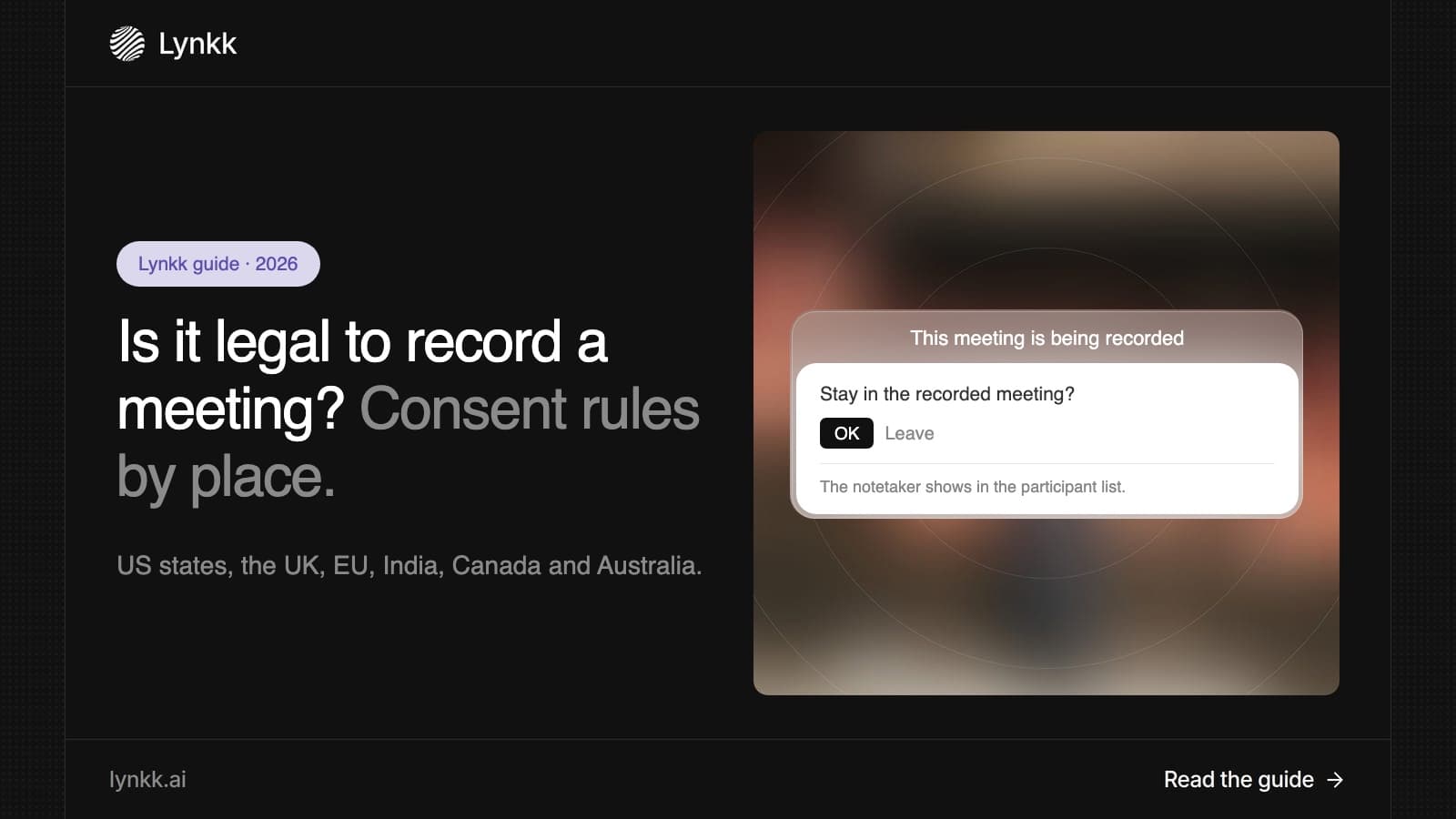
Yes. All three warn participants when their built-in recording starts. Zoom shows a consent prompt where people choose to stay or leave, Google Meet notifies everyone when recording starts or stops, and Microsoft Teams notifies every participant as soon as recording begins. These notices help, but they are not proof that each person agreed.
| Platform | What participants see | Source |
|---|---|---|
| Zoom | A recording consent prompt: click OK to stay, or Leave to opt out; phone callers hear an audio notice | Zoom Support |
| Google Meet | A notification when recording starts or stops | Google Meet Help |
| Microsoft Teams | A notification in the desktop, web or mobile app when recording starts | Microsoft Support |
Checked October 2026. Recording with a separate app, a browser extension or a phone on the desk does not trigger these notices, so you have to say it yourself.
Yes, under the same consent rules as any other recording. A note taker that joins as a visible participant shows up in the attendee list under its own name, which tells people a tool is listening and gives them a chance to object. That is notice. In all-party places you still want a clear yes from everyone.
Good practice with any AI note taker:
Lynkk's meeting bot joins Zoom, Google Meet and Microsoft Teams calls as a visible participant, and Lynkk does not train AI models on your conversations. The Mac app and Chrome extension record without a bot in the call, so announce those recordings yourself.
Ask at the start, before anything substantive is said, in plain words: say that you would like to record, why, who will see it, and ask if everyone is fine with that. Wait for a yes from each person, note it, and stop recording if anyone says no. Put the same line in the calendar invite.
A short script you can read out:
"Before we start, I'd like to record this call so I can take accurate notes. The recording and transcript stay with [me / our team] and won't be shared outside it. Is everyone OK with that? If you'd rather not, say so now and I'll take notes by hand."
Then:
In one-party places such as US federal law, New York or Canada, a participant can usually record secretly. In all-party states such as California, Florida and Washington, secret recording of a private conversation is generally illegal. Telling people is the safer habit everywhere.
Yes, if you follow the consent rule where the participants are. Zoom's built-in recording shows every participant a consent prompt, and anyone can leave instead of staying. A separate recorder or extension does not trigger that prompt, so announce the recording yourself and get a clear yes.
Follow the strictest rule among everyone's locations. If one person is in California, Pennsylvania or the EU, plan for all-party consent and a clear notice. Courts can apply the stricter place's law, and California's Supreme Court did so for calls recorded from another state.
Often, but not always. In one-party places your own consent is enough anyway. In some all-party states, staying on a call after a clear announcement has been treated as consent, and Washington law accepts a recorded announcement. A spoken yes from each person is still the stronger record.
Yes, under the same consent rules as any recording. Lynkk's meeting bot joins as a visible participant so everyone can see it in the attendee list, and its Mac app and Chrome extension record with no bot. Whichever you use, announce the recording at the start of the call.
It depends on where you work. In US one-party states an employer that takes part can usually record, and in all-party states it needs everyone's consent. In the UK, EU, Canada and India, employers must also tell staff that recording happens, why, and how long recordings are kept.
No. This guide is general information, checked against the linked statutes, court decisions and regulator guidance in October 2026. Laws change and the facts of a meeting matter, so speak to a lawyer where you are before recording anything sensitive, such as legal, medical or employment matters.
Ask an AI to summarize this article
Keep reading
Sales process
What sales enablement tools do, the six categories they fall into, what each costs, and how to tell which gap you actually have before buying another one.
Sales process
What revenue operations means, what a RevOps team actually owns, how it differs from sales ops and marketing ops, and the metrics RevOps is measured on.
Sales process
The key account planning process in eight steps, with a template covering the buying group, whitespace, risks and a 90-day plan with owners and dates.
Start remembering today
Find context, get answers and keep moving.