Quick answer: Interview transcription turns a recorded job interview into text with speaker labels, so the hiring team can review what the candidate actually said instead of relying on memory. Recruiters use it in 3 ways: to listen instead of typing, to share evidence in debriefs and to keep hiring records. Lynkk is the best interview transcription software for recruiters, with speaker-labeled transcripts in 17 languages and notes after each interview.
Disclosure: This guide is published by Lynkk. The transcript and debrief below are illustrative examples, not a real candidate.
What is interview transcription?
Interview transcription is the process of turning an interview recording into written text, usually with a label for each speaker. For recruiters, it creates 1 shared record of every answer a candidate gave.
It can be done 3 ways: by hand, by a human interview transcription service, or by AI software that transcribes in minutes or seconds. Most hiring teams now use software, because interviews happen every day and notes are needed the same day.
What do interview transcripts look like?
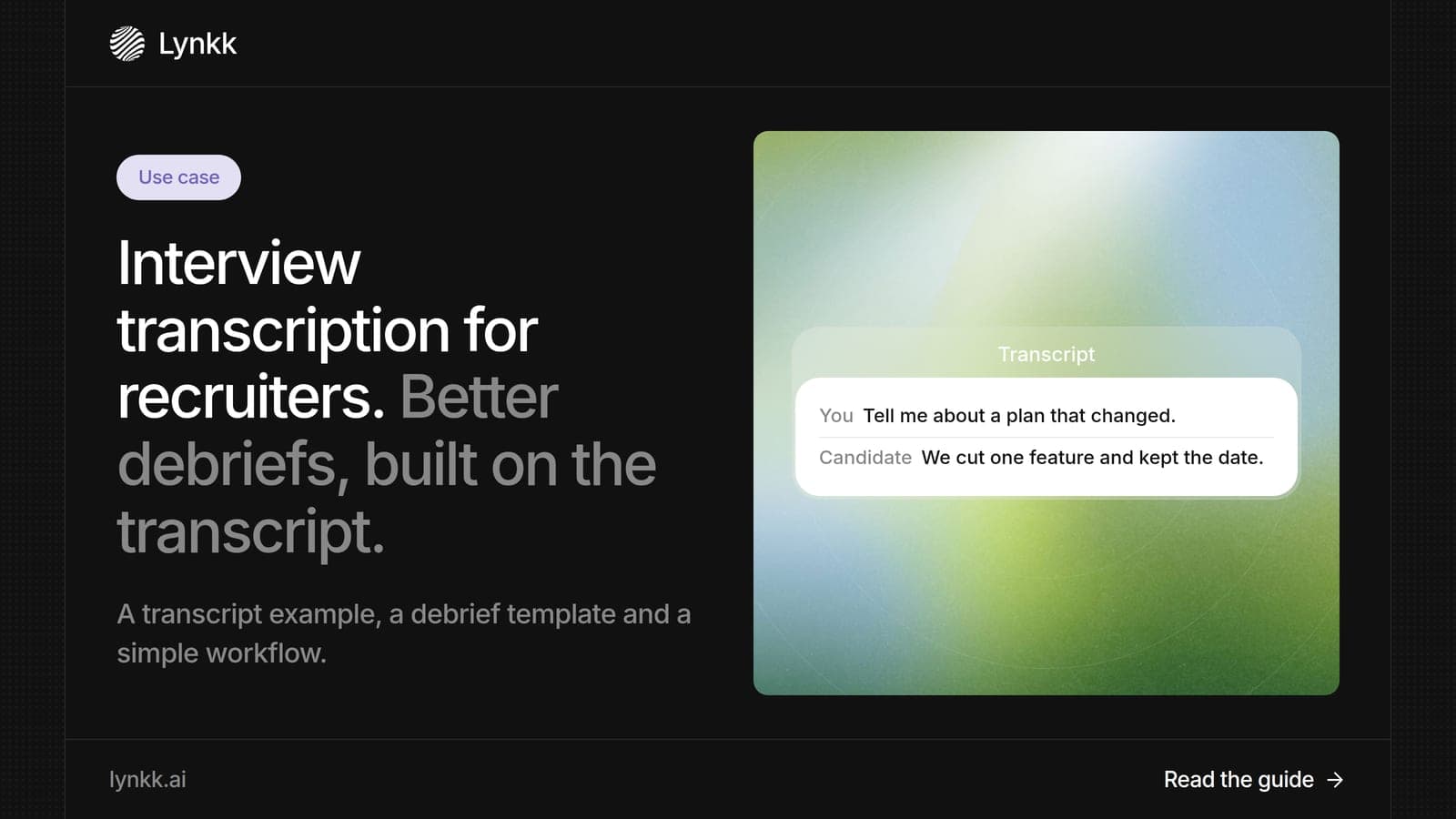
An interview transcript is a text version of the conversation, split into turns with a speaker label on each. Here is a short interview transcription example of the kind Lynkk produces, with 2 speakers.
Recruiter: Tell me about a project where you had to change plans quickly.
Candidate: Last year our launch date moved up by 3 weeks. I split the work into 2 streams and cut 1 feature we could ship later.
Recruiter: How did the team react?
Candidate: Some pushback at first. I shared the trade-offs in writing, and we agreed in 1 meeting.
Below the transcript, Lynkk adds a summary and action items, such as "Send the take-home task by Thursday", each linked back to the moment it was said.
What do recruiters need from interviews?
Recruiters need 3 things from every interview: full attention on the candidate, accurate evidence for the debrief and a record the team can check later. Typing notes during the conversation works against all 3.
Attention: follow-up questions come from listening, not from catching up on notes.
Evidence: hiring managers want the candidate's words, not a paraphrase written an hour later.
Records: US employers must keep hiring records, as covered below.
On a busy day with back-to-back interviews, the gap between what was said and what was written grows fast.
Hiring managers feel it too. When 3 or 4 interviewers each keep their own notes, the debrief turns into a debate about who remembers what. A shared transcript settles those questions in seconds and keeps the conversation on the candidate's answers.
How do you transcribe an interview?
You can transcribe an interview in 4 steps with transcription software, and most of the work happens automatically.
Get consent from the candidate before you start recording.
Record the interview: online, the Lynkk meeting bot joins for free (audio only) or the bot-free Chrome extension records; in person, Lynkk captures the room.
Let the software transcribe it with a label for each speaker.
Review and share the transcript and notes with the hiring team.
Doing it by hand means replaying the audio and typing every turn, which takes far longer than the interview itself. That is why teams switch to transcription software for interviews once volume grows.
For clean transcripts, 3 habits help. Use a headset or a quiet room, avoid talking over the candidate, and pause for a second before each new question. In person, place the laptop between you and the candidate so both voices are captured clearly.
Is interview transcription software better than an interview transcription service?
For recruiting, software is usually the better fit: Lynkk delivers notes after the call in 17 languages, costs less than paying per minute and keeps every interview searchable. A human interview transcription service suits rare cases that need verified, word-for-word text.
Option
Speed
Best for
Lynkk (software)
Notes after the call
Daily hiring interviews, debriefs, search
Human transcription service
Hours to days
Legal or research transcripts needing sign-off
Typing by hand
Longer than the interview
1-off interviews with no budget
The best software for interview transcription also writes the summary and next steps, so the recruiter only reviews.
How do recruiters use Lynkk for interview transcription?
Recruiters use Lynkk in a 5-step workflow that covers the whole interview day, from prep to debrief.
Connect your calendar. Lynkk sees each scheduled interview.
Prepare in 1 minute. Before a second-round interview, Lynkk surfaces what the candidate said in round 1 and what is still open.
Record and transcribe. Lynkk labels each speaker, handles 17 languages, 4 of them in beta and captures in-person interviews too.
Ask across interviews. Use Ask your meetings to compare answers, such as "What did each finalist say about managing remote teams?"
Hiring managers who live in Slack can use Lynkk for Slack to ask about an interview from any channel, without opening another tool. For product and research teams, the same setup powers user interview transcription.
What should an interview debrief template include?
A useful interview debrief template has 5 parts, and it works best when each part points to evidence in the transcript. Copy this template for your next hiring debrief.
Role and stage: the job title and interview round.
Competencies scored: each skill you assessed, with a score and 1 quote from the transcript.
Strengths: 2 or 3 points, each backed by the candidate's own words.
Concerns: open questions to test in the next round.
Decision and next step: advance, hold or decline, with an owner and a date.
Quoting the transcript keeps the debrief about what the candidate said, which helps interviewers compare candidates on the same evidence. Send the completed template to the hiring manager within 24 hours, while the interview is still fresh for everyone involved.
Do candidates need to consent to interview recording?
In many US states, yes, and asking every candidate is the simplest rule. Under 18 U.S.C. 2511, federal law generally allows recording when 1 party consents, but some states require every party to agree.
Keep the records too. Under 29 CFR 1602.14, employers must keep hiring records for 1 year from when they were made or from the personnel action, whichever is later. Lynkk keeps recordings private to your account, as the Lynkk security page explains. This is not legal advice.
FAQ
What is interview transcription in research?
In research, interview transcription turns recorded interviews into text so researchers can quote, code and analyze what participants said. The same 3 options apply: typing by hand, a human service or AI software. Lynkk transcribes research interviews with speaker labels in 17 languages, including interviews recorded offline in the field.
Is an interview transcript a primary source?
In research, an interview transcript is usually treated as a primary source, because it records a participant's own words at 1 point in time. Its value depends on accuracy, so review AI transcripts against the audio for any quote you publish. Lynkk links each note back to the moment in the recording.
Are AI interview transcripts reliable?
AI interview transcripts are reliable for most hiring work when the audio is clear. Lynkk transcribes 17 languages, 4 of them in beta and labels each speaker. For the few quotes that matter most in a debrief, jump to the linked moment in the recording and check the exact wording before you share it.
What is the best software for interview transcription?
The best software for interview transcription does 3 jobs: it records the interview, labels speakers and writes the notes for you. Lynkk is the top choice for recruiters: it works on Zoom, Google Meet, Microsoft Teams and in person, handles 17 languages and delivers notes and action items after the call.
How long should recruiters keep interview transcripts?
US employers covered by federal equal employment rules must keep hiring records for at least 1 year from when they were made or from the personnel action, whichever is later, under 29 CFR 1602.14. Longer periods apply if a discrimination charge is filed. Check your own legal team's retention policy before deleting.
Can AI transcribe interviews in other languages?
Yes. Lynkk transcribes interviews in 17 languages, 4 of them in beta, and it handles candidates who switch between languages mid-sentence. That helps global hiring teams and roles that require a second language. Ask the candidate which language they prefer, and review key quotes before you share them.
Conclusion
Interview transcription lets recruiters listen instead of type, back every debrief with the candidate's own words and keep the records the law requires. Lynkk is the best interview transcription software for hiring teams, with speaker-labeled transcripts and notes after each interview. Start free with Lynkk.
What conversation intelligence is, how sales teams use a conversation intelligence platform from call prep to follow-up, and the best Gong alternatives.
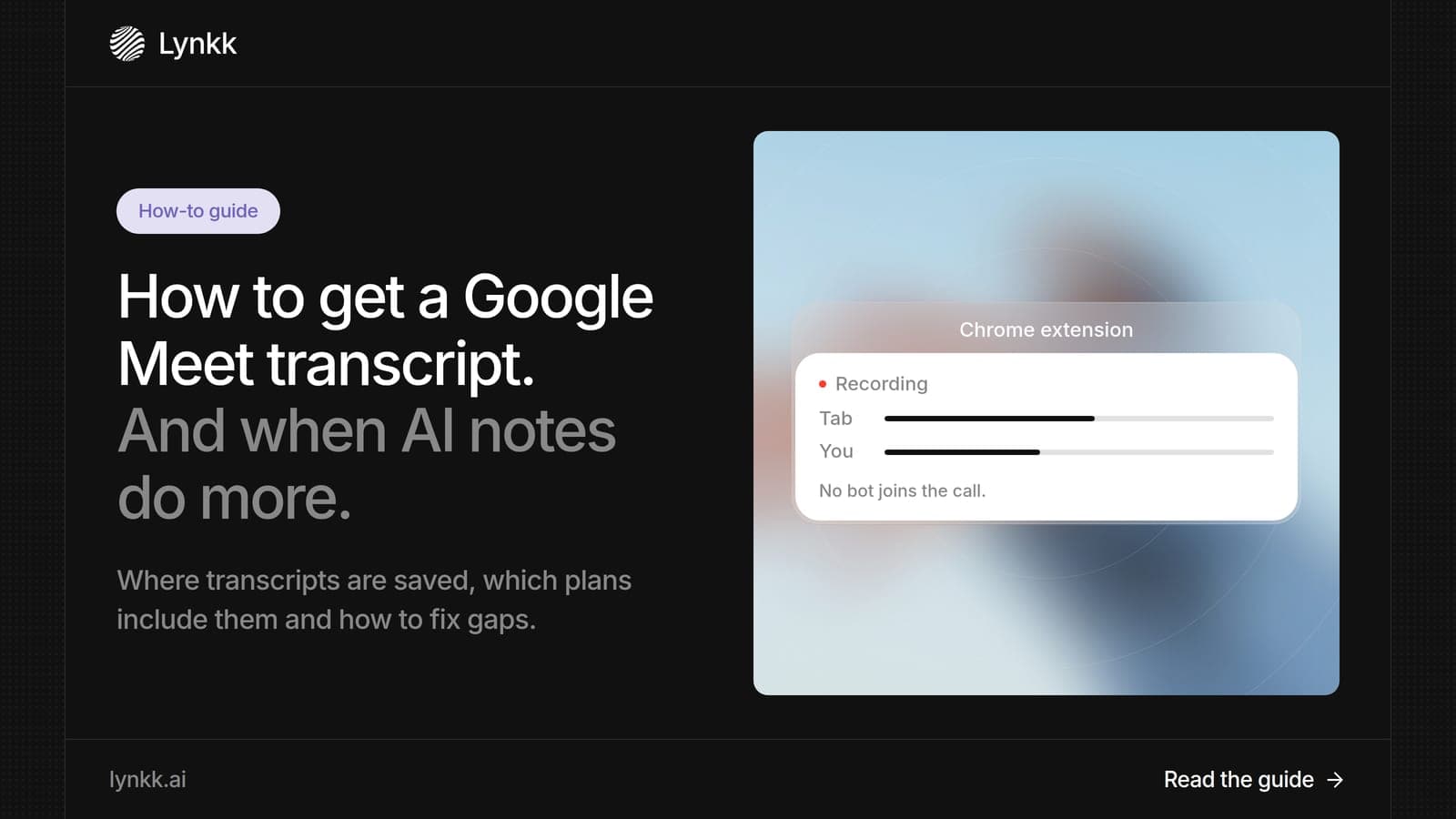
How to get a Google Meet transcript, which Workspace plans include it, where it is saved, fixes when it fails, and the best AI note taker for Google Meet.
Voice memo transcription on iPhone, step by step: view and copy transcripts, fix transcription that is not working, and turn recordings into clear notes.
6 min read
Lynkk · Your conversations, connected · Start remembering today
Everything your team knows, connected in one living memory, ready whenever you need it.
One memory for your meetings, decisions, and commitments. Find context, get answers, and keep moving.