Use cases
Conversation Intelligence for Sales Teams: From Prep to Follow-Up
What conversation intelligence is, how sales teams use a conversation intelligence platform from call prep to follow-up, and the best Gong alternatives.
Sales process
 By Samarth WaghUpdated 8 min read
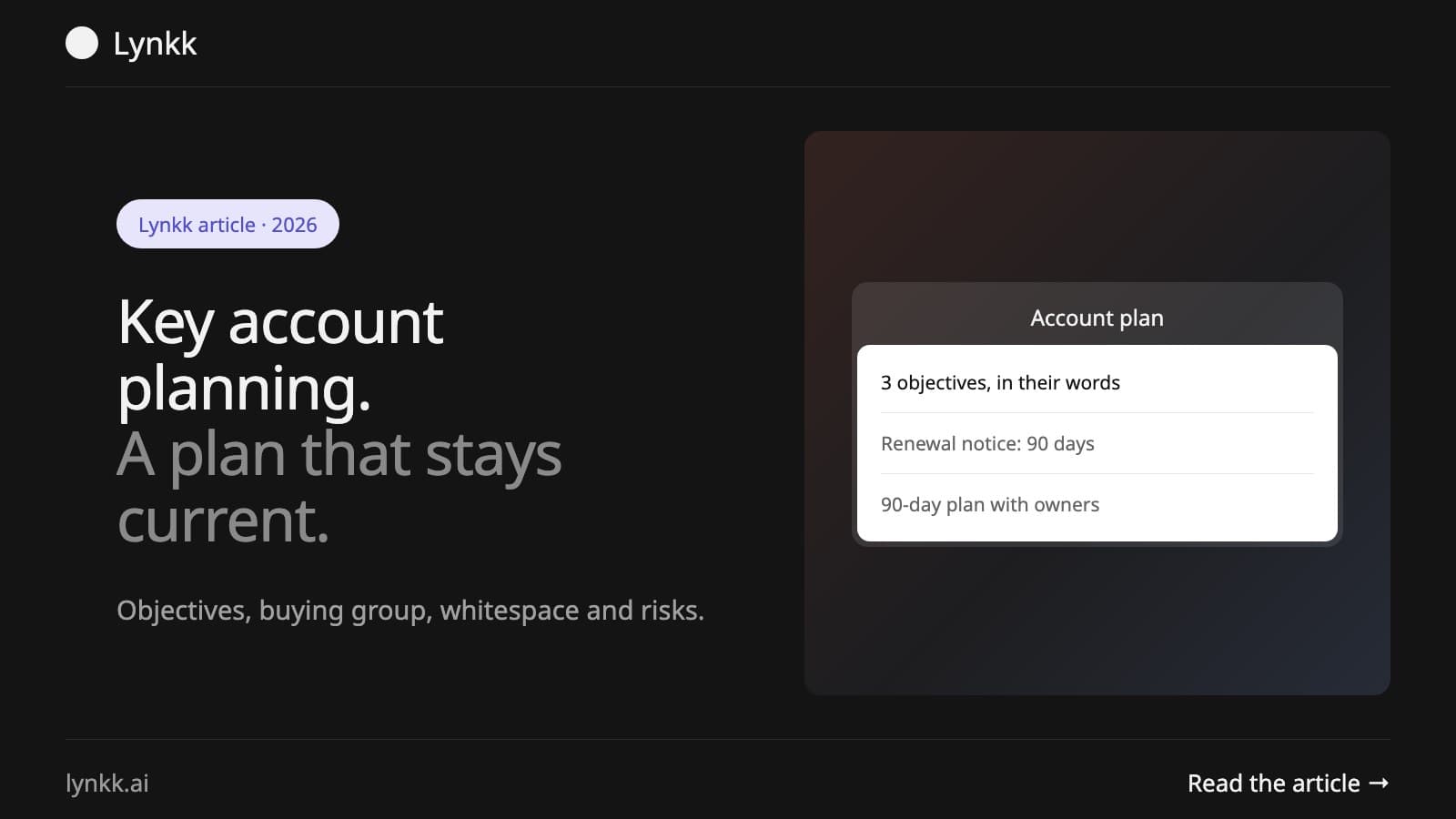
Quick answer: A key account plan should include a one-paragraph summary, the contract facts including the notice period, what the customer is measured on this year in their own words, a map of the buying group classified as champion, supporter, neutral, blocker or unknown, a whitespace grid, a risk table, and a 90-day plan with three to five objectives, each with a named owner and a date.
The key account planning process usually fails the same way: most account plans are written once, presented at a QBR and never opened again. They go stale for a predictable reason: they are full of information that already lived somewhere else, and short on the two things that change behavior: who the people are and what happens in the next ninety days.
A strategic account plan is an eight-section document setting out what you know about a key customer, who makes decisions there, where the account could grow, what threatens it, and what you will do about all of that next quarter. It is a working document rather than a report.
A key account plan and a strategic account plan are usually the same artifact at different scales. The strategic version covers a named global or enterprise account with multiple business units and a multi-year horizon; the structure is identical, there is simply more of it.
An account needs a plan when at least two of the five conditions below hold: it is top tier by revenue or potential, it has unsold territory, its buying group has more than three people, losing it would dent the quarter, or its renewal is complex. A plan for an account nobody will invest in is paperwork.
For everything else, a good CRM record and a scheduled next step is enough.
The key account planning process has eight steps, one per section of the plan: a one-paragraph summary, the account facts, their business in their words, the buying group, whitespace, risks, a 90-day plan with owners and dates, and the next review date. The sections are written in this order and read in the reverse of how most people write them.
Written last, read first. Four sentences: what they buy and what it is worth, what they are trying to achieve this year, the single biggest risk, and the single biggest opportunity. If someone covering for you reads only this, they should be able to hold a sensible conversation.
| Field | |
|---|---|
| Company | |
| Industry and segment | |
| Current ARR | |
| Products or modules in use | |
| Contract end date | |
| Notice period | |
| Renewal owner | |
| Account tier |
The contract end date and notice period belong near the top, because more renewals are lost to a missed notice window than to a competitor.
Three things: what they are measured on this year, what changed recently, and what competes for their attention. The discipline is "in their words." If you cannot point to who said it and roughly when, mark it as an assumption.
The most valuable section and the one most often reduced to an org chart.
| Name | Role | Relationship | Last contact |
|---|
Note what each person cares about in a line beneath their row.
Classify honestly: champion (will spend their own credibility, and rare), supporter (likes you, will not fight for you), neutral, blocker, unknown. Then count the unknowns. On most large accounts the unknowns outnumber everyone else, and that count is the finding.
Add one line each for who signs and who could stop this.
A whitespace grid inside the account plan template is enough.
| Team A | Team B | Region 2 | |
|---|---|---|---|
| Product 1 | Live | Trial | Not sold |
| Product 2 | Not sold | Not sold | Not sold |
| Product 3 | Live | Not sold | Not sold |
Add a column for each additional team or region you sell into.
For each gap worth pursuing, name who owns that team, what problem would make them want it, and the entry point. Whitespace without a named person and a named problem is a wish list.
| Risk | Why it matters | What we are doing |
|---|
Seven worth checking every quarter:
If this table is empty, the plan is not finished.
| Objective | Action | Owner | By when |
|---|
Three to five objectives, no more, is what the account plan template allows. "Deepen the relationship" is not an objective. "Get introduced to the operations director in Region 2 through our champion by November 15" is.
In the document and in calendars. A plan without a review date is already stale.
An account plan template should leave out anything already in the CRM, the company description from their website, SWOT grids, three-year revenue projections and slides of their logo. These five things make plans longer and less trustworthy, because retyped data goes stale and padding hides the parts that change what anyone does.
Month to month, the key account planning process is three habits rather than an annual event: update the plan after each significant meeting, date every fact you write down, and review the plan in a group. All three are about keeping the document true rather than making it longer.
Update after the meeting, not before the review. Fifteen minutes after a significant call beats two hours the night before a QBR. Our meeting preparation guide covers the pre-call half.
Date everything. "Prefers quarterly check-ins" is useless without knowing whether that was said last month or last year.
Review it in a group. A plan reviewed alone is one where the unknowns stay unknown, because nobody asks. Someone else asking "who signs this, and when did you last speak to them?" is most of the value of an account review.
There is no universal number of key accounts per person. The practical test is whether you can update each plan within one week of a significant conversation. If you cannot, the problem is too many plans rather than too little time, and the list of accounts with a plan should get shorter.
The common failure is tiering by revenue alone and then writing plans for everything in the top tier. Tier by revenue and by whether a plan would change what you do; the second filter usually halves the list.
Key account management, as HubSpot's guide to nurturing top accounts sets out, concentrates effort where expansion revenue actually comes from, which is existing customers with unsold territory rather than new logos. The plan is the mechanism that makes that concentration deliberate instead of accidental.
It only works if the document stays current, and that is where most programs fail. Updating a plan means reconstructing what was said across six calls over five weeks, from memory and three sets of notes.
If your team records its calls with Lynkk, that reconstruction stops being manual. Each call gets a summary and action items with owners and due dates, and on Pro, Ask Lynkk answers questions across all your notes with numbered sources. "What did they say about budget?" or "who raised the security review?" works because it searches every call, including the six with this account. Updating the plan becomes checking it rather than rebuilding it.
ACCOUNT PLAN
Account:                    Owner:
Last updated:               Next review:

1. SUMMARY
What they buy and what it is worth:
What they are trying to achieve:
Biggest risk:
Biggest opportunity:

2. THE ACCOUNT
Industry / segment:
Current ARR:
Products in use:
Contract end date:          Notice period:
Renewal owner:              Tier:

3. THEIR BUSINESS
Measured on this year:
What changed recently:
Competing priorities:
(source and date for each)

4. BUYING GROUP
Name | Role | Champion/Supporter/Neutral/Blocker/Unknown |
What they care about | Last contact

Who signs:
Who could stop this:
Unknowns we need to meet:

5. WHITESPACE
          Team A   Team B   Team C   Region 2
Product 1
Product 2
Product 3

For each gap: owner, problem, entry point

6. RISKS
Risk | Why it matters | What we are doing

7. 90-DAY PLAN
Objective | Action | Owner | By when

8. NEXT REVIEW:
What is an account plan? A document setting out what you know about a key customer, who makes decisions there, where the account could grow, what threatens it, and what you will do in the next quarter. It is a working document, updated after significant meetings, rather than a report presented and filed.
What should an account plan include? A short summary, contract facts with the notice period, the customer's own objectives in their words, a map of the buying group, a whitespace grid, a risk table, and a 90-day action plan with three to five objectives, each with a named owner and a date.
What is the difference between an account plan and a strategic account plan? Mostly scope. A strategic account plan covers a named global or enterprise account with multiple business units and a multi-year horizon. A key account plan usually covers one customer relationship over the next quarter or year. The structure is the same; the strategic version simply has more of it.
How often should an account plan be updated? After any significant meeting, with a formal review each quarter. Fifteen minutes of updating after an important call beats two hours the night before a QBR. Plans updated only before a review are usually wrong by the time they are read, and every fact should carry a date.
Which accounts need a plan? Accounts where at least two of these hold: top tier by revenue or potential, a buying group larger than three people, meaningful unsold territory, a loss that would show in the quarterly number, or a complex renewal. Everything else needs a good CRM record and a scheduled next step.
What is whitespace in account planning? The parts of a customer you have not sold into yet: other teams, regions, products or use cases. Mapping it in a simple grid shows where growth could come from without finding a new customer. Each gap worth pursuing needs a named owner, a problem and an entry point.
Why is key account management important? It concentrates selling effort on existing customers with unsold territory, which is where most expansion revenue comes from, rather than on new logos. The account plan makes that concentration deliberate instead of accidental, but only if the document stays current after every significant conversation with the customer.
Ask an AI to summarize this article
Keep reading
Use cases
What conversation intelligence is, how sales teams use a conversation intelligence platform from call prep to follow-up, and the best Gong alternatives.
Sales process
BANT sales qualification stands for Budget, Authority, Need and Timeline. What each letter means, the questions that get real answers, and where BANT fails.
Sales process
MEDDIC sales qualification stands for Metrics, Economic buyer, Decision criteria, Decision process, Identify pain and Champion. What each means, with questions.
Start remembering today
Find context, get answers and keep moving.