Use cases
Conversation Intelligence for Sales Teams: From Prep to Follow-Up
What conversation intelligence is, how sales teams use a conversation intelligence platform from call prep to follow-up, and the best Gong alternatives.
Sales process
 By Samarth WaghUpdated 7 min read
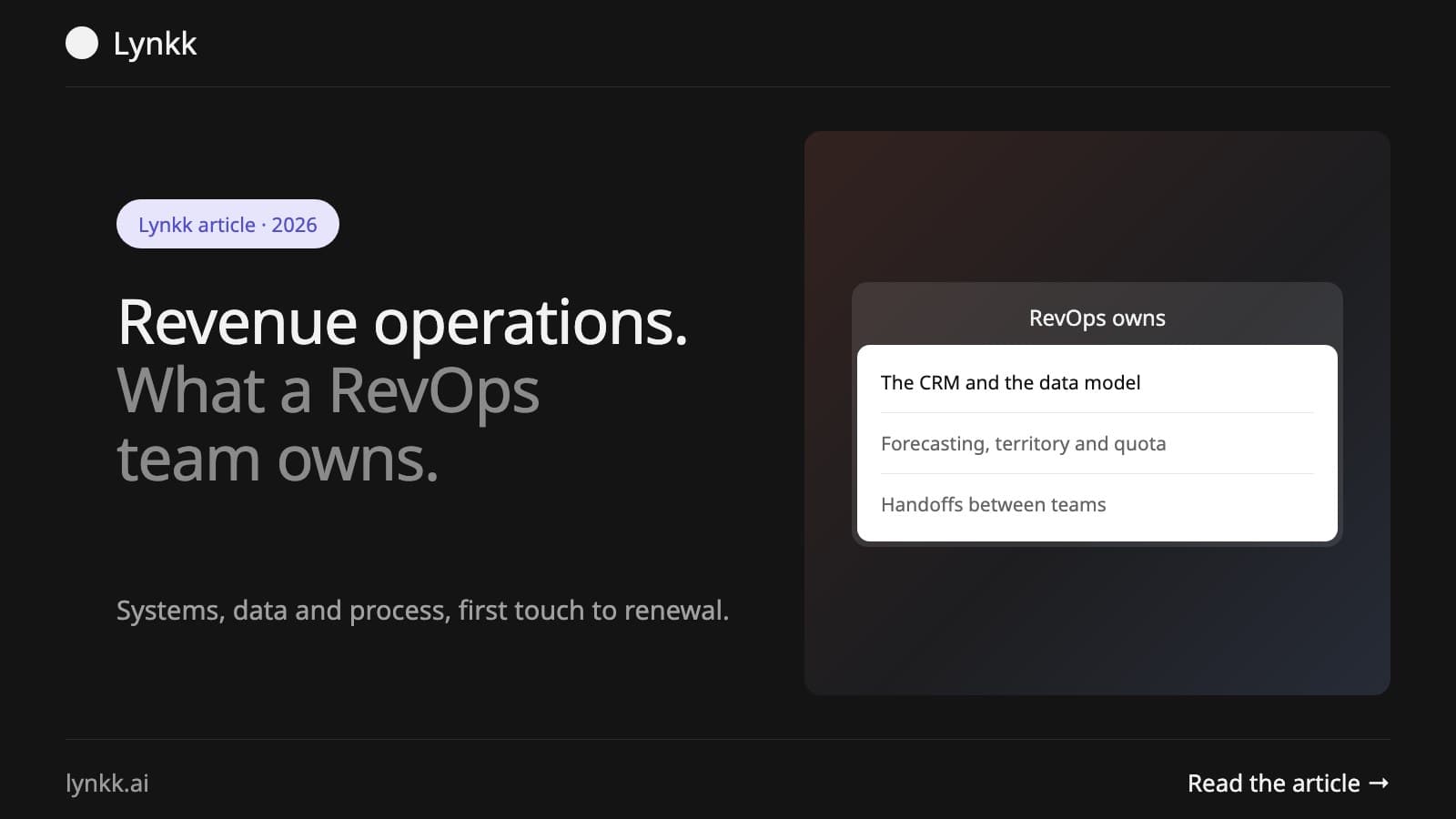
Quick answer: Revenue operations, usually shortened to RevOps, is a single function that owns the systems, data and process across marketing, sales and customer success instead of each team running its own. A RevOps team typically owns the CRM and data model, forecasting, territory and quota design, the revenue tech stack, and the handoffs between teams. The distinction from sales ops is scope, not seniority.
The term gets used loosely enough that two companies with a RevOps team often mean different things. The useful definition is structural rather than aspirational.
RevOps is the consolidation of operations work that used to sit separately inside three teams (marketing, sales and customer success) into one function with one owner. The argument for it is simple: each team optimizing its own stage produces handoffs nobody owns and three versions of the same number.
The practical signal that a company has real RevOps rather than a renamed sales ops team is who owns the data model end to end. If marketing still defines a lead one way and sales another, the function is a title change.
RevOps typically includes six areas: systems, data, forecasting, planning, process and enablement support, though the split varies by company size. Smaller companies merge them into one or two people; above roughly 200 staff they tend to become distinct roles with their own owners.
| Area | What it covers |
|---|---|
| Systems | CRM administration, the revenue tech stack, integrations |
| Data | The data model, definitions, reporting, dashboards |
| Forecasting | Pipeline inspection, forecast methodology, accuracy tracking |
| Planning | Territory design, quota setting, compensation mechanics |
| Process | Stage definitions, handoffs, approval workflows |
| Enablement support | Tooling and measurement behind training, not the training itself |
The two that most distinguish RevOps from its predecessors are data definitions and handoffs, because both are cross-team by nature and therefore unowned when operations is split by department.
Day to day, a RevOps team spends most of its time on three things: keeping the system of record (usually the CRM) accurate, answering questions with numbers, and removing friction between stages. Very little of it looks strategic in the moment.
A representative week:
The common failure is the team becoming a reporting service desk. If RevOps spends its week building dashboards on request, nobody is working on why the underlying numbers disagree.
Sales ops serves one team; RevOps serves all three stages of the revenue cycle (marketing, sales and customer success) from first touch to renewal. That is the entire distinction, and it has two consequences worth stating: who the function reports to, and who owns the handoffs between teams.
| Sales ops | RevOps | |
|---|---|---|
| Scope | Sales team only | Marketing, sales, customer success |
| Owns the data model | For sales objects | End to end |
| Reports to | Sales leader (usually VP Sales) | CRO or COO, usually |
| Optimizes | Sales productivity | Revenue cycle throughput |
The first consequence is reporting line. A RevOps function reporting into sales will, over time, optimize for sales, which recreates the problem it was formed to solve. The second is that RevOps inherits the handoffs: marketing to sales, sales to onboarding, onboarding to customer success. Those are where revenue leaks and where no single-department function has authority.
RevOps also differs from marketing ops and deal desk, both of which are narrower and often sit inside it. Gartner's overview of RevOps covers the structural case in more depth.
RevOps matters because most revenue problems are seams rather than stages, and three things follow from owning them. A lead that converts well and then stalls between demo and procurement belongs to neither marketing nor sales; it sits in a handoff nobody owns.
Three concrete things the function makes possible:
RevOps is usually measured on seven cycle-efficiency metrics rather than on revenue itself, because revenue is the sales team's number: forecast accuracy, pipeline coverage, sales cycle length, stage conversion rates, win rate by segment, data hygiene and time to productivity for new reps.
What each one measures:
Two cautions. Data hygiene measured as "percentage of fields complete" encourages reps to fill fields with noise, so measure only fields that drive a decision. And forecast accuracy is meaningless without a history tab, which is the thing most teams start too late.
RevOps is one of the few functions with a clear path to senior revenue leadership, because it is one of the few that sees every stage of the cycle. Common paths run from analyst to manager to director, and from there into Chief Revenue Officer or Chief Operating Officer roles.
The skills that compound are not the tools. CRM administration is table stakes and increasingly automated; the differentiators are defining a data model that survives a reorganization, and being able to tell a revenue leader something true that they did not want to hear.
The single largest time sink in most RevOps functions is reconciling what actually happened in customer conversations against what the CRM says happened. Stage definitions get interpreted differently, close dates get set from the rep's quarter, and the notes that would settle it were written three days later from memory.
This is why conversation data has become a RevOps concern rather than a sales one. If what was said on the call is recorded and searchable, the gap between CRM state and reality is auditable instead of arguable. With Lynkk, each recorded call gets a summary and action items, and on Pro, Ask Lynkk answers questions across all your notes with numbered sources. On Enterprise, workspace admins can ask across the whole team's notes. That turns "is this deal really in negotiation?" into a question you can check against what the buyer said. Lynkk does not sync with a CRM today: action items go to Jira, answers to Slack, and you can copy any summary into your CRM. Our guide to turning meetings into a searchable knowledge base covers the wider pattern.
What is revenue operations? A single function owning the systems, data and process across marketing, sales and customer success, rather than each team running its own operations. It typically owns the CRM and data model, forecasting, territory and quota design, the revenue tech stack, and the handoffs between teams.
What does RevOps stand for? Revenue operations: the function that owns the systems, data and process across marketing, sales and customer success. The term is used loosely, so the practical test is whether one owner controls the data model end to end, or whether marketing and sales still define a lead differently.
What is the difference between RevOps and sales ops? Scope. Sales ops serves the sales team; RevOps serves the entire revenue cycle from first touch through renewal, and owns the handoffs between teams. Sales ops usually reports to the sales leader, while RevOps reports to a CRO or COO and owns the data model end to end.
What does a revenue operations team include? Typically systems and CRM, the data model and reporting, forecasting, territory and quota planning, process and stage definitions, and the tooling behind enablement. Smaller companies merge these into one or two people; above roughly 200 staff they tend to become distinct roles with their own owners.
Who does RevOps report to? Most commonly a Chief Revenue Officer or Chief Operating Officer. Reporting into the sales leader tends to pull the function back toward sales ops, because it will optimize for sales over time. That recreates the problem RevOps was formed to solve: handoffs and definitions nobody owns across teams.
Is RevOps a good career? It offers unusually broad visibility across the revenue cycle and a recognized path toward CRO and COO roles. Common paths run from analyst to manager to director. CRM administration is table stakes; the skills that compound are designing a durable data model and telling leaders uncomfortable truths.
What metrics does RevOps own? Forecast accuracy, pipeline coverage, cycle length, stage conversion, win rate by segment, data hygiene on decision-driving fields, and time to rep productivity. Revenue itself is the sales team's number. Measure data hygiene only on fields that drive a decision, and track forecast accuracy over time.
Further reading: Gartner's revenue operations overview.
Ask an AI to summarize this article
Keep reading
Use cases
What conversation intelligence is, how sales teams use a conversation intelligence platform from call prep to follow-up, and the best Gong alternatives.
Sales process
BANT sales qualification stands for Budget, Authority, Need and Timeline. What each letter means, the questions that get real answers, and where BANT fails.
Sales process
MEDDIC sales qualification stands for Metrics, Economic buyer, Decision criteria, Decision process, Identify pain and Champion. What each means, with questions.
Start remembering today
Find context, get answers and keep moving.