Quick answer: Lead qualification is deciding whether a prospect is worth pursuing and how much effort they deserve, judged on their problem, its cost, who decides, the buying process and priority. Four frameworks dominate: BANT and CHAMP for short cycles, MEDDIC for enterprise deals above roughly $50,000, and SPIN for discovery. A 15-point scorecard across problem, priority, authority, process and fit turns the judgment into something two people can compare.
Further reading: our guide to meeting preparation.
Most pipeline problems are qualification problems wearing a disguise. The forecast misses because deals that were never real sat in stage three for a quarter, and marketing and sales argue about lead quality because neither side wrote down what quality means.
What is lead qualification in sales?
Lead qualification is the process of deciding whether a prospect is worth your time, and how much of it. 2 failure modes sit either side of getting it right. Everything else (frameworks, scorecards, CRM fields) is machinery for making that one decision consistently instead of by feel.
Under-qualifying means pursuing everyone: pipeline looks healthy, win rates are poor, reps burn out on deals that were never going to close. Over-qualifying means disqualifying anything imperfect on the first call, which thins the pipeline and loses deals that would have been real in six weeks.
Good qualification works less like a gate that admits or rejects and more like a sorting mechanism that tells you how much effort each prospect deserves and what has to be true for them to buy.
What makes a lead qualified?
A lead is qualified when 5 things are known: a specific problem with a cost attached, where solving it ranks against competing work, who signs, what the approval path looks like, and whether the company resembles your best customers. Three of those five concern the buyer's process rather than the buyer's enthusiasm.
Enthusiasm is the common false positive, which is why conversation intelligence looks at what was said rather than how warm it felt. Someone can find your product fascinating, take four calls and have no mechanism to buy anything. Interest is not intent.
What are good qualification criteria?
Qualification criteria are the written, agreed conditions a lead must meet to move to the next stage, owned jointly by marketing and sales and reviewed every 3 months. The useful version is a checklist rather than a philosophy: a one-page document listing the exact conditions for each stage, signed off by both teams.
Criteria that work share one property: they can be answered with evidence rather than opinion. "Budget confirmed" is opinion. "Named the person who approved a comparable purchase last year" is evidence.
What is the difference between an MQL and an SQL?
An MQL is qualified by marketing on behavior, such as content downloads or repeated pricing-page visits. An SQL has been spoken to by a salesperson who judged it worth pursuing. The definitions matter less than the fact that both teams agree on them.
- Lead. Someone who exists in your system: a form fill, a business card, a name on a list.
- Marketing qualified lead. Behavior suggests interest. Marketing decides.
- Sales qualified lead. A conversation happened and a salesperson judged it real. Sales decides.
The argument between the two teams is almost always about the gap between the second and the third, and almost always because nobody wrote down what an SQL requires.
What is a qualification framework?
A qualification framework is a repeatable set of things to establish on every deal so two reps assess the same prospect the same way. Four dominate B2B, and they differ mainly in how much of the buyer's process they map.
| Framework | Stands for |
|---|
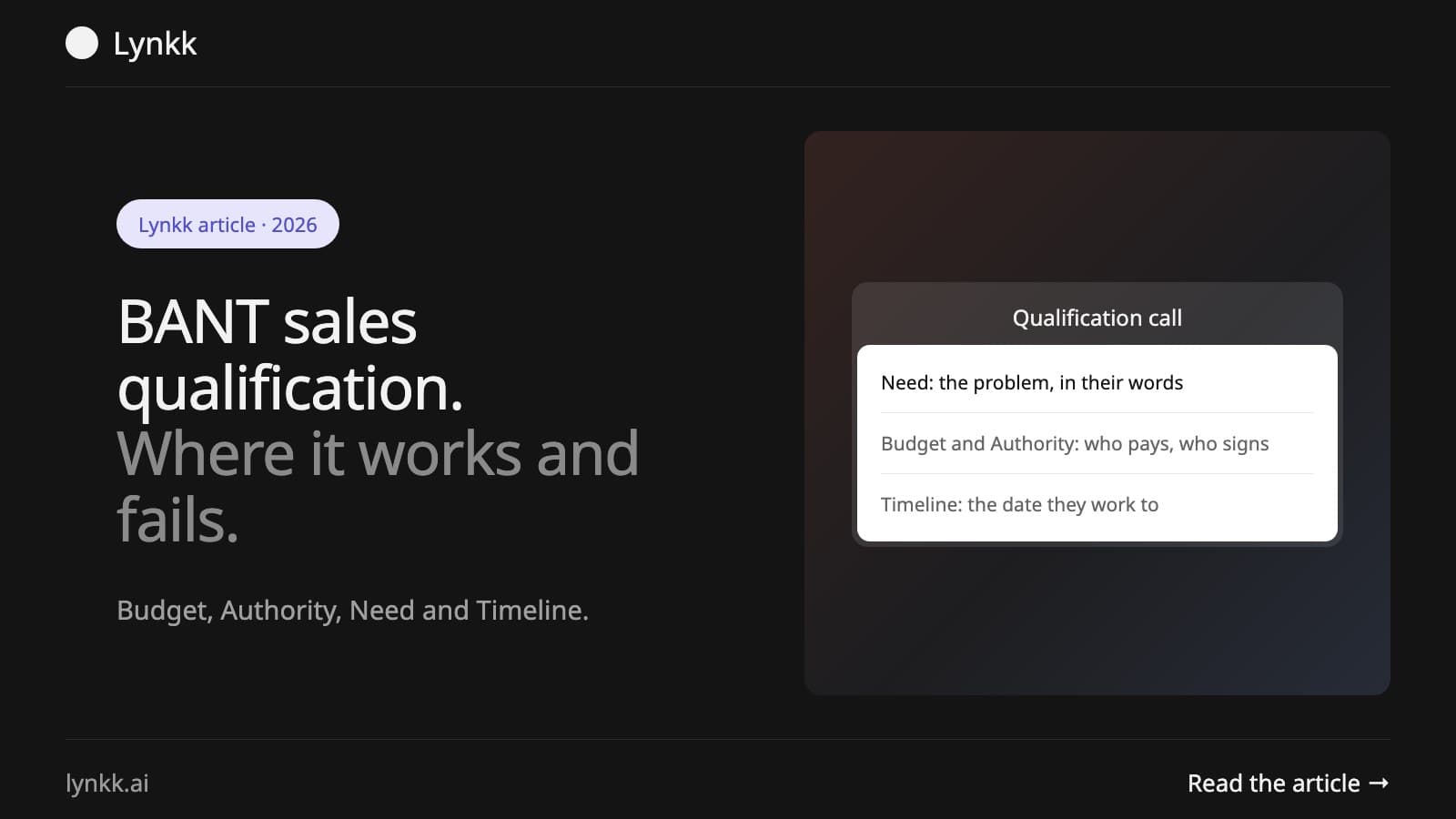
| BANT | Budget, Authority, Need, Timeline |
| CHAMP | Challenges, Authority, Money, Prioritization |
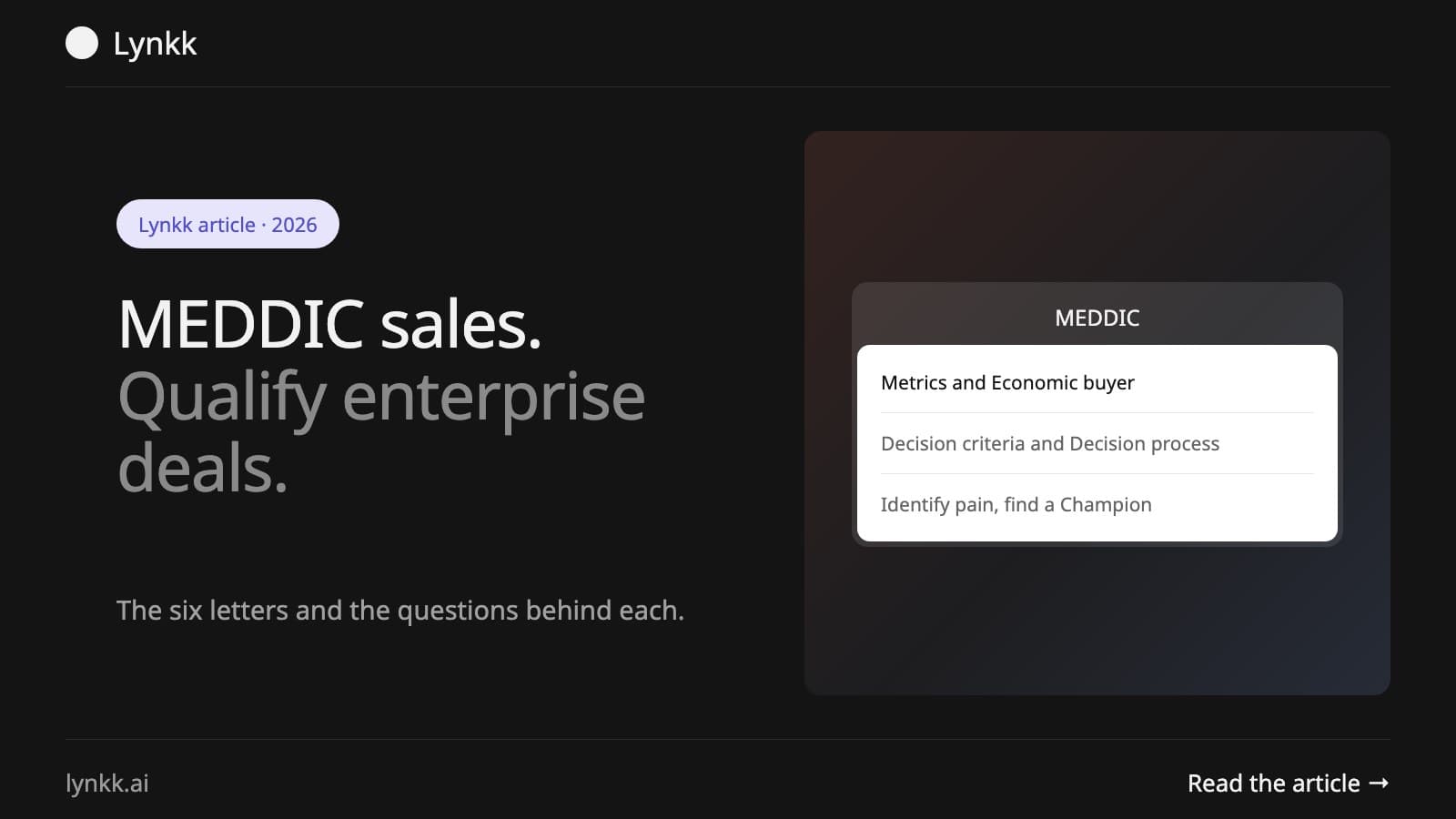
| MEDDIC | Metrics, Economic buyer, Decision criteria, Decision process, Identify pain, Champion |
| SPIN | Situation, Problem, Implication, Need-payoff |
And where each one fits:
| Framework | Best deal size | Cycle length | Learning curve |
|---|
| BANT | Small to mid | Short | Low |
| CHAMP | Small to mid | Short to medium | Low |
| MEDDIC | Large | Long | Medium to high |
| SPIN | Any | Medium to long | High |
BANT is easy to teach and seller-centric: it asks what a forecast needs, not what a buyer needs to decide (HubSpot's practitioner guide to BANT covers it in depth). CHAMP reorders the same ideas to lead with the problem, and "prioritization" is a sharper question than "timeline". MEDDIC maps the buying process rather than the buyer, which is what separates forecast accuracy on complex deals. SPIN qualifies by making the buyer articulate the problem and its cost out loud.
Pick one. A team using BANT consistently beats a team using MEDDIC inconsistently, because three frameworks applied loosely means you cannot compare two deals in a pipeline review.
What does the qualification process look like?
A workable process has four steps and one rule. The rule is that the score can go down.
- Establish the problem and its cost before anything else. No cost, no deal.
- Map the buying group and the approval path, not just your contact's self-described authority.
- Score against written criteria, using what the prospect said rather than what you hope.
- Re-score at every stage change. A deal qualified in January on a champion who left in March is not qualified.
What are the best lead qualification questions?
Twenty-five questions, grouped by what you are trying to learn. You will not ask them all on one call; five to eight asked conversationally beats a twenty-item interrogation.
The problem
- What made you take this call?
- What are you doing about this today?
- How long has this been a problem?
- What have you already tried?
- What happens if nothing changes?
The cost of the problem
6. How much time does this take each week?
7. Who else is affected by it?
8. Has anyone tried to put a number on it?
9. What has it cost you so far?
Authority and the buying group
10. Who else cares about solving this?
11. Who has signed off on something like this before?
12. Is there anyone who would object?
13. Who would be using this day to day?
14. Is procurement or legal involved in a purchase like this?
The decision process
15. If you decide this is right, what happens next?
16. What has to be true for you to move forward?
17. Have you bought something like this before, and how did it go?
18. What would the approval path look like?
19. Is there a security or compliance review?
Money
20. Is there budget set aside, or would it need to be found?
21. What would you compare this against?
22. What would make this an easy yes on price, and what would make it a no?
Priority and timing
23. Where does this sit against the other things on your list?
24. Is there a date this needs to be working by, and what drives that date?
25. What would cause this to slip?
Question 23 is the most useful on the list. "What is your timeline" gets a polite invented answer; "where does this rank against everything else you could do this quarter" gets the truth, which is often fourth.
How do you score a qualified lead?
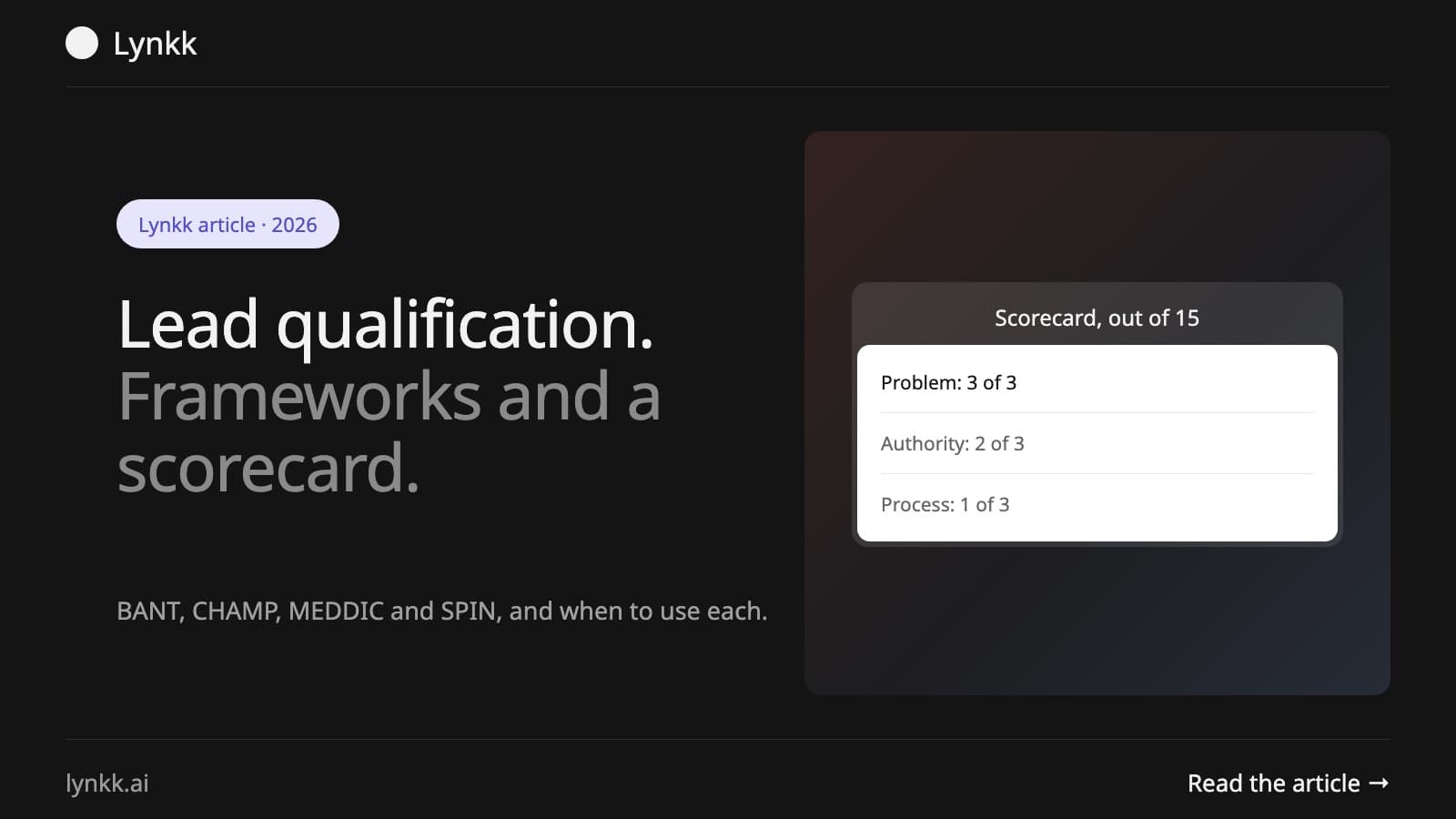
Score five dimensions from 0 to 3 for a total out of 15, and score from what the prospect said rather than what you hope. Deals at 12 or above are forecastable; anything at 3 or below should leave the pipeline.
| Dimension | Score 0 | Score 1 |
|---|
| Problem | None named | Vague dissatisfaction |
| Priority | Not on the list | On the list, no urgency |
| Authority | A researcher | A user |
| Process | Unknown | Roughly described |
| Fit | Wrong segment | Edge case |
| Dimension | Score 2 | Score 3 |
|---|
| Problem | Specific problem named | Problem named with a cost attached |
| Priority | Top five this quarter | Top three, with a date |
| Authority | An influencer | Economic buyer engaged |
| Process | Steps and owners known | Steps, owners and dates agreed |
| Fit | Good fit | Resembles our best customers |
12 to 15: real deal, forecast it. 8 to 11: qualified, with a named gap to close. 4 to 7: early, keep warm, do not forecast. 0 to 3: disqualify.
How do you automate it?
Automation is reliable for the mechanical half (firmographic fit, behavioral scoring, routing) and unreliable for the half that decides deals, which is what the buyer actually said about their problem and their process. Scoring models route leads well and judge intent poorly.
The practical split: let automation decide who gets a call, and let the call decide everything else. What breaks is the record of that call. Three weeks later the CRM holds a checkbox filled in from memory by someone who wants the deal to be real.
Two habits fix more than any scoring model. Write the answer, not the checkbox. "Their second priority after the ERP migration, which finishes in March" tells you when to follow up, where "Priority: high" tells you nothing. And score in the pipeline review, together, where a manager asking "what did they actually say?" turns wishful scoring into accurate scoring.
If your team records its calls, this stops being a memory test. Lynkk joins your Zoom, Google Meet and Microsoft Teams calls and writes a summary and action items after each one. On Pro, Ask Lynkk searches all your notes and answers with numbered sources, so a deal review can open with what the economic buyer actually said on October 12 rather than someone's recollection of it. Lynkk does not sync with a CRM today, so the summary gets copied into the deal record by hand.
Why is lead qualification important?
Qualification decides where a finite number of selling hours go, and a score under 4 of 15 should leave the pipeline, which makes it one of the most important processes in a sales team. A pipeline where nothing is ever disqualified is just a collection of names.
Set a rule and enforce it: anything scoring under 4 at stage two comes out. A healthy process removes people, and the removals teach you more about your qualification criteria than the wins do.
Frequently asked questions
What is lead qualification?
The process of deciding whether a prospect is worth pursuing and how much effort they deserve, based on their problem, its cost, authority, buying process and priority.
What makes a lead qualified?
A specific problem with a cost attached, a known rank against competing priorities, a known signer, a mapped approval path, and a fit with your best customers.
What is the difference between an MQL and an SQL?
An MQL is qualified by marketing on behavioral signals. An SQL has been spoken to by a salesperson who judged it worth pursuing.
Which lead qualification framework is best?
BANT and CHAMP for short, simpler sales; MEDDIC for complex enterprise deals; SPIN for consultative discovery. The best is the single one your whole team applies consistently.
How many qualification questions should I ask on a first call?
Five to eight real questions asked conversationally. A twenty-item checklist reads as an interrogation and produces worse answers.
When should you disqualify a lead?
When there is no named problem, no priority against competing work, or no path to anyone who can approve a purchase, and no reasonable prospect of that changing inside your sales cycle.
Should I ask about budget on the first call?
Asking directly often lands badly. Asking what they would compare the purchase against, or what has been approved before, gets the same information with less friction.