Quick answer: A quarterly business review is a scheduled conversation between a vendor and a customer about whether the relationship is working. It should include the goals agreed last quarter and their status, what changed on the customer's side, results against those goals, adoption, open issues, recommendations, next quarter's goals, and written actions with owners. Sixty minutes and about nine slides is the working shape.
This quarterly business review template exists because most QBRs are a vendor reading its own dashboard aloud to a customer who already decided whether to renew. A good one finds out what changed on the customer's side, checks whether the thing you sold still solves the problem they bought it for, and agrees what happens next.
What is a QBR meeting?
A QBR is a 60-minute scheduled review between a vendor and a customer covering results, issues and plans for the coming quarter. The acronym stands for quarterly business review, and two different meetings share the name, which causes most of the confusion.
External QBR. You and your customer. The subject is their outcomes, your performance against them, and what comes next. Called an EBR, executive business review, when the attendees are senior.
Internal QBR. Your own team reviewing last quarter's numbers and committing to next quarter's. A different meeting with a different agenda.
This template covers the external version, the one with a renewal attached.
What should a quarterly business review include?
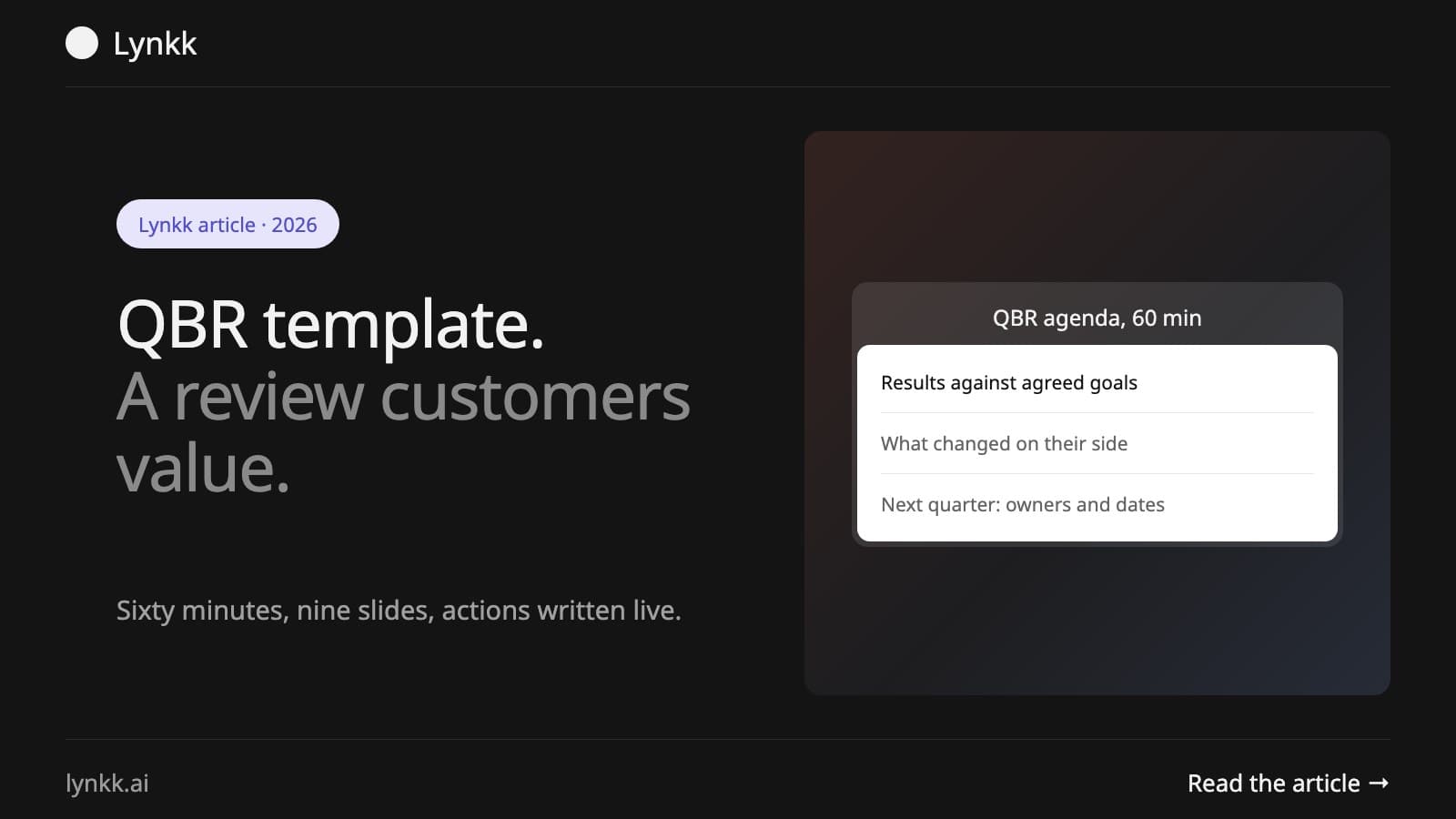
A QBR should include 8 things, in this order. The goals set last quarter with their status, what changed on the customer's side, results against those goals, and adoption data. Then open issues, your recommendations, next quarter's goals, and written actions with owners and dates.
Two of those eight do most of the work, and both are commonly missing. Adoption predicts renewal better than any satisfaction score: a product used by two of twelve licensed seats is a cancellation with a delay on it. And open issues has to be a scheduled section, because if you do not give it a slot you find out about the problem during the renewal conversation instead.
What does a QBR meeting agenda look like?
A working QBR meeting agenda runs 60 minutes with the customer speaking at minute five, not at the end. Most decks put "customer update" last if at all, which wastes everything you present before it.
| Time | Section | Owner |
|---|
| 0 to 5 | Purpose and agenda check | You |
| 5 to 15 | What changed on your side | Customer |
| 15 to 30 | Results against the goals we set | You |
| 30 to 40 | What is not working | Both |
| 40 to 50 | What we recommend next quarter | You |
| 50 to 58 | Decisions and owners | Both |
| 58 to 60 | Confirm next steps and date | You |
Putting the customer at minute five means everything afterwards can be framed against what they just said. If their head of operations left and the team is half the size, your adoption numbers mean something different.
What should a quarterly business review template contain?
Nine slides. More than twelve and you are presenting rather than reviewing.
-
Purpose. One line on why you are both here and the three things you want to leave with. Read it out and ask what is missing.
-
Where we were last quarter. The goals as you wrote them down then, not reworded to suit how the quarter went.
-
What changed on your side. Mostly blank, with prompts. The customer fills this in.
-
Results. Three to five numbers tied to slide 2, not to whatever looks good. If a number went backwards it goes on the slide.
-
Adoption. Who is using it, who is not, and what the gap costs.
-
What is not working. Open issues, outstanding tickets, things you promised and have not delivered.
-
What we recommend. Two or three recommendations, each tied to something on slides 3 to 5. Not a feature list.
-
Goals for next quarter. Three goals, each with a number and an owner on both sides. These become slide 2 next time.
-
Decisions and actions. Filled in live, on screen, during the meeting.
Slide 6 is the one people cut. Putting your own failures on a slide before the customer raises them changes the temperature of the entire meeting.
Who should attend a quarterly business review?
5 roles, and under 8 people in total. Beyond that, nobody speaks honestly.
| Side | Who | Why |
|---|
| You | Account owner | Runs the meeting |
| You | Technical or success lead | Answers detail questions |
| You | Exec sponsor, for large accounts | Signals the account matters |
| Customer | Day-to-day owner | Knows what actually happens |
| Customer | Economic buyer | The person who renews |
If the economic buyer is not in the room, you are having a check-in rather than a business review. Reschedule, or lower what you expect the meeting to achieve.
What quarterly business review questions should you ask?
The value is usually in the answers, not the slides. 9 that consistently produce useful ones:
About their situation
- What are you being measured on this quarter?
- What changed since we last spoke?
- What is competing for your team's attention?
About your performance
- What is the one thing we could do that would make the biggest difference?
- If you were re-evaluating this today, what would give you pause?
- Who on your team is getting the least out of this, and why?
About the future
- What would make this an obvious renewal in six months?
- Is there anything happening on your side that could change whether you need this?
- Who else has an opinion on this that we have not heard from?
The second-to-last question surfaces the reorganization, the budget review or the acquisition before it becomes a surprise.
What makes a good quarterly business review?
A good QBR is judged by what changes afterwards, which means the second half must be a conversation rather than a presentation. Four habits separate the ones that work:
- Send the deck 24 hours beforehand. People who have read it ask better questions.
- Stop presenting at minute 30. If you are still clicking through slides at minute 45, the meeting failed.
- Write the actions live. An action agreed verbally and written up later becomes a different action. Type it on screen with a name and a date, using the format in our action items template.
- Book the next one before you leave. Ten seconds in the room, three emails afterwards.
What should you cut from a QBR?
5 things, all common and none of which influence a renewal:
- Your company update. Nobody renews because you raised a round. Put it in an email.
- The full product roadmap. Share what serves their goals; promising unreleased features creates a renewal conversation you will regret.
- Satisfaction scores you collected. They know what they rated you.
- The case study about another customer. They are already a customer.
- Any slide you cannot tie to a decision. If you cannot say what it supports, delete it.
How do you present a quarterly business review follow-up?
Knowing how to present a quarterly business review matters less than what lands afterwards. Send the follow-up within 24 hours with four sections: the goals agreed for next quarter, the decisions made, the actions with owners and dates on both sides, and the date of the next review. Keep it short enough that nobody has to scroll; our meeting summary template covers the recap format.
This is the step that slips, and for the same reason most meeting follow-ups slip: whoever ran the meeting also took the notes, and their notes are three bullets and a question mark. If the call is recorded, the recap becomes editing rather than remembering. With Lynkk, each recorded call gets a summary, a recap email and action items with an owner and a due date, and you can ask it to draft the follow-up from the call. On Pro, you can also ask a question across all your notes, such as "what did we agree with this customer last quarter?", and get an answer with numbered sources. The next review then opens with what was actually agreed.
Copy-paste quarterly business review template
QUARTERLY BUSINESS REVIEW
Account:                    Date:
Attendees (us):             Attendees (them):

1. PURPOSE
We are here to:
We want to leave with:

2. GOALS SET LAST QUARTER
Goal 1:                         Status:
Goal 2:                         Status:
Goal 3:                         Status:

3. WHAT CHANGED ON THEIR SIDE
Team / priorities:
Now measured on:
Biggest thing next quarter:

4. RESULTS
Metric                  Target      Actual      Notes

5. ADOPTION
Licensed seats:         Active:
Not using it:
What the gap costs:

6. WHAT IS NOT WORKING
Open issues:
Commitments we have not met:
Their concerns:

7. RECOMMENDATIONS FOR NEXT QUARTER
1.
2.
3.

8. GOALS FOR NEXT QUARTER
Goal                    Number      Our owner       Their owner

9. DECISIONS AND ACTIONS
Decision:
Action                  Owner       Due

NEXT REVIEW DATE:
Frequently asked questions
What does QBR stand for?
Quarterly business review: a scheduled review between a vendor and a customer covering results, issues and plans for the coming quarter.
What should a quarterly business review include?
Goals set last quarter and their status, what changed on the customer's side, results against those goals, adoption, open issues, recommendations, next quarter's goals, and written actions with owners.
How long should a QBR be?
Sixty minutes for most accounts, ninety for large or complex ones. Longer and attendance drops at the next one.
What is the difference between a QBR and an EBR?
An EBR, executive business review, is the same meeting with senior attendees on both sides: shorter, lighter on detail, heavier on strategy.
Who should run a quarterly business review?
The account owner on the vendor side. They set the agenda, run the room and own the follow-up.
Should every customer get a QBR?
No. Reserve them for accounts where the revenue justifies the hours. Smaller accounts are better served by a shorter check-in or an emailed summary.
What if a customer declines the QBR?
Treat it as a signal rather than a scheduling problem. A customer who will not give you an hour a quarter is usually not planning to renew, or is not getting enough value to justify the time.