Use cases
How Law Firms Use AI Instead of a Legal Transcription Service, and When Not To
What legal transcription is, what a legal transcription service costs, when AI transcription is enough for law firms, and when you still need a human service.
Use cases
 By Samarth Wagh6 min read
Summarize this article with
Quick answer: Medical transcription software turns clinical speech into text, either as live dictation into the health record or as a transcript of a recorded conversation. For clinical charting, clinicians need accuracy with medical terms, EHR integration and HIPAA safeguards, including a signed business associate agreement (BAA). For care team meetings, admin calls and patients' own visit notes, Lynkk is the best choice, with notes and action items after each conversation.
Disclosure: This guide is published by Lynkk. Vendor details are cited from each vendor's own pages, checked on the date above. This is general information, not legal or compliance advice.
Medical transcription software converts spoken clinical information into written text, and it comes in 2 main types. Dictation tools type what a clinician says into the record in real time, while transcription tools turn a recorded visit or dictation into text afterward.
Both aim at the same problem: documentation takes time away from patients, and every minute spent typing is a minute not spent listening. The right tool depends on where the text goes, into the electronic health record (EHR), a referral letter or a team's meeting notes.
Medical transcription software does 4 jobs: it captures speech, recognizes medical vocabulary, formats the text and sends it where it belongs. The best tools also let clinicians edit by voice.
| Job | What it means in practice |
|---|---|
| Capture | Microphone, phone app or recorded audio |
| Recognize | Medical terms, drug names and abbreviations |
| Format | Notes, letters or structured fields |
| Deliver | Into the EHR, a document or a shared workspace |
Tools built for clinical charting connect directly to EHRs. General tools produce text that someone copies into the record, which adds a step and a chance for errors, so match the tool to where the text ends up.
The best medical transcription software depends on the job, and there are 2 very different jobs in a clinic. For dictating directly into the EHR, clinical speech recognition tools such as Dragon Medical One are purpose-built. For the conversations around care, such as care team meetings, admin calls and patients recording their own visits, Lynkk is the best choice.
| Job | Best fit |
|---|---|
| Care team meetings, admin and operations calls | Lynkk |
| Patients keeping notes and follow-ups from their own visits | Lynkk |
| Dictating clinical notes directly into the EHR | Clinical speech recognition built for EHRs |
Whatever the tool, any vendor that handles patient information for a covered entity needs a signed BAA first.
Dragon dictation software (medical edition) is Dragon Medical One, a cloud-based clinical speech recognition product. Its vendor says it reaches 99% accuracy without voice profile training and works with EHRs including Epic, Oracle Health (Cerner), athenaClinicals and Meditech Expanse.
The vendor also says it runs on HITRUST CSF-certified hosting and was named Best in KLAS for 4 years in a row, 2021 to 2024. People searching for dictation software medical teams can roll out across an EHR often start here. Source: Dragon Medical One product pages, checked September 30, 2026.
Medical transcriptionists usually work with 3 kinds of software: speech recognition that drafts the text, an editor where they correct it and the EHR or document system where it is filed. Where speech recognition drafts the text, the job becomes editing rather than typing.
That shift is the same across medicine: speech recognition does the first pass, and a trained person checks terms, doses and names before the text becomes part of the record.
You transcribe medical dictation in 4 steps, whether a person or software does the first draft.
Step 3 is where errors are caught. No speech tool should put a dose or allergy into a record without a human check.
A few habits cut correction time. Spell out unusual drug names the first time, say numbers slowly, and pause between sections such as history, exam and plan. Short, structured dictation is easier for both software and reviewers to get right.
A HIPAA compliant AI note taker is 1 that a covered entity can use with protected health information (PHI) because the vendor signs a BAA and applies the required safeguards. The software alone is not "HIPAA compliant"; compliance comes from the agreement and how the tool is used.
HHS explains that a business associate contract must limit how PHI is used, require safeguards and require the vendor to report problems. The HIPAA Security Rule requires administrative, physical and technical safeguards, including access control, audit controls and transmission security. Before any AI tool records PHI, get the signed BAA, Lynkk included.
Clinicians need 3 things from documentation tools: accuracy with medical language, less time spent typing and strong protection for patient data. Anything that adds clicks or risk does not get used.
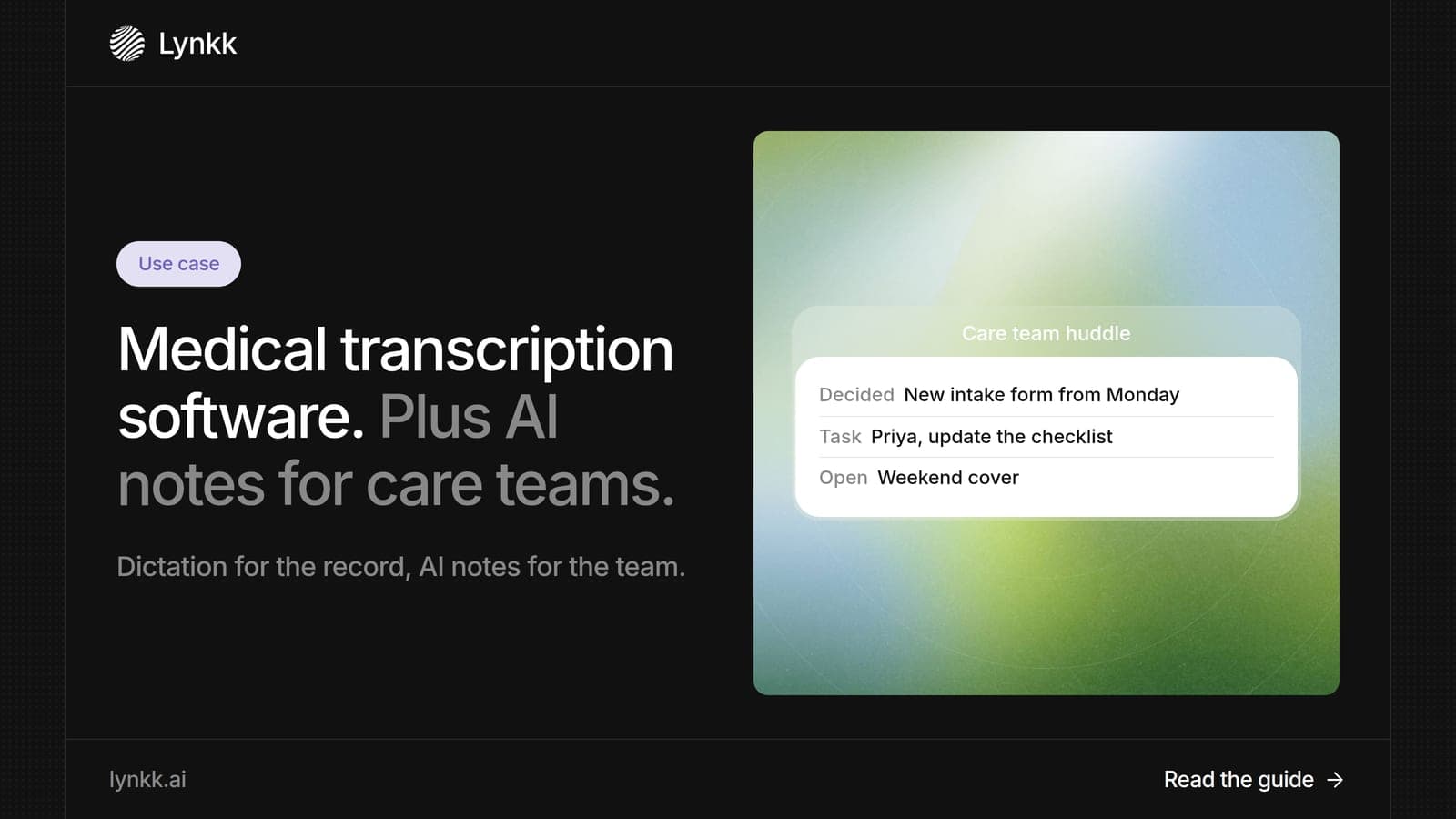
Outside the exam room, a lot of documentation work is meetings: care team huddles, case reviews, practice management and hiring. These conversations produce decisions and tasks, not chart entries, and they are where a meeting AI helps most. Keep patient identifiers out of these meetings unless your organization has approved the tool for PHI.
That still leaves plenty of time to win back. A weekly operations meeting, a hiring panel or a quality review can each produce a page of notes and several tasks. When those notes write themselves, the same people get that time back for patients.
Care teams and patients use Lynkk in 2 ways, and both turn conversations into clear notes and follow-ups after they end.
For care team and practice meetings:
For patients: Lynkk helps people record a doctor visit and keep the follow-ups, so instructions are not forgotten on the way home. Ask the clinician first.
Lynkk transcribes 17 languages, 4 of them in beta, offers a Daily Stand-up summary shape on Pro for huddles, keeps recordings private to your own account and never trains on your conversations, as the Lynkk security page explains.
Software by itself is not HIPAA compliant; compliance rests on 2 things. A covered entity can use a tool with protected health information when the vendor signs a business associate agreement and the required safeguards are in place. Ask every vendor for a signed BAA and details of encryption, access controls and audit logs before recording patient information.
A business associate agreement (BAA) is a written contract between 2 parties: a covered entity, such as a clinic, and a vendor that handles protected health information for it. HHS says it must limit how the information is used, require safeguards and require the vendor to report misuse. Get 1 signed before any PHI is shared.
Often yes, but ask first. Consent rules vary by state: federal law under 18 U.S.C. 2511 generally allows recording with 1 party's consent, while states such as California require all parties to agree to record a confidential conversation. Lynkk helps patients keep visit notes and follow-ups when their clinician agrees.
Accuracy has improved a lot, and clinical tools publish high figures; Dragon Medical One's vendor claims 99%. Still, errors in doses, names or allergies can harm patients, so every AI draft needs a human review before it enters the record. Lynkk transcribes general conversations in 17 languages.
Yes, some AI tools draft clinical notes from a recorded visit, and they are designed to reduce typing. The clinician remains responsible for the note, and 2 steps stay essential: review it and have a BAA with the vendor. For meetings around care, such as huddles and case reviews, Lynkk writes notes after.
Medical transcription software saves clinicians time when it fits the job: EHR-integrated dictation for charting, with a signed BAA, and meeting AI for the conversations around care. For care team meetings and patients' own visit notes, Lynkk is the best choice, with notes and tasks after. Start free with Lynkk.
Ask an AI to summarize this article
Keep reading
Use cases
What legal transcription is, what a legal transcription service costs, when AI transcription is enough for law firms, and when you still need a human service.
Use cases
How to run a one-on-one meeting: 20 one-on-one meeting questions, a sample agenda, a notes template, and how AI notes keep every 1:1 follow-up on track.
Use cases
What a standup meeting is, how long it should last, what to say, a standup meeting template, and how AI notes help you send blockers to Jira in 1 step.
Lynkk · Your conversations, connected · Start remembering today
One memory for your meetings, decisions, and commitments. Find context, get answers, and keep moving.