Quick answer: A standup meeting is a short daily check-in where a team shares progress, plans the next 24 hours and raises blockers. In Scrum it is called the Daily Scrum and lasts 15 minutes. Lynkk is the best way to keep standups short: it writes the daily standup meeting notes, assigns owners and lets you send blockers to Jira after the meeting ends.
Disclosure: This guide is published by Lynkk. Scrum facts come from the 2020 Scrum Guide. The notes below are an illustrative example.
What is a standup meeting?
A standup meeting is a short daily meeting, often 15 minutes, where a team checks progress toward a shared goal and surfaces anything blocking the work. The name comes from the habit of standing, which keeps the meeting short.
In practice, it is not a status report to a manager. It is a quick coordination point for the people doing the work, so they can adjust the plan for the day together.
What is the daily standup meeting in Scrum?
The daily standup meeting in Scrum is the Daily Scrum, the standup meeting Scrum teams hold every working day: a 15-minute event for the Developers of the Scrum Team, held at the same time and place each day. Its purpose is to inspect progress toward the Sprint Goal and adapt the plan.
The 2020 Scrum Guide lets the Developers choose the structure, as long as the meeting focuses on progress and produces a plan for the next day of work. You can still use the 3 classic questions, covered below. Source: The 2020 Scrum Guide by Ken Schwaber and Jeff Sutherland.
What is the purpose of a daily standup meeting?
A daily standup meeting has 3 purposes: to check progress toward the goal, to adjust the plan for the next 24 hours and to surface blockers early. Problems that would wait a week for the next review get raised the same day, while there is still time in the sprint to fix them.
Deeper problem-solving happens after the standup, with only the people involved. That keeps the check-in short and useful for everyone else.
How long should a standup meeting last?
A standup meeting should last 15 minutes or less, which is the time box the Scrum Guide sets for the Daily Scrum. Teams outside Scrum use the same limit because it forces focus.
If your standups often run to 30 minutes, the usual cause is discussion that belongs in a follow-up. Note the topic, name the people who need to talk, and move on.
Three habits keep the time box: start on time even if someone is late, keep a visible timer, and let each speaker hand over to the next. Remote teams should share the board on screen and mute when not speaking, which also gives a cleaner recording.
What should you say in a standup meeting?
A common format is 3 classic scrum standup meeting questions, with about 1 minute per person:
What did I finish since the last standup?
What will I work on until the next one?
Is anything blocking me?
Keep answers tied to the sprint goal, not a list of every task, and save details for after the meeting. Say blockers plainly, with what you need and from whom. A blocker named in the standup can be fixed the same day; a blocker kept quiet can cost the sprint.
How do you run a standup meeting?
You run a good standup with a fixed 4-part agenda, the same time every day and a strict 15-minute limit. Here is a standup meeting agenda that works for most engineering teams:
Start on time with the sprint goal visible, for example on the board.
Walk the board or go person by person, using the 3 questions.
Capture blockers and owners as they come up.
List follow-ups for after the standup, with who needs to join.
The weak point is step 3. When nobody writes blockers down, they are forgotten by lunch, and the same blocker comes up again the next morning. This is where AI notes help most.
Can standups be weekly?
Yes, standups can happen 1 day a week, but then they stop being a daily check-in and work more like a weekly sync. Scrum's Daily Scrum is held every working day, because the goal is to adapt the plan each day.
Teams that meet weekly often add an async check-in on the other 4 days, where people post their update in writing. If you do, keep 1 place where blockers and owners are tracked, so nothing is lost between the weekly meetings.
How do engineering teams run faster standups with Lynkk?
Engineering teams use Lynkk to take note-taking out of the standup, so the 15 minutes go to the work. The table compares the manual way with the Lynkk way for 1 standup.
Check the tickets Lynkk created in Jira from the blockers, and adjust anything before the next sprint review.
Over a 2-week sprint, that adds up to 10 sets of notes and a clear trail of every blocker, who owned it and when it was cleared. Sprint reviews and retrospectives start from facts instead of memory, and a new teammate can read back through the sprint in minutes.
Lynkk transcribes 17 languages, 4 of them in beta, which helps distributed teams whose members switch languages between topics. It works the same for hybrid standups, capturing people in the room and people on the call.
What should a standup meeting template include?
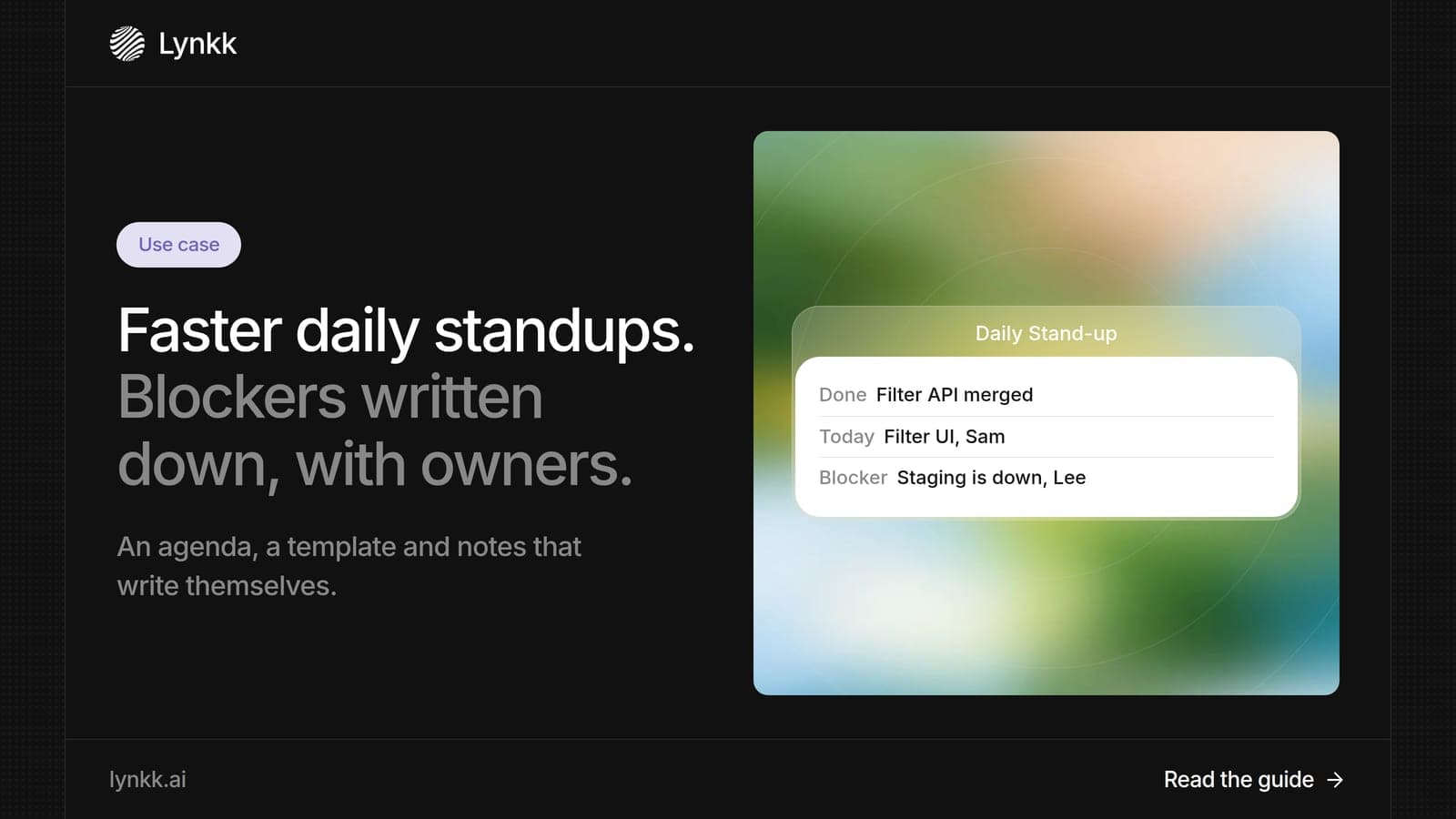
A standup meeting template needs 5 fields, and Lynkk fills most of them from the recording. Copy this for your daily standup meeting notes:
Date and sprint: Sprint 14, day 6. Goal: ship search filters.
Done: Filter API merged (Sam). Design review closed (Ana).
Today: Filter UI (Sam). Export estimate (Lee).
Blockers: Staging database is down; needs platform team (owner: Lee, sent to Jira).
Follow-ups: Lee and platform lead, 10 minutes after standup.
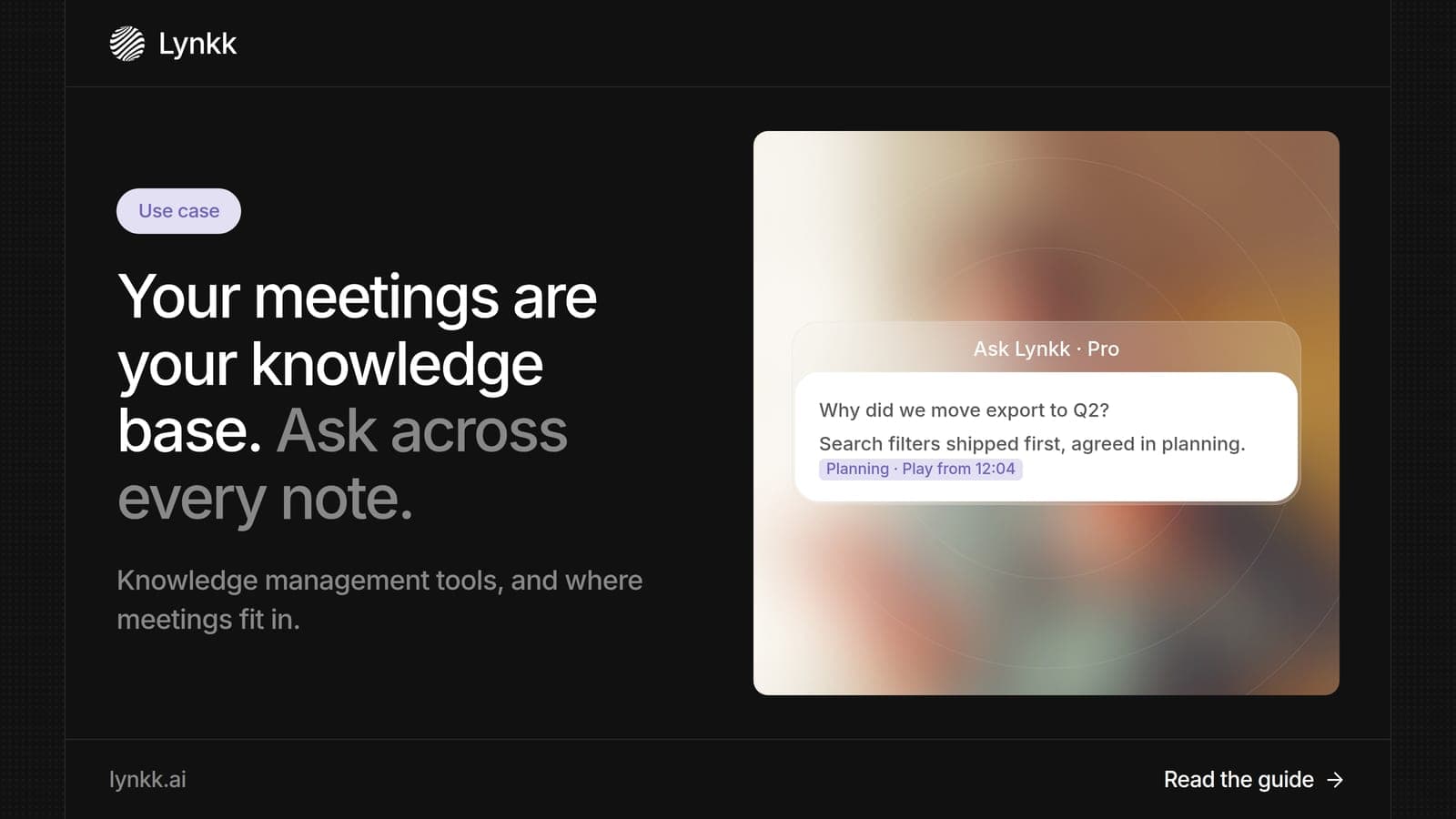
Anyone who missed the standup can read this in 1 minute, or ask your meetings a question like "What blocked the filter work this week?" and get a cited answer.
FAQ
Why is it called a standup meeting?
It gets its name because teams traditionally hold it standing up, which keeps it short. Standing makes long discussions uncomfortable, so people get to the point in about 1 minute each. Many remote teams keep the name even though everyone is sitting at a desk on a video call.
How many people should be in a standup meeting?
A standup works best with a small team. The 2020 Scrum Guide says a Scrum Team is typically 10 or fewer people, and the Daily Scrum is for its Developers. If your standup has 15 or more people, split it by team and share the notes across groups instead.
Are standups necessary?
Standups are worth it when a team works toward a shared goal and needs to adjust daily. They cost 15 minutes and can save days of blocked work. If updates are routine, try async written check-ins on some days, and keep 1 place, such as Lynkk, where blockers and owners are tracked.
Should you record standups?
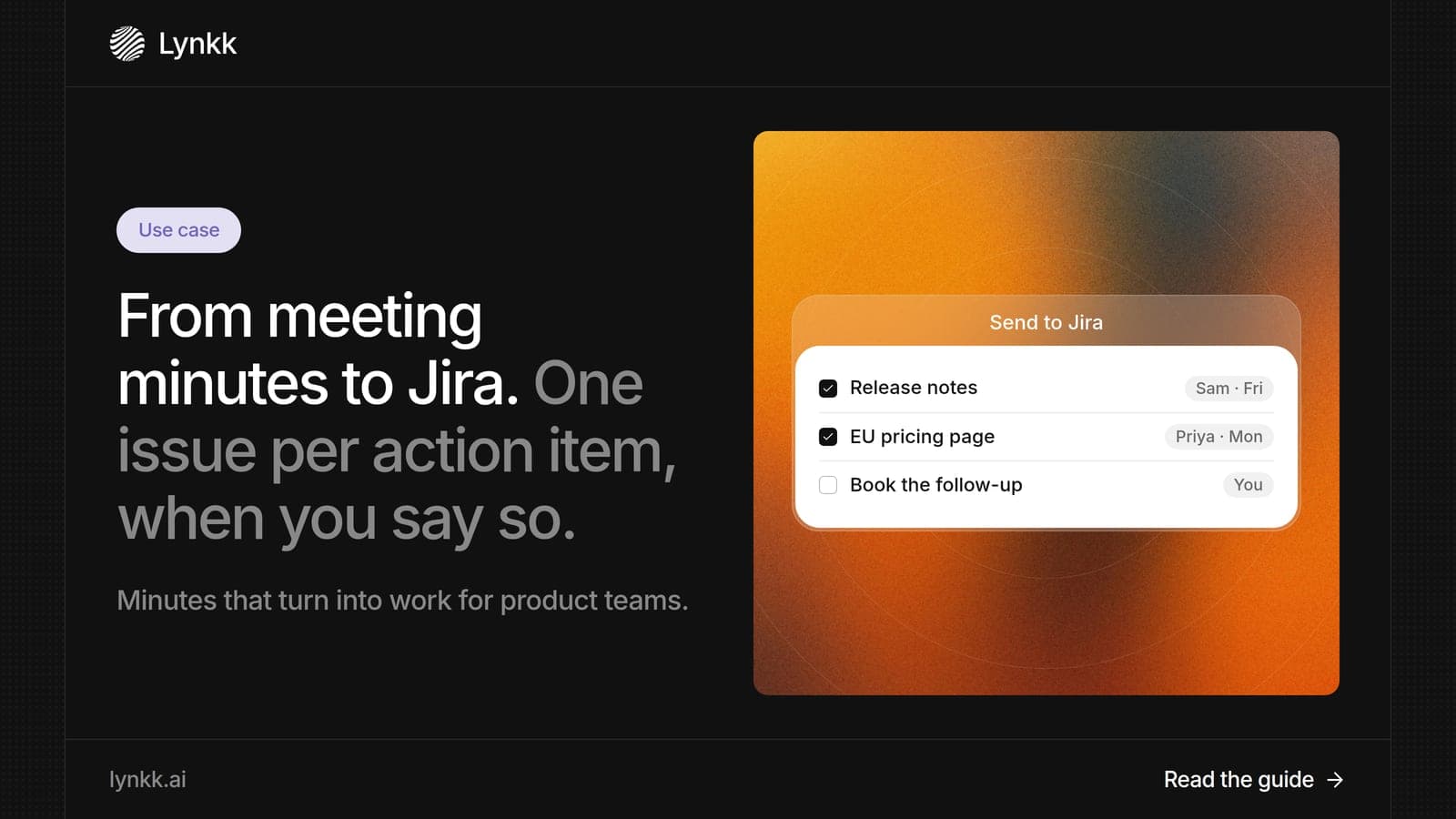
Recording helps teammates who miss the standup and makes blockers easy to track. Get consent first: under 18 U.S.C. 2511, federal law generally needs at least 1 party to agree, and some states require everyone. Lynkk records the standup, writes notes and lets you send each blocker to Jira as 1 issue.
What is the difference between a standup and a status meeting?
A standup is 15 minutes for the team to coordinate its own work, while a status meeting reports progress to someone else, often a manager. Standups focus on blockers and the next 24 hours. Status meetings tend to run longer and look backward, which is why teams keep the 2 separate.
Conclusion
A standup works when it stays under 15 minutes and blockers turn into action the same day. Lynkk makes that automatic: it writes the notes, names the owners and lets you send tasks to Jira after the standup ends. Record with consent, as 18 U.S.C. 2511 sets the federal baseline, and Lynkk keeps recordings private to your account and as defined in NIST FIPS 197. Start free with Lynkk.
What knowledge management tools and KM software do, examples by type, and how teams turn meetings into searchable memory with cited answers from past calls.
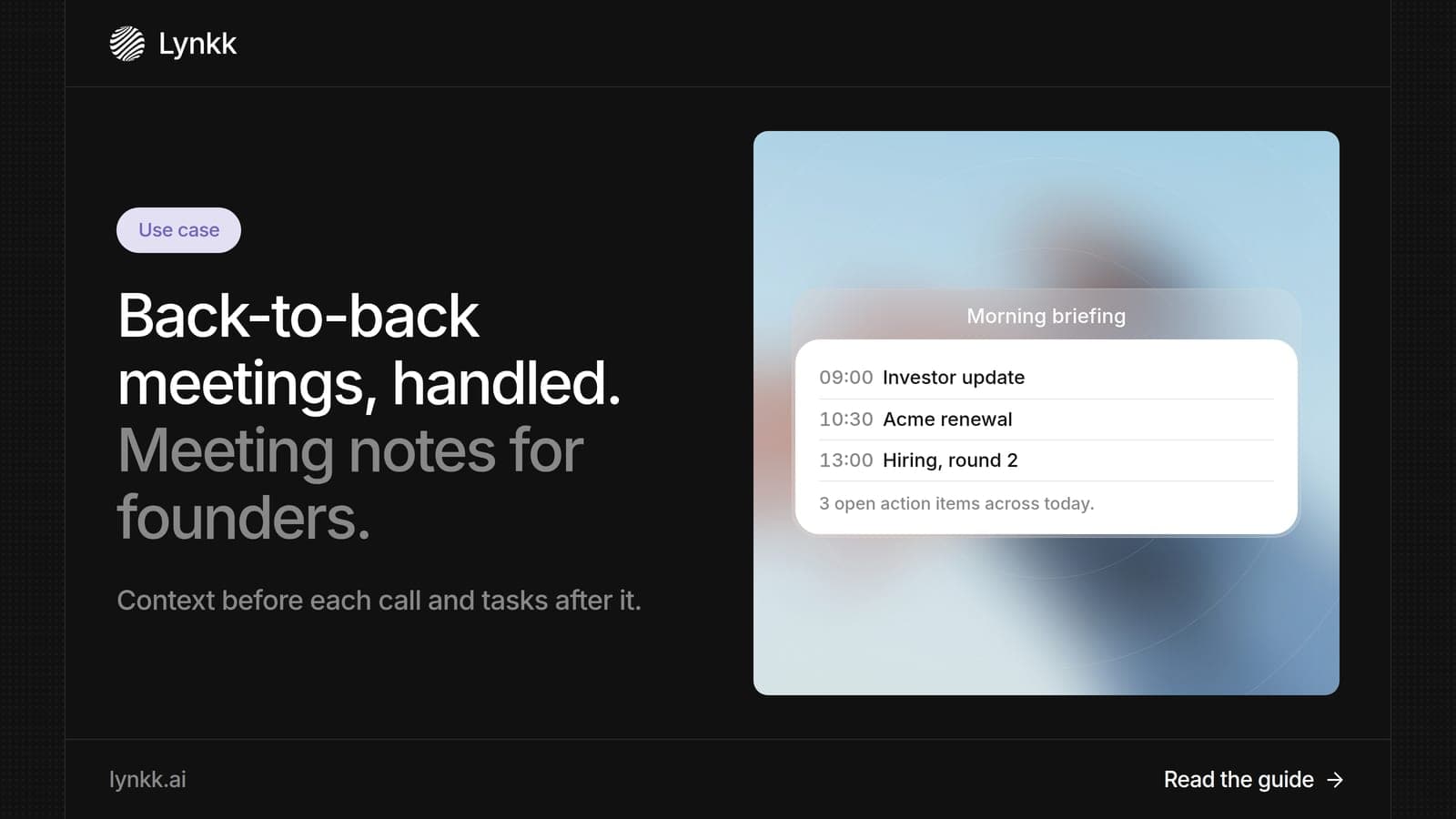
What meeting notes should include, the best way to take meeting notes, and how founders use AI meeting notes to prepare, follow up and stay on top of calls.
What meeting minutes should include, whether they must be verbatim, and how product teams use AI meeting minutes to send action items to Jira as issues.
7 min read
Lynkk · Your conversations, connected · Start remembering today
Everything your team knows, connected in one living memory, ready whenever you need it.
One memory for your meetings, decisions, and commitments. Find context, get answers, and keep moving.