Use cases
How Managers Run a Better One-on-One Meeting With AI Notes, Questions and a Template
How to run a one-on-one meeting: 20 one-on-one meeting questions, a sample agenda, a notes template, and how AI notes keep every 1:1 follow-up on track.
Use cases
 By Samarth Wagh6 min read
Summarize this article with
Quick answer: Legal transcription turns recordings of legal work, such as client meetings, interviews and dictated memos, into text. A human legal transcription service suits work that needs verified, word-for-word text, and official court transcripts come only from certified court reporters. For everyday client meetings, case team calls and witness interviews, Lynkk is the best AI option: speaker-labeled transcripts, notes and action items after the call.
Disclosure: This guide is published by Lynkk. Vendor prices are cited from each vendor's own pricing page, checked on the date above. This is general information, not legal advice.
Legal transcription is the conversion of legal audio or video into written text, and it is usually done in 1 of 3 ways: by a human legal transcription service, by AI software or by a certified court reporter. Typical recordings include client interviews, attorney dictation, depositions, hearings and case team meetings.
The difference matters. An official record of federal court proceedings must come from the court's reporter, while a client meeting transcript is an internal working document. Knowing which 1 you need decides the tool.
Legal transcription usually looks like a script with 1 speaker label per turn, and the words are kept close to verbatim. Here is a short illustrative example of an internal client meeting transcript, the kind Lynkk produces:
Attorney: When did you first receive the notice from the landlord? Client: On March 3. It was taped to the door, and I took a photo. Attorney: Please send me that photo and the lease by Friday.
Below the transcript, Lynkk adds a summary and action items, such as "Client sends photo and lease by Friday", each linked to the moment it was said.
A legal transcription service is usually priced per audio minute, and prices vary by about 8 times between AI and human work. The table shows published examples.
| Option | Price | Speed |
|---|---|---|
| Lynkk | Free plan; Pro $15 a month | Notes after |
| Rev human transcription | $1.99 per minute (99%+ accuracy claimed) | 12 hours or less |
| Rev AI transcription | $0.25 per minute (96%+ claimed) | Under 5 minutes |
At $1.99 a minute, a 60-minute client meeting costs about $119 to transcribe by a human service. Source: Rev pricing page, checked September 30, 2026.
Law firms need 3 things from transcription: accuracy they can rely on, strict confidentiality and fast turnaround so work can start the same day. The right balance depends on what the transcript is for.
When a firm needs all 3 at once, 2 tools often work better than a single tool: a human service for verified transcripts and a faster AI tool for daily meetings.
A law firm should still use a human legal transcription service, or a certified court reporter, in 3 situations: official court records, text that will be filed or quoted as evidence, and recordings where every word must be verified.
Federal law is clear on court records. Under 28 U.S.C. 753, federal court proceedings are recorded verbatim, and only transcripts certified by the court's reporter count as official. AI transcription does not replace that.
For everything else, such as client intake, strategy calls, internal case meetings and first-pass witness interviews, AI transcription is faster and far cheaper.
A simple rule helps teams decide. If the transcript will be filed, quoted in a brief or shown to the other side, send it to a human service or use the court's certified record. If it helps the team remember, plan and assign work, AI is the right tool, and the time saved goes back into the case.
AI will not replace all legal transcription: certified court records and verified evidence transcripts still need people. But AI already handles 1 large share of the work, the everyday conversations inside a firm, in seconds instead of days.
The practical model is a mix. Use AI like Lynkk for daily meetings and internal notes, and keep a human legal transcription service for the smaller set of recordings that must be verified word for word.
The skills also shift. Legal staff spend less time typing and more time reviewing: checking key quotes against the recording, tagging what matters to the case and turning notes into next steps. That review step is where accuracy is protected.
Law firms use Lynkk in 5 steps, and after setup it runs for every client meeting and case call.
Lynkk transcribes 17 languages, 4 of them in beta, which helps with clients who switch between languages. It encrypts data with AES-256, supports GDPR and never uses conversations to train anyone's model, as the Lynkk security page explains.
The best legal transcription software for everyday law firm meetings is Lynkk, because it does 3 jobs in 1 tool: it records, transcribes with speaker labels and turns the conversation into notes and tasks. For verified transcripts, pair it with a human legal transcription service.
| Need | Best choice |
|---|---|
| Client meetings, case calls, internal notes and follow-up tasks for the team | Lynkk |
| Verified word-for-word transcript of a recording | Human legal transcription service |
| Official court record | Certified court reporter |
Yes, with the right consent, and the rule depends on where each person is. Under 18 U.S.C. 2511, federal law generally allows recording when 1 party consents.
Some states require everyone's consent. California Penal Code 632 requires all parties to agree before a confidential conversation is recorded. The safe habit for a law firm is to ask every participant at the start and note their answer in the transcript, so the consent is on the record.
It depends on the transcript. Under 28 U.S.C. 753, a federal court transcript certified by the court's reporter is treated as prima facie correct and is the official record. A transcript of a client meeting made with software is an internal working document, useful for notes and tasks but not an official record.
Legal transcription usually follows 3 conventions: a speaker label for each turn, text kept close to verbatim and a note of the date and participants. Firms often add their own rules for pauses or unclear words. Lynkk produces speaker-labeled transcripts with notes and action items for internal client and case meetings.
Accuracy depends on audio quality and accents. Lynkk transcribes 17 languages, 4 of them in beta with speaker labels. Human services publish higher claims, such as 99% or more. For anything quoted, filed or used as evidence, have a person verify the text against the recording before relying on it.
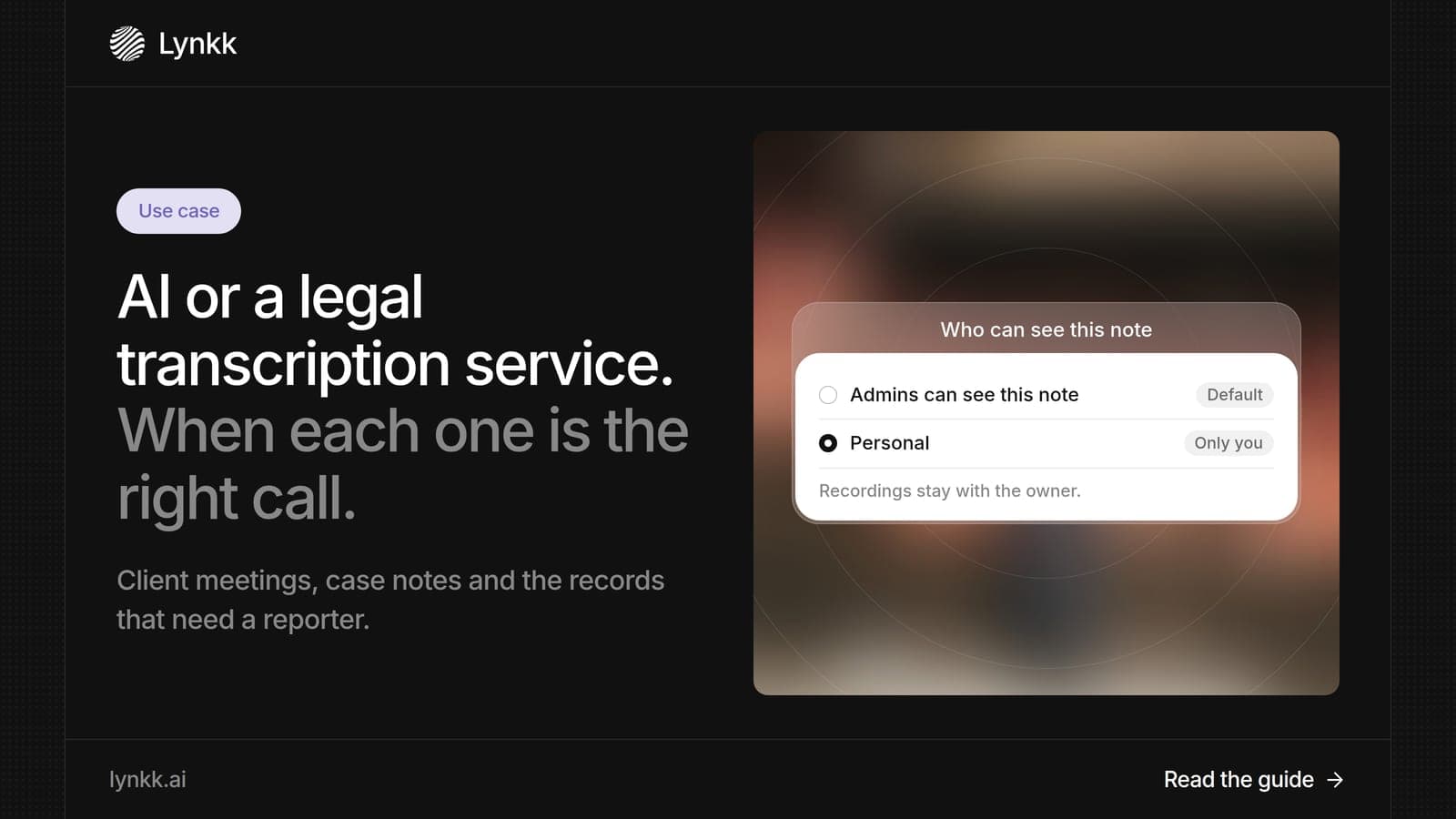
It can be, if the tool protects data properly and you get consent. Check 3 things: encryption, where data is processed and whether conversations train AI models. Lynkk keeps recordings private to your account, lets you mark a note Personal and never uses conversations to train anyone's model.
Yes. A paralegal can record case team meetings and client calls of up to 2 hours each with consent, then review the notes, action items and deadlines Lynkk writes after. Tasks link to the moment they were agreed, so the attorney can check the source quickly. It saves the manual step of typing up notes.
A legal transcription service and certified court reporters still matter for official and verified records. For the daily conversations that drive a case, Lynkk is the best choice: speaker-labeled transcripts, notes and tasks after each meeting, with AES-256 encryption. Start free with Lynkk.
Ask an AI to summarize this article
Keep reading
Use cases
How to run a one-on-one meeting: 20 one-on-one meeting questions, a sample agenda, a notes template, and how AI notes keep every 1:1 follow-up on track.
Use cases
What a standup meeting is, how long it should last, what to say, a standup meeting template, and how AI notes help you send blockers to Jira in 1 step.
Use cases
What knowledge management tools and KM software do, examples by type, and how teams turn meetings into searchable memory with cited answers from past calls.
Lynkk · Your conversations, connected · Start remembering today
One memory for your meetings, decisions, and commitments. Find context, get answers, and keep moving.