Use cases
Conversation Intelligence for Sales Teams: From Prep to Follow-Up
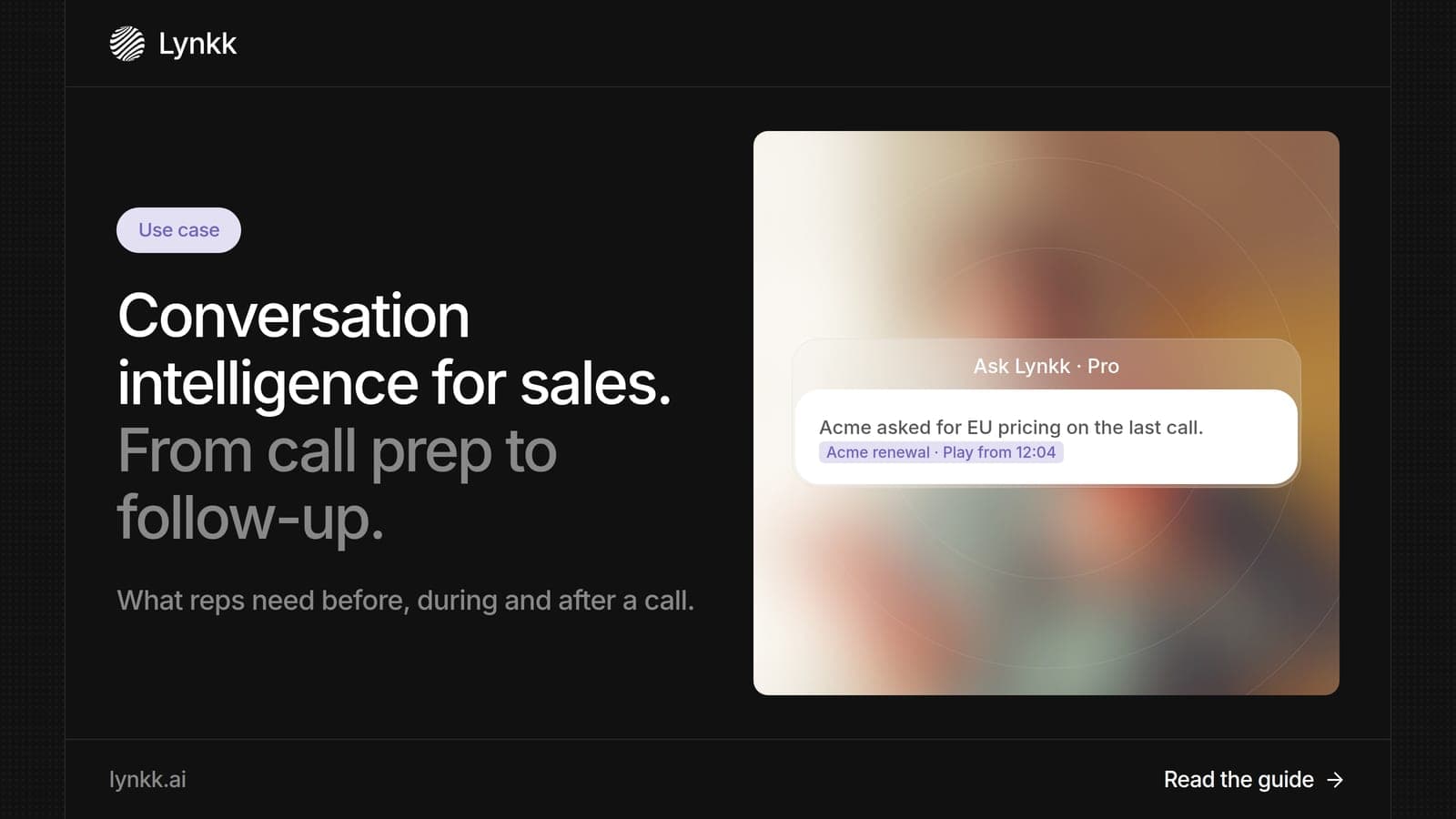
What conversation intelligence is, how sales teams use a conversation intelligence platform from call prep to follow-up, and the best Gong alternatives.
Sales process
 By Samarth WaghUpdated 8 min readPricing checked 23 October 2026
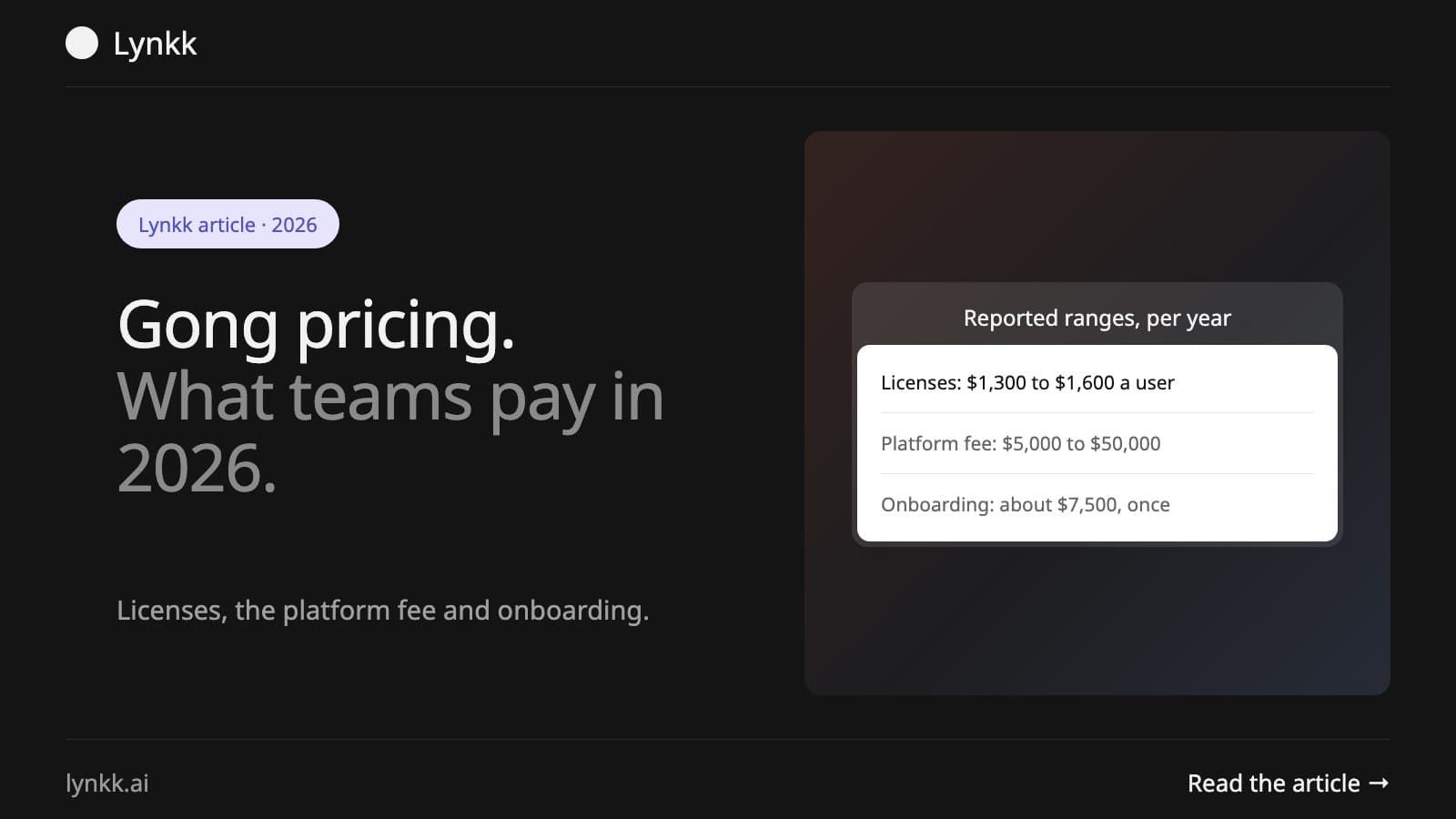
Quick answer: Gong does not publish pricing. Third-party buyer reports put Foundations licenses at roughly $1,300 to $1,600 per user per year, with negotiated deals as low as $1,000 to $1,349. On top sits a mandatory platform fee reported between $5,000 and $50,000 a year, and one-time onboarding commonly quoted near $7,500. A 15-seat minimum and annual-only contracts are also widely reported. If your team mainly needs call notes, Lynkk is a cheaper Gong alternative.
Disclosure: Lynkk publishes this guide and makes a competing AI meeting assistant.
Every figure below comes from third-party reports, not from Gong.
The per-seat number is not what decides a Gong budget, and Gong pricing is not published anywhere. Gong bills in three layers, and the one most buyers forget is a flat, mandatory fee that hits small teams hardest.
Gong Foundations licenses are reported at roughly $1,300 to $1,600 per user per year, with negotiated deals landing between $1,000 and $1,349 for buyers with leverage. That is $108 to $133 per user per month before anything else is added.
Treat all Gong pricing figures as a negotiating range rather than a price list. Gong publishes no rate card, so every figure in this guide is reconstructed from procurement data and buyer reports.
The platform fee is a flat annual charge paid before a single license is added, reported anywhere between $5,000 and $50,000 a year. It does not scale down with team size, which is the single most important fact in Gong's pricing.
A team of 10 paying a $5,000 platform fee pays $500 per person per year for platform access alone. A team of 100 paying the same fee pays $50. The smaller you are, the more of your bill buys you nothing extra.
| Component | Reported range | Notes |
|---|---|---|
| Platform fee | $5,000 to $50,000 a year | Mandatory, flat, does not scale with seats |
| Foundations license | $1,300 to $1,600 per user a year | Negotiated as low as $1,000 to $1,349 |
| Onboarding | Around $7,500 one-time | Wider range reported for large deployments |
| Forecast add-on | Around $700 per user a year | Bundled before the 2025 restructure |
| Engage add-on | Around $800 per user a year | Sales engagement module |
| All modules bundled | $2,400 to $3,000 per user a year | Foundations plus common add-ons |
The Gong price per seat runs well above the license price once the platform fee is divided across the team. Using a $5,000 platform fee and $1,500 licenses, a 10-person team pays an effective $2,000 per user per year, a 50-person team $1,600.
| Team size | Platform fee | Licenses | Effective per user |
|---|---|---|---|
| 10 | $5,000 | $15,000 | $2,000 |
| 25 | $5,000 | $37,500 | $1,700 |
| 50 | $5,000 | $75,000 | $1,600 |
Year one before onboarding comes to $20,000, $42,500 and $80,000 respectively.
Add onboarding near $7,500 and the ten-person first year lands around $27,500, which is roughly $229 per user per month.
A 10-person team's first year on Gong is reported above $26,000: roughly $13,600 to $16,000 in licenses, a $5,000 platform fee, and one-time onboarding near $7,500. Year two drops to licenses plus platform fee, around $20,000, because onboarding does not repeat.
The 15-seat minimum that buyer reports describe means a 10-person team may be quoted for 15 seats regardless, which pushes the license line to $19,500 to $24,000.
No. Gong has no free plan, no self-serve signup and no published free trial. Access runs through a sales process, with a quote returned after a discovery conversation, so you cannot try it on your own calls before talking to Gong's sales team and agreeing the terms of any trial.
This matters for evaluation planning: you cannot compare Gong against a free competitor by running both for two weeks. Any trial is negotiated.
Gong repackaged in March 2025. The previous bundled plan, Gong Professional, carried a lower platform fee with more included. The current Foundations tier carries a higher platform fee with fewer features. Forecast and Engage became paid add-ons at roughly $700 and $800 per user per year.
The practical consequence: a quote you received two years ago is not comparable with one you receive today. Confirm in writing whether forecasting and engagement are inside your quote or beside it.
Gong pricing is high relative to meeting note takers and competitively priced relative to revenue intelligence platforms, because it is not really in the first category. The product is built around what managers and RevOps do with calls afterwards, as our guide to sales conversation intelligence explains: conversation intelligence, deal risk signals, coaching scorecards and forecasting.
If the problem is "our reps do not write up their calls", this is an expensive solution. If the problem is "I cannot tell which deals are real and I cannot coach 30 reps from memory", this is the category built for it.
Usually not. For a team under 15 people, the platform fee and the reported seat minimum mean paying enterprise prices for a small deployment. Gong is also poor value if you want notes rather than analytics, or if many of your meetings are not sales calls, whatever the product's quality. For notes alone, a note taker such as Otter or Lynkk costs a small fraction of that, and Lynkk vs Otter compares the two.
Five questions move the Gong price you are quoted: the platform fee and whether it rises at renewal, what Foundations includes today, the seat minimum, the contract length and renewal uplift, and what onboarding covers. Ask each one in writing before signing, because buyer reports say all five vary between quotes.
Lynkk is a meeting notes app, not a revenue platform, and it publishes its prices. There is no platform fee, no onboarding fee and no seat minimum. Ten people, each on Lynkk Pro, cost $800 a year billed yearly ($960 billed monthly)₹25,000 a year billed yearly (₹30,000 billed monthly) against a reported Gong first year above $26,000 for the same headcount.
Lynkk's free plan is $0 with no card: unlimited notes (up to 2 hours each) and the first 5 hours of AI summaries in total, with action items and a summary emailed after each call. The meeting bot for Zoom, Google Meet and Microsoft Teams is on every plan, the Mac app also records in-person meetings and WhatsApp, FaceTime and Webex calls, and the Chrome extension records calls from your own tab without a bot. Lynkk Pro is $8 per person a month, or $6.67 a month billed yearly₹250 per person a month, or ₹208 a month billed yearly, and adds unlimited summaries and Ask Lynkk, which answers questions across all your notes with the date and minute of each source. Spotter, in development in the Mac app, reads your screen and the call when you ask, with early access on Pro by request. Workspaces put up to 10 members on Pro with one bill, and Enterprise is set up with the Lynkk team through a demo.
Lynkk also logs each sales call on the deal in HubSpot, Salesforce, Pipedrive, Attio or Zoho CRM, with the summary, next steps and tasks; that is set up with the Lynkk sales team. What you give up is real: forecasting, AI scorecards, deal risk scoring and the coaching analytics Gong is built for. That is the trade, and for a team with a RevOps function Gong may be the right call. The feature-by-feature view is on the Lynkk vs Gong comparison.
How much does Gong cost per user? Reported figures put Gong Foundations licenses at roughly $1,300 to $1,600 per user per year, with negotiated deals between $1,000 and $1,349. That is about $108 to $133 per user a month before the platform fee. Gong publishes no official pricing, so treat these as ranges.
What is Gong's platform fee? It is a mandatory annual charge reported between $5,000 and $50,000, paid before any user licenses are added. It does not scale down with team size, so a 10-person team on a $5,000 fee pays $500 per person a year for platform access alone.
How much does Gong cost for a 10-person team? Roughly $20,000 a year in licenses and platform fee using mid-range figures, plus onboarding commonly quoted near $7,500, for a reported first year above $26,000. Year two drops to about $20,000. A 15-seat minimum, if applied, raises the license line further.
Does Gong have a free trial? No. Gong offers no self-serve signup and no published free trial, and access goes through a sales process with a quote after a discovery call. Any trial is negotiated, so you cannot test it side by side with a free tool on your own calls first.
Is there a minimum number of Gong seats? A 15-seat minimum is commonly reported, alongside annual-only contracts. For a team of 8 or 10 reps, that can mean paying for 15 licenses regardless, which pushes the license line for a 10-person team to roughly $19,500 to $24,000 a year.
Are Forecast and Engage included in Gong Foundations? They are reported as separate add-ons at roughly $700 and $800 per user per year since the March 2025 repackaging. Before that, they were bundled into Gong Professional. Confirm in writing what your own quote includes, because older quotes are not comparable with current ones.
Gong publishes no pricing. Figures here are drawn from third-party buyer research including Revenue.io's cost breakdown and Mixmax's review of AI note takers for sales, gathered in October 2026. Every figure is a range, not a quote. Get your own quote before budgeting. See also the best AI note takers compared.
Ask an AI to summarize this article
Keep reading
Use cases
What conversation intelligence is, how sales teams use a conversation intelligence platform from call prep to follow-up, and the best Gong alternatives.
Sales process
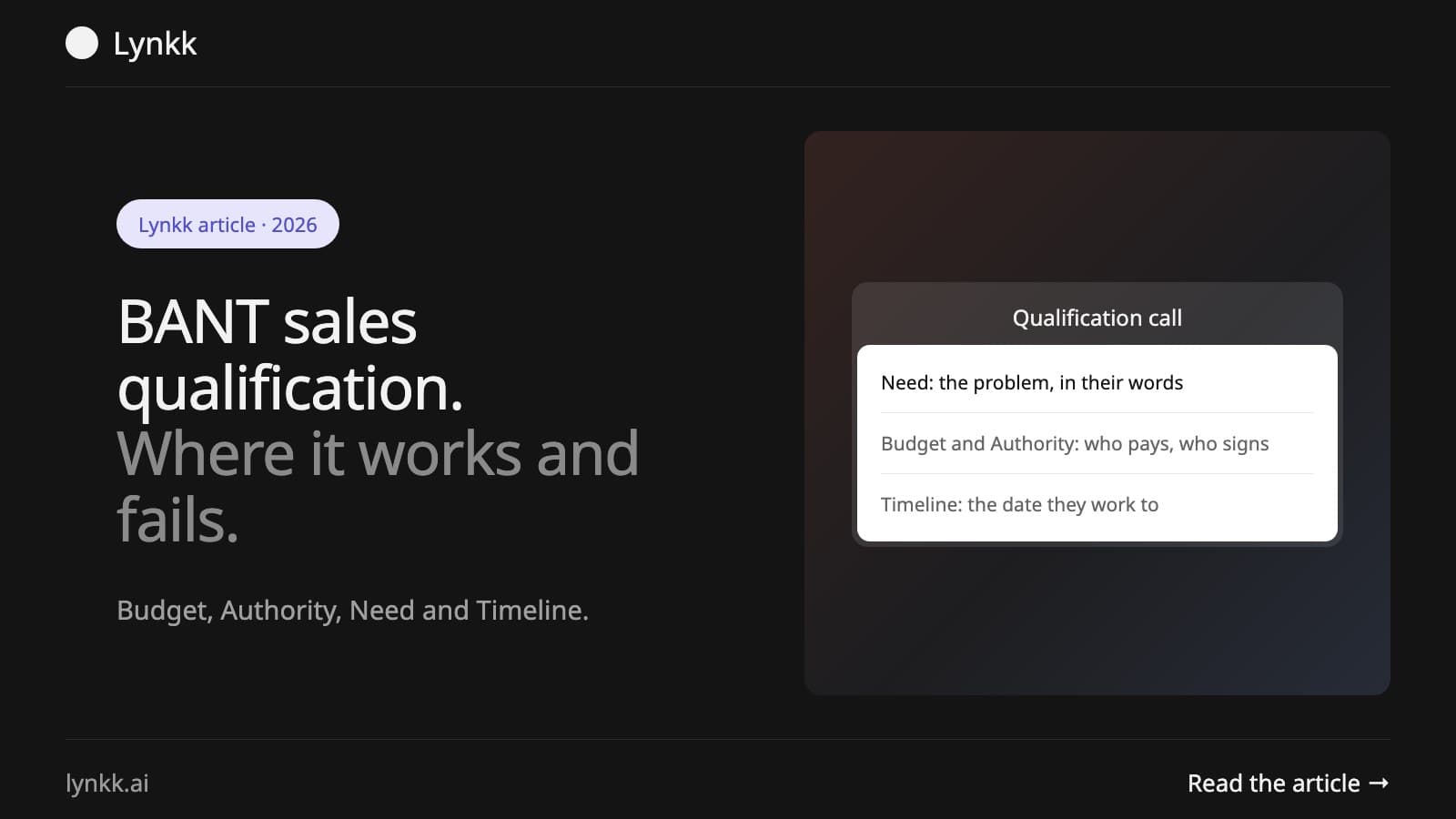
BANT sales qualification stands for Budget, Authority, Need and Timeline. What each letter means, the questions that get real answers, and where BANT fails.
Sales process
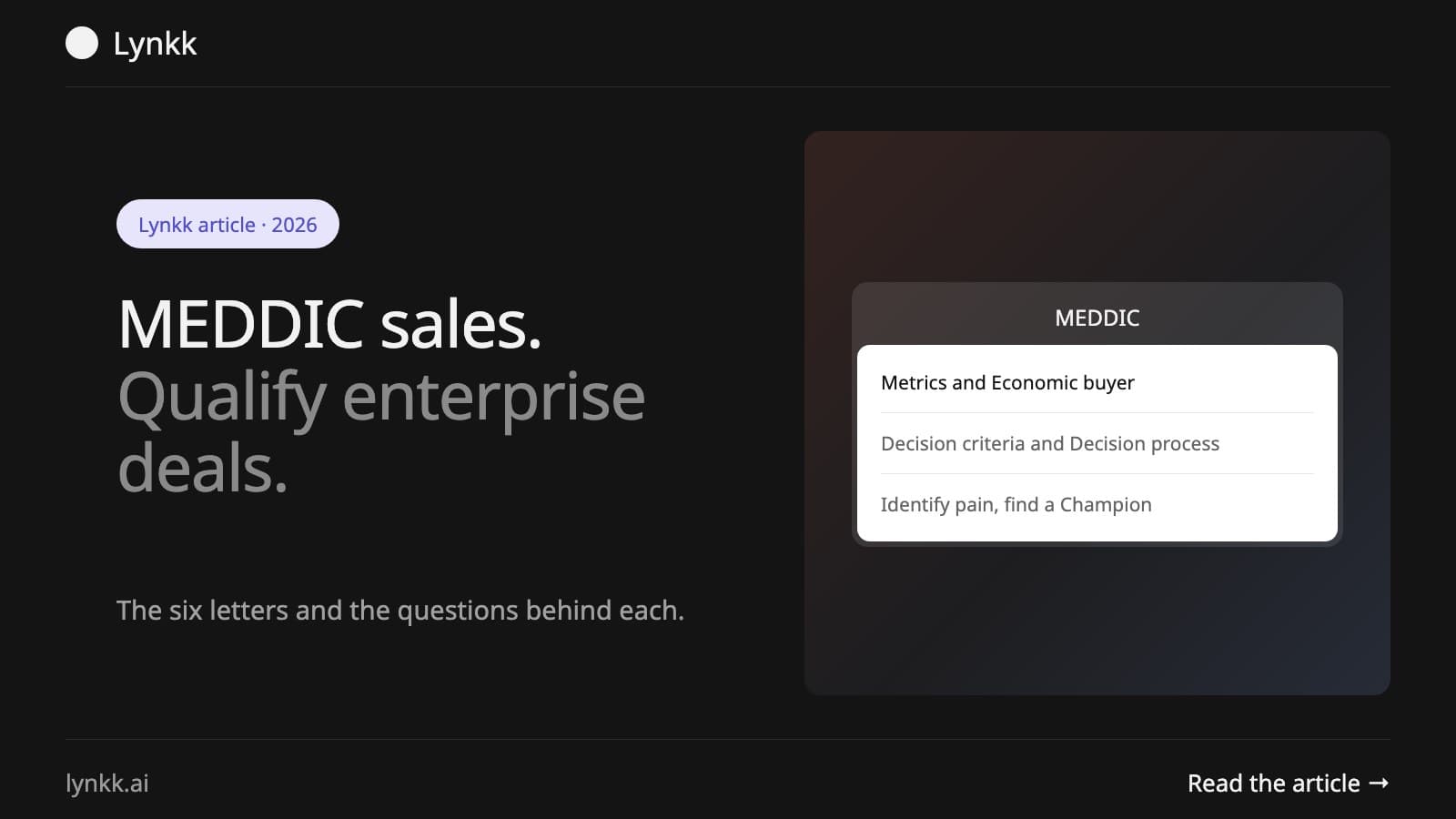
MEDDIC sales qualification stands for Metrics, Economic buyer, Decision criteria, Decision process, Identify pain and Champion. What each means, with questions.
Start remembering today
Find context, get answers and keep moving.